

Cited:
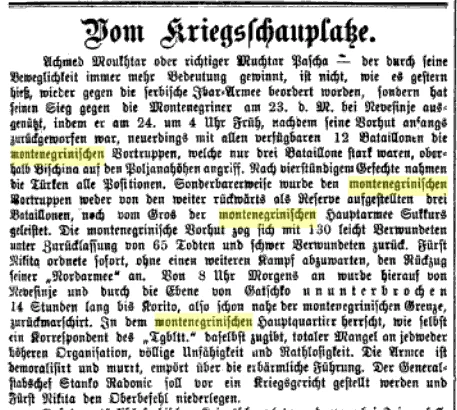
“Regarding the theater of war: Ahmed Mukhtar Pasha—who is gaining increasing importance due to his mobility—was not, as previously rumored, ordered back against the Serbian Ibar Army; rather, following his victory over the Montenegrins at Nevesinje on the 23rd, he pressed his advantage.
On the 24th at 4 a.m.—after his vanguard had initially been repulsed—he launched a fresh attack with all 12 available battalions against the Montenegrin advance guard (which numbered only three battalions) near Bišina on the Poljana Heights. After a four-hour battle, the Turks held all positions. Strangely, the advance guard received no support either from the battalions stationed further back in reserve or from the main body of the Montenegrin army.
The Montenegrin vanguard retreated, leaving behind 65 dead and seriously wounded, and suffering 130 minor casualties. Without waiting for further combat, Nikita immediately ordered a retreat for his Northern Army. From 8 a.m. onwards, the withdrawal proceeded from Nevesinje across the Gacko Plain for 14 hours as far as Korito—bringing them close to the Montenegrin border.
At the Montenegrin headquarters—as a correspondent for the Tageblatt on the scene admits—there is a total lack of higher-level organization, along with complete incompetence and bewilderment. The army is demoralized and mutinous, outraged by the wretched leadership. The Chief of Staff, Stanko Radonic, is to face a court-martial, and Prince Nikita is expected to resign as commander-in-chief.”
Source
XV. Jahrgang Wien Samstag. 29 Juli. 1876. Gemeinde Zeitung Unabhängiges politisches Journal.

