
During the Middle Ages, Albanians gave the world leaders—both secular and religious—as well as cultural figures whose influence extended far beyond Europe’s borders. Several Popes were Albanian, for instance—Clement XI being the most prominent among them. Albanians also held leadership roles in faiths of global significance, heading both Orthodox Christian and Muslim institutions.
Throughout history, we find distinguished Albanian leaders across many European countries—figures who at times determined the outcome of pivotal historical battles. (In 1515, it was Merkur Bua—leading a Venetian light cavalry unit composed entirely of Albanians—who secured the victory at the Battle of Marignano, known as the “Battle of the Giants,” rather than the 19-year-old Francis I of France, who actually learned the art of warfare during those two days of combat.)
Albanians provided the Ottoman Empire with numerous distinguished prime ministers and generals (the Köprülü family alone produced five grand viziers). Albanians also produced many heroes of the Greek War of Independence, such as Kountouriotis, Markos Botsaris, Kanaris, Kolokotronis, Karaiskakis, and Bouboulina. …who were at the forefront of the Greek Revolution, including several prime ministers of the newly independent Greek state.
Romania also had a princely family of Albanian origin (Alexander and Vladimir Ghica, as well as Princess Eleonora, known as Dora d’Istria). Francesco Crispi—a friend of Garibaldi, Cavour, and Mazzini, and a major Italian prime minister—was of Albanian descent.
Painters such as Carpaccio and Albani, the humanist Leonic Tomeo (a teacher of Copernicus), and many other Albanian figures have been honored in Italian history. Muhammad Ali, the reformer of modern Egypt—dubbed the “Napoleon of the Middle East” by French historians—was the Albanian who founded the royal dynasty that ruled Egypt for nearly 150 years.
The Taj Mahal in Agra, India—a masterpiece of Islamic architecture—was the work of an Albanian, as were the Blue Mosque and many other significant mosques in Istanbul. Finally, there is the Albanian National Hero, Gjergj Kastrioti Skanderbeg—a near-universal symbol of the freedom fighter—honored worldwide with memorials not only in Tirana, Pristina, and Skopje, but also in Rome, Brussels, Geneva, Detroit, and Buenos Aires.
Further memorials to Skanderbeg are planned for London, Warsaw, Melbourne, Manila, and elsewhere. Given that Albanians have contributed so significantly to human civilization, why are so few people worldwide aware of this—and why, conversely, have so many refused to acknowledge this reality?
This can be attributed, in part, to the relative isolation of Albanians from the international community—and the European community in particular—following the Congress of Berlin (1878). Indeed, after the Ottoman defeat in the Russo-Turkish War, the international press began to overlook the Albanians, effectively renaming the former Illyrian Peninsula—inhabited continuously from prehistoric times to the present day by the Illyrians (the ancestors of the Albanians).
It was given the name it bears today—the Balkan Peninsula—derived solely from the Balkan mountain range. Why were the Albanians targeted? Much of the conservative European diplomatic establishment employed the pejorative term “Turk” to label all Muslim communities in the Balkans as Turks, even though the vast majority were not Turkish at all. Europe supported and expanded the territories of Greece, Serbia, and Montenegro at the expense of the Albanians.
None of the great European powers supported the Albanian cause when Albanians formed the League of Prizren to defend their legitimate interests against the decisions of the Congress of Berlin. They were abandoned by everyone…
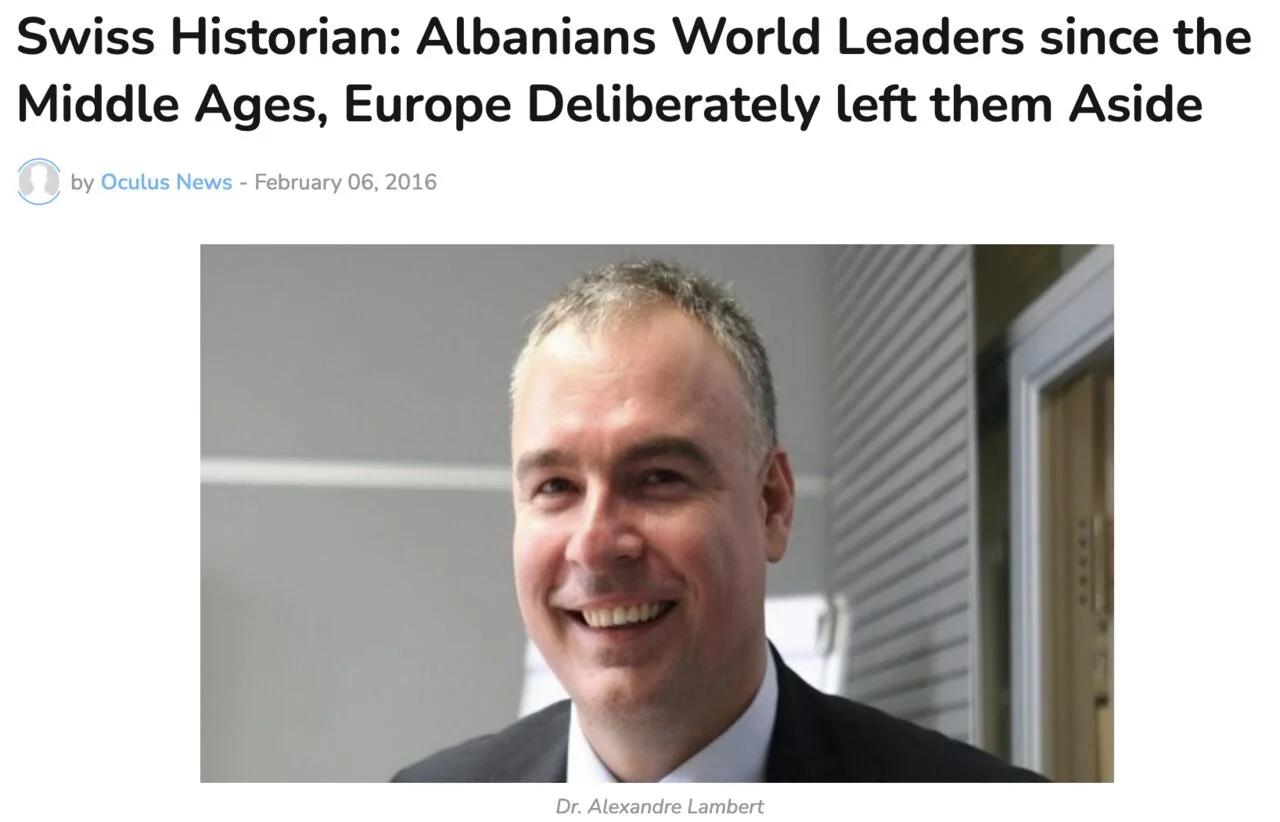
By Dr. Alexandre Lambert, Geneva.

