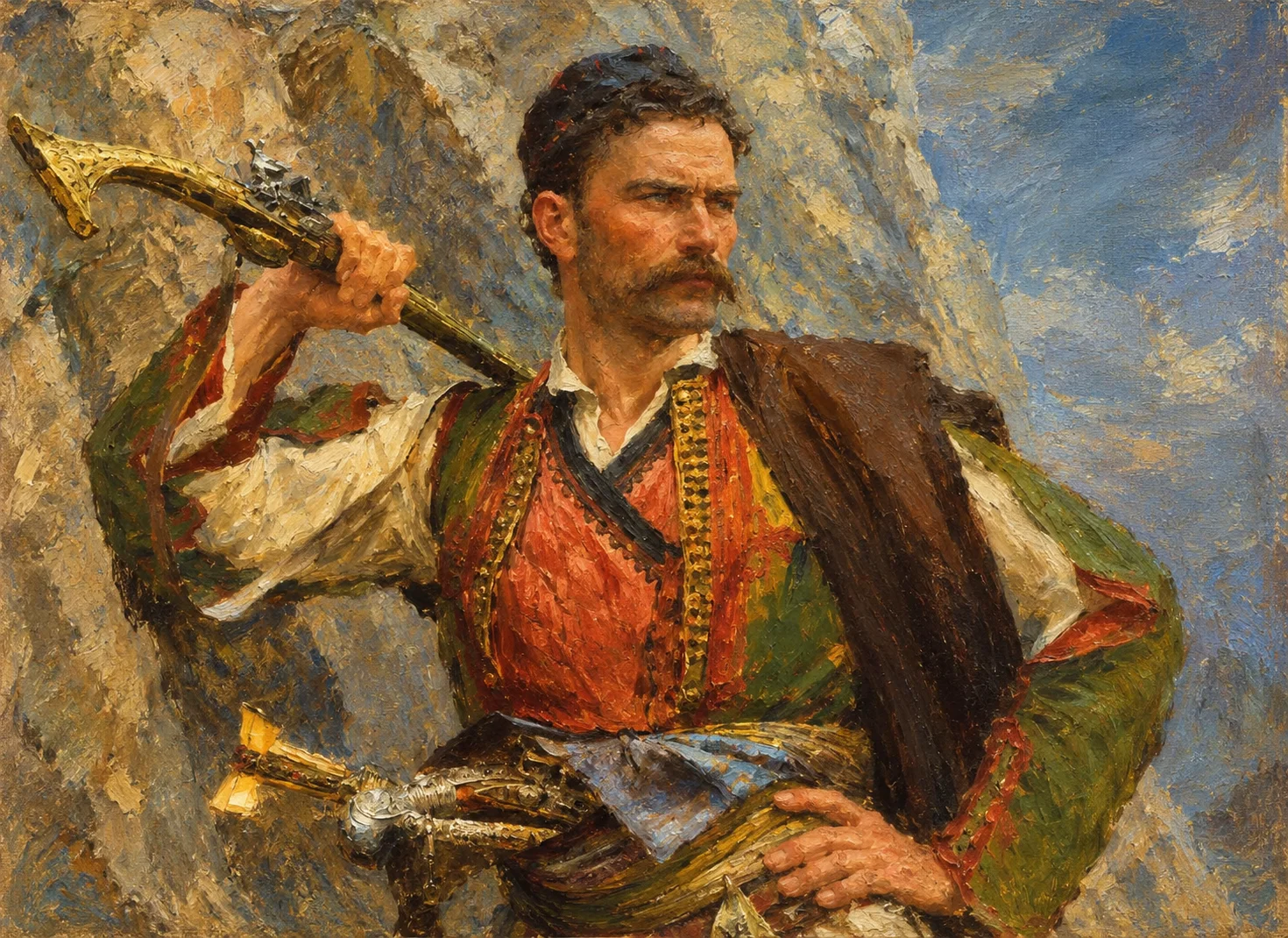

Cited from the Gemeinde-Zeitung unabhängiges politisches Journal from 1876:
“… Ismail Pasha in Monastir had also urgently requested reinforcements, as the Greeks in Thrace are becoming increasingly restless, and the wavering stance of Turkish authority is having dangerous repercussions even among the Albanian tribes; recently, for instance, 700 Catholics from the Drekalović clan—who had previously fought alongside the Turks—suddenly defected to the Montenegrins and the Kuči.”
Background
Drekali was traditionally the leader (vojvoda , “duke”) of the Kuçi tribe and founder of the Drekalovići brotherhood, which provided the Kuçi chieftains for three centuries. According to Pavel Rovinsky, Drekale is the Albanian corruption of Andrej, which is his actual name.
Similarly, Mehmet Ahmetaj argues that the name is a compound of the Albanian anthroponyms Ndre(ri) + Kalë and is reflected in microtoponyms such as Gropa e Drekalit (Albanian “Drekali’s Pit”) in the village of Stjepoh in Trieshe. Drekali was elected to the position of vojvoda (“duke”) of the Kuçi tribe probably in the second half of the 16th century, at the proposal of Dreca Dedin.
According to one account, Vojvoda Žijo Peralov from Kosor married his daughter Mara to Drekali. Their descendants would be known as Drekali or Drekalović. There are several oral traditions and legends about its origin: One tradition says that Drekal’s father was from Kuçi i Vjetër, while his mother was the daughter of the leader of Kelmendi, a certain Martini.
According to Edith Durham , Drekali was a descendant of the Berisha tribe of Northern Albania. Legends about the ancestor of the Kastrati say that it was Drekal’s brother who came from Kuçi, while Gj. Slijepçević emphasizes that it was more likely that the ancestor came from Kuçi but had descent from some other family since Drekal actually had no brothers.
Dedin Dreca actually passed on his title of voivode, impressed by the successful peace negotiations with the vizier of the Sandžak of Shkodra. Mark Milani (Marko Miljanov) reports that he was the first elected voivode, as well as the first voivode of the general tribe, since at that time the Ottoman authorities appointed one in each village. Drekali had two sons, Nikolla and Lale.
According to tradition, Drekal, together with his eldest son, Nikolla, was killed in a skirmish by members of the Kelmendi tribe, while they were grazing in the mountains of Žijeva. His son Lale survived thanks to the fact that, while still small, he swapped clothes in a child’s game with a Muslim boy from Podgorica named Lisičić. Instead, the unfortunate boy, who occasionally grazed with them, was killed. Some historians place this event around 1550.
Lale later avenged the deaths of his father and brother, with the help of Muslims from Podgorica. The revenge is described in the epic folk song Prifti Milutin dhe Drekalovići. Drekali is commemorated in traditional Montenegrin literature and oral poetry, as Vojvoda Drekali and Vuk i Klimentëve . Mark Milani has written in his works about Drekali and his descendants. Simo Matavul discusses Drekali extensively in one of his novels.
Sources
Ahmetaj, Mehmet. Fjalor onomastik i territoreve shqiptare në Mal të Zi. Prishtinë: Instituti Albanologjik, 2017.
Daničić, Đura, Pero Budmani, and Tomislav Maretić. Rječnik hrvatskoga ili srpskoga jezika. Zagreb: U knižarnici L. Hartmana na prodaju, 1976.
Durham, Edith. High Albania. London: Edward Arnold, 1909.
Bibliografski vjesnik. Cetinje: Obod, 2001.
Mitološki zbornik. Vol. 12. Belgrade: Centar za mitološke studije Srbije, 2004.
Miljanov, Marko. Život i običaji Arbanasa. 1907.
Miljanov, Marko, and Jovan Čađenović. Primjeri čojsvta i junaštva. Cetinje: Obod, 1996.
Petrović, Rastislav V. Pleme Kuči: 1684–1796. Belgrade: Narodna knjiga, 1981.
Radovanović, Milovan. Etnički i demografski procesi na Kosovu i Metohiji. Belgrade: Liber Press, 2004.
Rovinski, P. A. Černogorija v ee prošlom i nastojaščem. Moscow: Ripol Klassik, 2013.
Šimundić, Mate. Rječnik osobnih imena. Zagreb: Nakladni zavod Matice hrvatske, 1988.
Slijepčević, Đoko M. Srpsko-arbanaški odnosi kroz vekove sa posebnim osvrtom na novije vreme. 1983.
Slovanský sborník. 1881.
“Istorija – Milačići – Pleme Kuči.” Milačići.
“MONTENEGRINA – digitalna biblioteka crnogorske kulture i nasljedja.” Montenegrina.
“Drekale vojvoda i Klimenta Vuk.” Harvard University.

