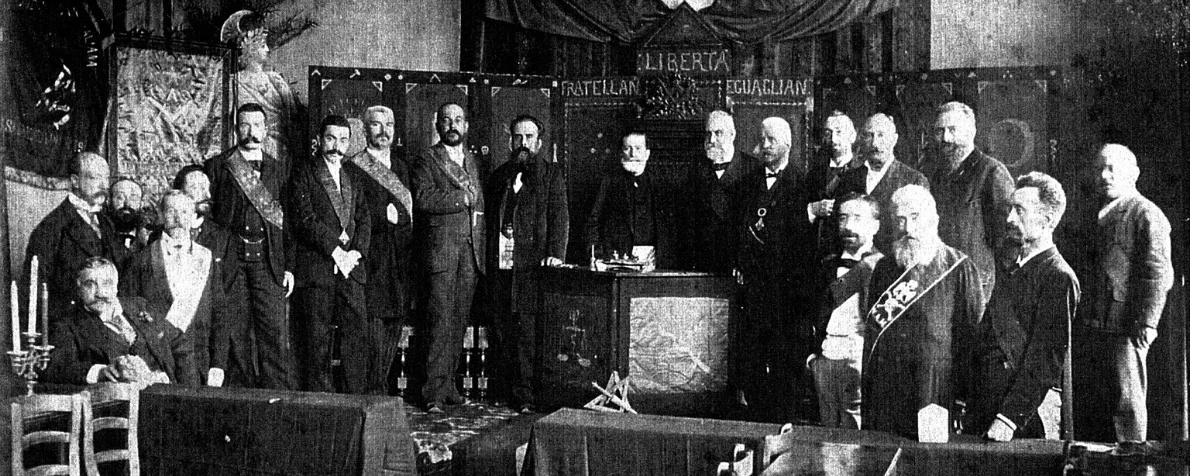

Quote:
“In the same way, Serbia cannot claim any rights or claims even on the vilayet of Kosova, almost purely Albanian up to Mitrovitsa. Nor did the so-called Old Serbia ever exist because in the era of Emperor Dushan that place was called Rashka,”
Source
Rivista massonica 1913. Biblioteca Nazionale Centrale di Roma. Massoneria. p. 209
Summary
Serbian expansionism in the late nineteenth and early twentieth centuries was not confined to military conquest. It developed through a combination of educational institutions, ecclesiastical organizations, diplomatic networks, cultural associations, and political propaganda directed toward territories still under Ottoman rule. Macedonia and the Kosovo Vilayet, particularly the area later incorporated into the Serbian conception of so called “Old Serbia,” became central objects of this policy. Serbian institutions sought to cultivate a Serbian imperial consciousness among populations whose ethnic, linguistic, religious, and political identities were considerably more complex than the Serbian categories imposed upon them. At the same time, contemporary critics questioned the historical legitimacy of Serbian claims to Kosovo, arguing that the term “Old Serbia” was itself a modern political construction rather than an established historical and geographical designation. The evidence presented here illustrates how cultural expansion, historical reinterpretation, and territorial ambition became mutually reinforcing elements of Serbian nationalism.
1. Serbian Expansionism beyond the Kingdom’s Borders
By the late nineteenth century, the Kingdom of Serbia had increasingly adopted a strategy of imperial expansion that extended beyond the formal borders of the Serbian state. Two principal directions were particularly important: Macedonia and the territories of the Kosovo Vilayet and Bosnia Herzegovina. This expansion was not initially or exclusively military. Rather, it depended upon the creation of institutions capable of producing and disseminating a specifically Serbian irredentist consciousness among populations living outside the kingdom.
Macedonia was an especially important arena. The region was economically poor and affected by emigration, banditry, and demographic instability. In this environment, competing Balkan national movements sought to establish influence through schools, churches, cultural associations, and political organizations. Serbian activity became particularly pronounced in the areas described by Serbian nationalists as “Old Serbia” and in northwestern Macedonia. Serbian Macedonian ecclesiastical communities were established, alongside political and cultural associations and, above all, educational institutions.¹
The significance of education should not be underestimated. In the context of nineteenth century Balkan nationalism, schools were not merely institutions for literacy. They became mechanisms for defining collective identity. Language, historical narratives, religious affiliation, and loyalty to a particular national project could all be cultivated through education.
Serbian expansionism therefore operated partly through a form of institutional nation building beyond the borders of the Serbian state.
2. The Saint Sava Association and the Nationalization of Education
One of the clearest examples was the Saint Sava Association in Belgrade. Its stated purpose was to “educate Serbs living in territories that remained under Ottoman rule “in a national spirit.”²
The formulation is significant because it reveals the underlying political logic. The objective was not simply to provide education to Orthodox Christians or local populations in general. Education was explicitly connected to the cultivation of Serbian irredentist and expansionist consciousness.
This development corresponded with the increasing involvement of the Serbian colonial state itself. The establishment of Serbian consulates in Thessaloniki, Skopje, Bitola, and Pristina between 1887 and 1889 provided Serbia with an institutional presence throughout Ottoman Macedonia and Kosovo. At the same time, a special section was created within the Serbian Ministry of Foreign Affairs to supervise schools and churches outside the kingdom, particularly in Macedonia and the territories designated in Serbian political terminology as “Old Serbia.”³
The transformation was consequently from relatively decentralized cultural activism toward a more coordinated state policy. Schools and churches became instruments through which Serbia could project expansionist influence without formally challenging Ottoman sovereignty.
This was particularly important because the Ottoman Empire still exercised legal sovereignty over these territories. Direct territorial annexation was therefore not immediately possible. Cultural and ecclesiastical penetration offered an alternative means of preparing the political ground.
3. Diplomacy and the Ottoman Empire
Interestingly, Serbian policy was not consistently confrontational toward the Ottoman government during this period. Between approximately 1892 and 1898, Serbian policy was characterized as “Turcophile,” in the sense that Belgrade sought to maintain sufficiently good relations with Constantinople to obtain permission for the establishment of additional Serbian schools and churches within Ottoman territory.⁴ This apparent contradiction is revealing.
Serbian imperialism did not necessarily require immediate confrontation with the Ottoman authorities. On the contrary, diplomatic cooperation could serve ultra-nationalist objectives when it enabled Serbia to expand its institutional presence among non-Slavic populations beyond its borders.
The strategy can therefore be understood as operating on two levels. First, there was diplomatic accommodation with Ottoman authorities where necessary to obtain legal permission for Serbian institutions. Second, there was imperialist consolidation among populations outside Serbia through education, ecclesiastical structures, and cultural organizations.
In this respect, Serbian expansionism was not simply a military phenomenon. It was a gradual process of transforming contested territories into spaces in which Serbian historical and iredentist claims appeared increasingly natural and legitimate.
4. The Construction of “Old Serbia”
The concept of “Old Serbia” was particularly important to this process. The term suggested that territories outside the contemporary Serbian kingdom represented an older Serbian historical homeland whose separation from Serbia was the result of foreign domination rather than historical development.
Such terminology had considerable political utility. By describing Kosovo and adjacent territories as “Old Serbia,” Serbian imperialism could transform a contemporary territorial claim into an alleged act of historical restoration. Yet this historical interpretation was not universally accepted.
A particularly striking contemporary criticism appeared in the Rivista massonica in 1913. Discussing Serbian territorial claims, the publication rejected the idea that Serbia possessed historical rights to the Kosovo Vilayet, describing the region as “almost purely Albanian up to Mitrovitsa.” It further challenged the historical terminology itself, arguing that the so called “Old Serbia” had never existed as such and that under Emperor Dušan the territory had instead been associated with Raška.⁵
The importance of this statement lies less in whether its characterization of the population or medieval geography should itself be accepted uncritically than in the fact that it demonstrates that the Serbian historical narrative was contested already in contemporary discourse. The terminology of “Old Serbia” was therefore not a neutral geographical description. It was part of a political argument and an ideological construction.
5. Kosovo and the Problem of Competing National Narratives
The Kosovo Vilayet represented a particularly complicated case because several competing historical and national narratives overlapped there.
For Serbian irredentism, Kosovo, though never having been Serbian demographically and having an Albanian majority for centuries, possessed a symbolic and mythological significance. The medieval Serbian state, the Battle of Kosovo of 1389, the Serbian Orthodox Church, and the memory of the medieval Nemanjić dynasty all provided material for constructing a strange narrative of an alleged historical continuity.
The contemporary criticism preserved in the 1913 Rivista massonica illustrates precisely this distinction. Its argument was essentially that medieval Serbian political influence could not simply be translated into an unrestricted modern territorial claim. The historical name of a region, moreover, did not necessarily correspond to the political geography of the modern period.
6. From Cultural Influence to Political Territorialism
The development of Serbian schools, churches, consulates, and cultural organizations outside the kingdom created an institutional infrastructure for Serbian colonialism. The significance of this infrastructure became increasingly apparent as the Ottoman Empire weakened.
Once a territory contained Serbian schools, Serbian ecclesiastical communities, Serbian associations, Serbian diplomatic representatives, and a population increasingly described through Serbian national categories, Serbia possessed more material with which to claim that the territory constituted part of its national sphere.
This process was not unique to Serbia. Bulgarian, Greek, Romanian, and other national movements pursued comparable strategies throughout Ottoman southeastern Europe. Nevertheless, the Serbian case is particularly instructive because the political vocabulary of “Old Serbia” linked contemporary institutional activity to a claimed medieval territorial inheritance.
The result was a circular process:
historical claim, cultural activity, institutional presence, national identification, territorial claim.
The expansion of institutions therefore helped create the very political realities that could later be invoked as evidence for territorial entitlement.
7. Conclusion
Serbian imperialism before the Balkan Wars should consequently be understood as a multidimensional process. Military power was only one component. Equally important were schools, churches, consulates, cultural associations, diplomatic initiatives, and historical narratives.
The Saint Sava Association and the Serbian educational network demonstrate how imperialism was cultivated beyond the kingdom’s internationally recognized borders. The Serbian consulates established in Thessaloniki, Skopje, Bitola, and Pristina provided the state with a diplomatic framework for this activity, while the Ministry of Foreign Affairs increasingly coordinated schools and churches abroad. At times, Belgrade even maintained cooperative relations with Ottoman authorities precisely in order to facilitate this expansion.⁶
At the ideological level, the concept of “Old Serbia” supplied a historical vocabulary through which these activities could be interpreted as the recovery of an ancestral homeland rather than the expansion of a modern state.
Yet contemporary observers disputed this interpretation. The 1913 Rivista massonica explicitly challenged both Serbian territorial claims to Kosovo and the historical validity of “Old Serbia” as a distinct medieval designation.⁷
The evidence therefore reveals an important feature of Balkan nationalism: territorial claims were not simply produced by armies and treaties. They were also constructed through institutions, education, cartography, historical terminology, and competing interpretations of the past. Serbian expansionism was consequently both a political project and a struggle over the meaning of history itself.
Notes
- Alberto Becherelli, Serbia e crisi balcanica (1908–13): Il carteggio dell’addetto militare italiano a Belgrado (Rome: Nuova Cultura, 2015), 25–26.
- Becherelli, Serbia e crisi balcanica (1908–13), 25–26.
- Ibid.
- Ibid., 25–26, citing W. S. Vucinich.
- “Serbia,” Rivista massonica (1913), 209, Biblioteca Nazionale Centrale di Roma, Massoneria.
- Becherelli, Serbia e crisi balcanica (1908–13), 25–26.
- “Serbia,” Rivista massonica (1913), 209.
Bibliography
Becherelli, Alberto. Serbia e crisi balcanica (1908–13): Il carteggio dell’addetto militare italiano a Belgrado. Rome: Nuova Cultura, 2015.
“Serbia.” Rivista massonica. 1913. Biblioteca Nazionale Centrale di Roma, Massoneria, p. 209.

