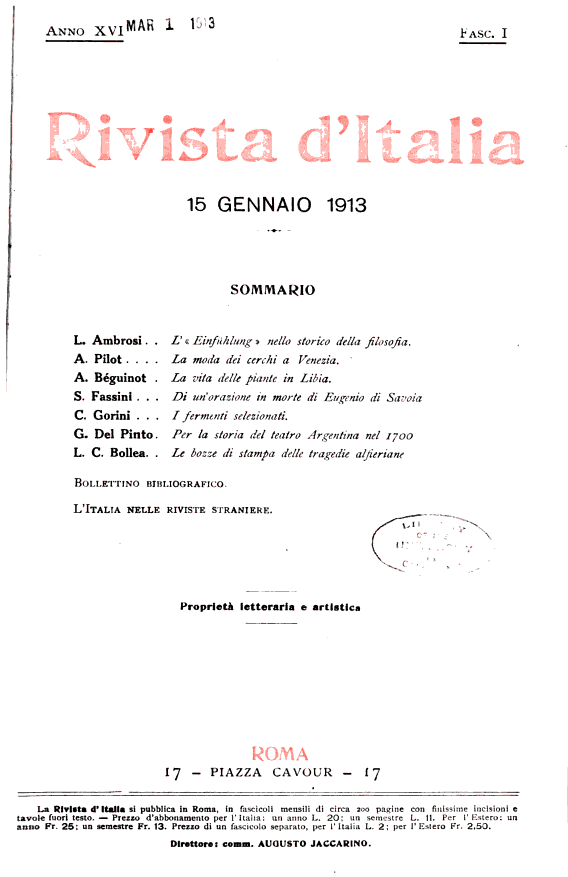

“Serbs-rather monsters than men” – quote from the publication.
Cited from the Rivista d’Italia in 1913:
“Indeed, what is now Serbia was once Illyria, and the relationship between Illyrians and Albanians is akin to that of fathers and sons. By this logic, the Albanians ought to issue the command veteres migrate coloni (“old colonists, move on”) to the Serbs. Nor is that all. If Serbia bases its excessive claims on a ledger of debits and credits, it is doubly in the wrong, for the strip of land between Leskovac (in Albania) and Nish (in the heart of its own territory) is ethnically Albanian.
Serbia ought, therefore, to restore what was wrongfully taken rather than attempt to reclaim territory that was never lastingly its own. Their vaunted historical rights hold no greater weight. The Serbs claim that, in the Middle Ages, Albania was a province of the Serbian Empire. This is true up to a point.
But firstly, if all lands held by ancestors were to revert to their distant descendants, the Serbian name would have to vanish from the face of the earth; their small kingdom would have to be returned to the Albanians—who occupied it from proto-historic times until the 6th century AD—or at the very least to Italy, the seat of the Roman Empire, of which Moesia was a part of, until the Serbian kingdom arose.
Secondly, Albania was a Serbian province for only six years.
Around 1350, the Byzantine Empire—assailed by Albanians on one side and torn apart on the other by the war between the heir John Palaiologos and the regent John Kantakouzenos—was on the verge of collapse. Taking advantage of this situation, the
Serbian King Stefan Dušan conquered all of Albania and Epirus, extending as far as Arta and the Gulf of Corinth; he occupied Thessaly and Macedonia and had himself crowned in Skopje (Usküb) as Emperor of Romania, Slavonia, and Albania. Yet, after Stefan Dušan’s death around 1357, the Serbian Empire—to use the words of the historian Kantakouzenos—shattered into a thousand pieces.
Thus, it is on the basis of a mere seven-year rule that the Serbs assert their historical rights over Albania. What other rights do the Serbs have over this nation? The right of conquest. Yet the Serbs conquered only a strip of land stretching from Mitrovica, through Gjakova and Tirana, to Durrës—lands they would be forced by the will of Europe to abandon, in accordance with the principle they themselves accepted: “the Balkans for the Balkan peoples.”
Moreover, through this conquest, the Serbs dishonored their own name; the atrocities they committed against peaceful, unarmed populations surpassed those committed twenty years earlier by the Turks against the Armenians—atrocities for which Sultan Abdul Hamid was deservedly branded by Gladstone as the “Great Assassin.”
Peaceful citizens in Pristina, Usküb, Gjakova, and many other places were struck down by Serbian bayonets in the public streets; others were slaughtered in their own homes while seeking refuge from Serbian savagery or begging for mercy; others still were falsely accused of colluding with the Turks and were publicly butchered without even the semblance of a trial.
Women were raped before their husbands’ eyes. Brothers and fathers were shackled and forced to witness the slaughter of their loved ones, unable to defend them; pregnant women were disemboweled and fetuses impaled on spear-points; children were run through with bayonets; villages were burned and destroyed. Twenty-five thousand Albanians were massacred by the rabble of Serbian soldiery.
Anyone reading the Reichspost report recoils in horror at the savage atrocities committed by the Serbs—monsters rather than men, brutes rather than conquerors, unworthy of the human community. Moreover, the right of conquest cannot be invoked here: at the time of the conquest, Albania was no longer a Turkish province but an autonomous state—a status granted by the Sublime Porte with the concurrence of the Great Powers.
By asserting rights of conquest over it, the Serbs violate the law of nations. Their economic arguments for possessing Durrës are invalid, as they would set a precedent that all the ravenous bitches of Europe would exploit by fair means or foul. They do not have the right to seize territory simply because they need access to the sea to boost their trade and foster their nation’s prosperity.”
Source
Rivista d’Italia 1913. Società editrice dante alighieri. University of California. ANNO XVI. FASC. I.Proprietà letteraria e artistica. ROMA 17. PIAZZA CAVOUR. p.372

