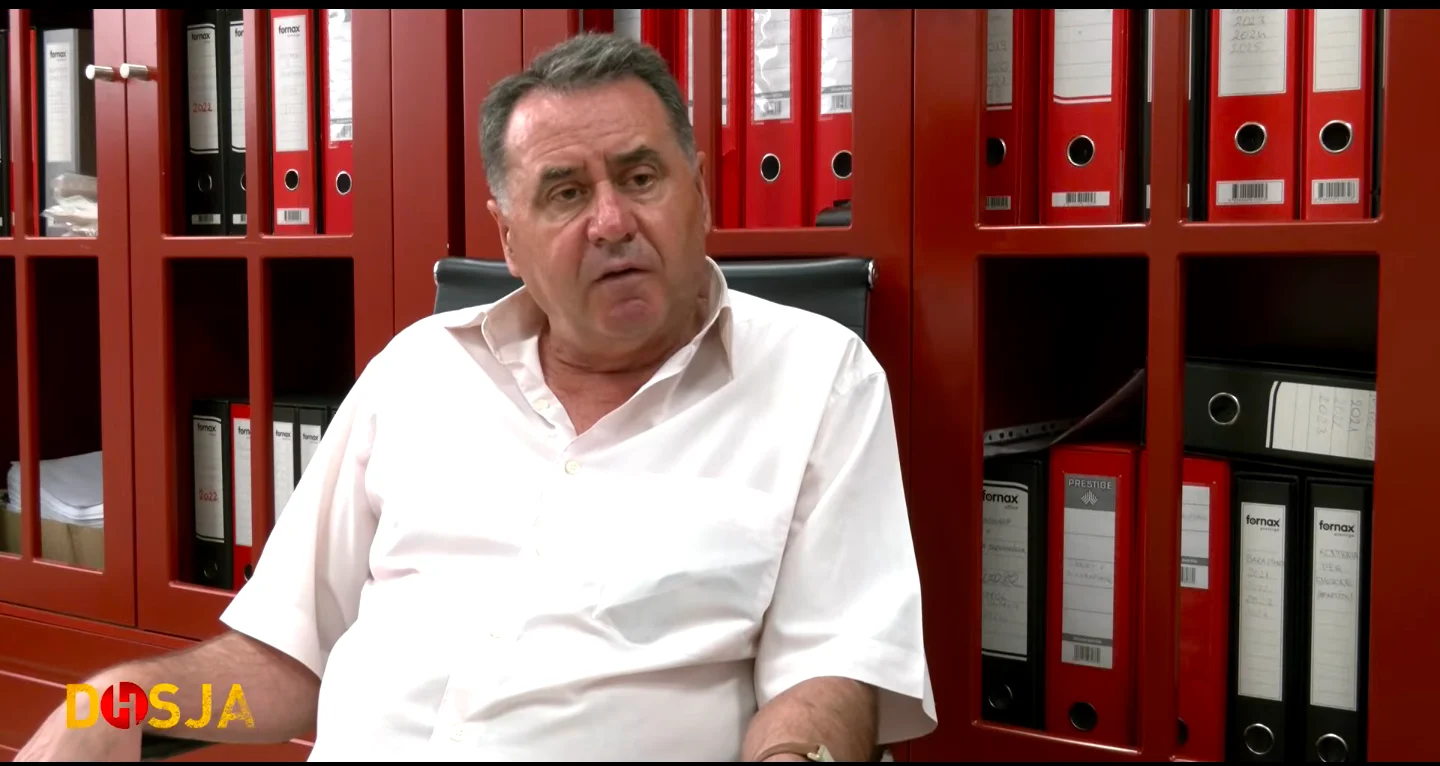

by Qazim Namani Dr, Archaeology/Cultural Heritage. My interview with TV Dukagjini
Abstract
This interview with Dr. Qazim Namani examines the historical development and impact of Russian political, military, religious, and cultural influence in Albanian-inhabited territories from the early modern period through the nineteenth and early twentieth centuries. It focuses on Russia’s expanding strategic interests in the Balkans, particularly its efforts to weaken the Ottoman Empire and strengthen relations with Serbia and Montenegro.
The study highlights the role of Russian diplomacy, Orthodox clergy, missionaries, educational networks, financial assistance, and military support in extending Russian influence across the region. Particular attention is given to the Russo-Ottoman conflicts, the Serbian uprisings, the Eastern Crisis, the Treaty of Saint Stephen, and the Balkan Wars, which are presented as decisive stages in the territorial and political transformation of Albanian lands.
The paper also considers the role of intellectual and cultural movements, including Pan-Slavism, the development of Serbian literary and historical narratives, and the formation of the Kosovo myth. Through references to historical books, maps, travel accounts, church records, and other sources, the study argues that Russian influence contributed to political changes, territorial losses, population displacement, and cultural transformations affecting Albanian communities. It concludes that the legacy of these historical processes remains significant for understanding contemporary political and cultural relations in the Balkans.
Main points:
- Strategic interest: Russia increasingly focused on the Balkans, especially during the 18th–19th centuries, seeking to weaken the Ottoman Empire, expand southward, and gain access toward the Adriatic and warm-water routes.
- Religious and cultural influence: Russian influence operated significantly through the Orthodox Church, clergy, missionaries, schools, intellectual networks, and financial support, particularly among Orthodox and Slavic communities.
- Serbia and Montenegro: Russia developed strong relations with Serbia and Montenegro and supported uprisings against the Ottoman Empire. The interview presents these relationships as contributing to the expansion of Serbian and Montenegrin control into Albanian-inhabited areas.
- Treaty of Saint Stephen (1878): The author identifies the Russo-Ottoman War of 1877–78 and the Treaty of Saint Stephen as a major turning point because Albanian-inhabited territories were proposed for transfer to Montenegro, Serbia, and Bulgaria.
- Albanian resistance: The interview describes places such as Himara and Suli as areas that Russia sought to connect with in its broader effort to encourage resistance against Ottoman rule.
- 19th-century institutions: The opening of a Russian consulate in Shkodra in 1856 and the activities of Russian diplomats and clergy are presented as important mechanisms for increasing Russian influence in northern Albanian territories and Kosovo.
- Eastern Crisis and Balkan Wars: The author connects Russian support for Serbia and Montenegro with the displacement of Albanians, particularly around the Sanjak of Niš, and later with territorial changes during the Balkan Wars of 1912–13.
- Historical narratives: Considerable attention is given to intellectual figures such as Jovan Rajić and Vuk Karadžić, the development of Serbian literature and language, and the emergence of the Kosovo myth, which the interview portrays as part of broader nationalist and Pan-Slavic intellectual developments.
- Sources and historical research: The author emphasizes books, maps, travel accounts, church records, and other historical materials as evidence for the changing ethnic and political landscape of Albanian territories.
- Overall argument: The interview concludes that Russian-backed Pan-Slavic and territorial projects helped reshape the Balkans and contributed to the occupation, displacement, and cultural transformation of Albanian lands. It argues that these historical developments continue to influence Balkan politics and memory today.
Summary
This documentary presents Russian influence in the Balkans as a long-term combination of geopolitical expansion, support for Serbia and Montenegro, Orthodox religious influence, intellectual/cultural activity, and military-diplomatic intervention, which the author argues had major consequences for Albanians.
Introduction: Russia and its influence on Albanian lands
For centuries, Albanian territories have been at the center of the interests of the great powers. The geographical position, the exit to the Adriatic and the routes connecting the Balkans with the Mediterranean make the Albanian space an important point in the political and strategic clashes of Europe.
Among these powers was Russia. Russian interest in the Balkans was particularly strengthened during the 18th and 19th centuries, at a time when the Russian Empire sought to expand its influence southward, weaken the Ottoman Empire and gain a stronger position in the Balkans and towards the straits and seas in the warm waters up to the Adriatic Sea. In this policy, Russia relied heavily on ties with the Slavic peoples and its allies in the Balkans, especially Serbia and Montenegro.
At the end of the 19th century, this policy would directly conflict with the interests of the Albanians. The year 1878 marks a turning point. After the Russo-Ottoman War of 1877-78, Russia imposed the Treaty of Saint Stephen. In the new territorial project of the Balkans, the territories inhabited by Albanians were envisaged to be transferred to Montenegro, Serbia and Bulgaria. At this moment, Russia no longer appears only as a distant power seeking influence in the Balkans.
Its policy begins to directly influence the fate of the Albanian lands. However, the rise of Russia began even earlier. I would have started from the fall of Constantinople and the influence of Russia, that is, in the region. In fact, we will go into brief points, but let’s see in general how long it took for Russia to appear in our region as a military and political power, to understand its influence, which was quite large. With the fall of Constantinople, Russia, in other words, declared itself the hereditary successor of the Eastern Roman Empire. At the end of the 15th century, it issued a law on the centralization of the country.
From the end of the 15th century, Russia began collecting literature from the Byzantine Empire and all those scholars who knew how to translate the works of Byzantium with great dedication. One of the scholars who went to Russia at the beginning of the 19th century is Mihail Trivoli or Artioti who was from Southern Albania who, after being educated in Italy, went to Russia and ended up there until his death, as a translator of the works of the Byzantines. In fact, those who went to work in Russia did not return, a fairly large dictatorship was used against them.
Russia expanded its influence in the territory, and later expanded its influence in other countries of the region, so it began slowly, with expansion, applying in administration all the lessons from the Byzantine Empire to apply them in politics.
It is important to note that at the time when Suleiman the Lawgiver achieved the greatest results in the expansion of the Ottoman Empire, Russia’s influence was quite large with agents and missionaries who had even intervened in the sultan’s court.
In this period we also have Mehmet Pasha Sokolovic who was a Slavic missionary. who had a great influence on the court and leadership of Sultan Suleiman Kanun. We know that this also has to do with Kosovo because in 1557 he declared the Patriarchate of Peja a patriarchal unit for the first time, and brought his brother Makarije as the first patriarch to the patriarchate of Peja. Sokolovic also took under his protection several other churches in Kosovo, which slowly began to spread Slavic influence through Christian clergy and other missionaries.
Before Russia emerged as a direct factor in the Albanian issue during the crises of the 16th century, it had begun to seek allies in the territory of the Ottoman Empire, because the weakening of the latter was one of the main objectives of Russian foreign policy. For this reason, Moscow began to create links with Christian communities and local groups that could rise up against the Ottoman administration. Himara and Suli were also included in this strategy.
The Himarjets had a long tradition of autonomy and clashes with the Ottoman authorities, and the Suliots had built up a strong resistance to Ottoman expeditions. This made them potential partners for Russian policy in the Balkans. Also in the 16th century, Russia supported the Himarjets and Suliots with financial means and with weapons against the Ottoman Empire. Russia’s role is mainly shown in the Peace of Karlovci of 1699 where it appears on the political scene as a military factor.
After the Austro-Turkish wars at the beginning of the 18th century, Russia clearly appears with its influence, as it already begins to encourage the Christian population to rise in rebellion against the Ottoman Empire and at the beginning of the 18th century, supports Prince Danilo in Montenegro.
When it comes to Danilo, around 1712, who manages to go to Russia to also receive financial assistance, but also other instructions to rise in rebellion, since the Turks had already conquered the city of Cetinje and destroyed the church. At this time, an uprising of the Montenegrins begins, constantly under the supervision and control of Russia.
In European countries, the Enlightenment was emerging and spreading in Europe, a new era of thought that focused on reason, knowledge, freedom and individual rights, while the Balkans continued to remain under the rule of the Ottoman Empire. It is important to note that that period of movements that began in Western Europe were the currents that emerged from the Enlightenment, which for us is important to know that Europe at that time had a very great cultural and civilizational development and, especially in Paris and in general in France, many people of art and culture, various philosophers, people who had come to live in France from Poland, Prussia and other European countries, had gathered and had begun to organize themselves in salons run by women and this movement was called the Republic of Letters.
In fact, it was a communication of the time based on letters, a postal communication that expressed different ideas for the development of society, culture, but also for the formation of new states, and for the expulsion of the Ottoman Empire. It seems that we Albanians in that period did not have any intellectuals of that caliber who were active in Western Europe, but from the Balkans and other peoples there were. Albanians in that period had begun to strengthen their pashaliks.
We know that those pashaliks did not have any important national project, and they did not have disagreements among themselves and sometimes they worked, according to the instructions of the Ottoman Empire, sometimes they were in rebellion, but they did not have any project to successfully realize their independence.
It is important to note that in this period the first ideas for turning attention to antiquity also arise. At this time, Wickelman’s theory appears, which begins to come up with theories of art. He makes distinctions between the pillars of architecture, the building style of Greek art, Roman art.
Jovan Raici was a Slavic cleric and intellectual who was active at that time. Jovan Raici was born in Karloqin, Mitrovica, Srem. He was educated in Hungary at a Protestant college and later went to Russia, but it seems that he had a continuous correspondence with other intellectuals who were active in Europe because this is also evident from his ideas about the Balkans, which were published in a book in 1793. In that book he predicted the formation of Slavic kingdoms in the Illyrian lands of Slovenia, Bosnia and Serbia.
It is important to note when talking about this book, that this book was later criticized by a Serbian historian, Ilarion Rovarac, for which book Rovarac emphasized that it was full of lies, and falsifications. During the 18th and especially the 19th century in Europe, romanticism and nationalism developed, as peoples began to look to the past for arguments for their identity, territories and political rights. It was precisely in this climate that peoples were formed, systematized and politicized according to historical law, which would later be used to support national and territorial projects.
One of the most important examples is the myth of Kosovo in Serbian historiography and political culture. It is a period when myths are created, for example, the myth about Kosovo, it is said that they have their beginning precisely in this organization of the intellectual elite in the West, later also in the Vienna Club that operated in Vienna where a large number of refugees from the territories of our peninsula that were mainly under the Russian mission were concentrated.
One of them that I can mention for example was Vuk Karadžić who worked for the interests of Russia, as well as with Karađorđe Petrović. Karađorđe Petrović was encouraged to armed uprising and was also supported by Russia.
Russia actually became stronger especially after the Turkish-Russian war of 1768-1774, during the time of Catherine, and after that in the peace treaty of Kaynakja, Russia gained some rights, after conquering it, it was recognized as the right of Crimea, then it was recognized as the right to take under protection all Orthodox Christians of our peninsula, or of Southeastern Europe, it was also recognized as the right of free movement in warm waters.
After this treaty, Russia gained the right to organize, distributed money and clergy in the field, but also in the church of Karlovci. Russia begins the uprising of the Orthodox, after this treaty with Karadjorgje Petrovic. Karadjorgje Petrovic at that time had started some robberies and was accused of killing four Turkish merchants, when together with Fazli Basha.
The uprising began to expand to organize the uprising of 1804. Russia, in addition to money, also supported it with military forces, as we have the case in the occupation of Kraljevo, where it is described that there were 3,000 Russian soldiers who helped Karadjorgje Petrovic to take Kraljevo, to then take Jagodina and many other cities that were mainly inhabited by Albanians.
The attacks continued in Belgrade, then we have the capture of Belgrade. In 1811, Russian soldiers were also very active, and supported the uprising until 1812, when the Peace of Bucharest was reached, and Karađorđe Petrović was forced to flee to Vienna. Russia at that time was at the forefront of power, despite the fact that there were attempts to make the Serbian language more Polish, but the influence of Russia was significantly stronger than the Polish influence, the Slovak influence, and the club members who operated in the Vienna club. Jerinej Kopitari from Slovenia and Šafarić from Slovakia were very involved in the formation of the Serbian language at this time.
For Russia, which during this period sought to expand its influence in the Balkans, the Holy Alliance of 1814, between the European powers to control the uprisings of the European peoples, was of interest. In the project of Pan-Slavic interests, the importance of Shkodra was related to its position, to access the waters of the Adriatic Sea, including the Albanian territories bordering Montenegro.
The more Russia strengthened relations between Montenegro and Serbia, the more Albanian territories came under its influence and control. For example, where is the book that presents the limits of the extent of Russia’s influence, where Shkodra is also mentioned. I have mentioned this book before in my writings, when Otto Budislav of the Habsburg family visits the territories of our peninsula that were under Ottoman occupation.
The book was published and written in 1829. This was a military man from the Habsburg family, a military family, who makes a journey, that is, to the Balkan regions after seeking to enter the war against the Ottoman Empire, but is not allowed. And this book describes the plans for the extension of the Russian Pan-Slavic borders up to Shkodra.
In fact, it is noted that as I said before, in all those projects that were drafted in that period, the border up to Shkodra is mentioned. It is important to know, for example, that in 1814 Vuk Karadjiqi published the first grammar in the Serbian language, which is also known as the beginning of Serbian literature, another issue is that the Serbs tried to lay the foundations of literature until the 11th and 12th centuries, but the truth is that the 1814 primer and the dictionary that he published in 1818 are the first steps of Serbian literature.
Vuk Karadzic’s supporters for the formation of the Serbian language were Jerinej Kopitari, a Slovene who constantly supported the formation of the Serbian language. Then there was Shafarik, there was Simo Sarajlia, and in fact other members of the Vienna Club.
From the Vienna Club, Simo Sarajlia is sent to Montenegro and for the first time the name Serbian is mentioned there, and for us it is particularly important to know that in that period the Myth about Kosovo and about Miloš Obilić also appears, which is important to know, because until that period from all sources we do not have the name Miloš Obilić, but he is mentioned by other names.
I also have Konstantin Mihajli’s book to present here. Konstantin Mihajli was an Orthodox Albanian from the Artana district, who had a similar fate to Skanderbeg when Artana was conquered. He was taken by the Ottoman Empire, mobilized in the Ottoman army and took the opportunity to desert.
Then he went to Czechoslovakia and Poland. It is important for us to know that he was among the first scholars who wrote about our hero Skanderbeg. For our hero Gjergj Kastrioti – Skanderbeg the first authors who wrote are Konstantin Mihajli and Martin Segorin from Artana. Later Barleti and other scholars took notes from these two authors to write books about Skanderbeg.
Konstantin Mihajli’s book was translated by Shafarik and published in 1865, where when he translated the book, he wrote Konstantin Mihajli’s book, and wrote in the footnote that there was a mistake in the name of Milosh Obiliq, which means that he is mentioned by another name.
An important turning point in the expansion of Russian influence in the Balkans came at the beginning of the 19th century with the Serbian uprising and the gradual gaining of Serbian autonomy in 1833 from the Ottoman Empire. In this process, Russia played an important diplomatic and military role. For Moscow, the creation of an autonomous Serbian entity within the Ottoman Empire was an opportunity to strengthen its presence and influence in the Balkans.
Slowly, with the gaining of Serbian autonomy in 1833, Russia began to act with its policy of increasing its influence in these territories. We have a school that opens in 1836, first in Prizren. Then we come to 1856 where the first Russian consulate opens in the city of Shkodra. So, we are dealing with a consulate that operated in Shkodra and its influence was so great that in my opinion it managed to appropriate both people and cult objects and assimilate a number of the population, and develop propaganda.
The creation of this consulate cannot be seen in isolation from the developments of the time. Shkodra was the political and commercial center of northern Albania, a city with important connections with Montenegro, Kosovo, the Adriatic and other Albanian areas of the Balkans. For a power like Russia, the diplomatic presence in Shkodra created an opportunity to gather information, to follow political and social developments and to expand contacts with the population.
Another name closely related to this activity in Prizren and Shkodra is Ivan Stepanovi Jastrebov, who operated at the beginning of the Eastern Crisis of the 1870s. I also have his book that I am presenting to the viewer. Here is this book by Astrebov as a Russian consul operating in Prizren. However, although operating in Prizren, he was very present in Shkodra and in the Highlands, who with his propaganda operated on the ground to assimilate the Orthodox population and for the falsification of cult objects.
Then we have the other Russian consul who was killed in 1903 in the city of Mitrovica and as we see, this means that Russia had the main influence in the wars and in the eastern crisis and after it in the Albanian territories. There are arguments and facts, there are written evidence and sources for the role of Russia in the assimilation of our people. It is in this book here, for example, how the Russian allies of the Balkans and some Russian soldiers participate in the eastern crisis in the occupation of Albanian lands.
Then we have Russian diplomats, like Gilferding who operated in Sarajevo and Ignjatev who operated as ambassador to the Ottoman Empire, who is also the drafter of the first plan of the Treaty of St. Stephen. So, Russia had a very great influence, especially in that period, its influence was played mainly through the clergy. It is important to know that those who deserted from the Ottoman army or went to Russia, were educated there for administration, military and clerical cadres and later were sent to the Albanian territories.
We were very divided after the Tanzimat reforms of 1839. In 1844, in fact, when Vranje was conquered and Hysen Pasha left, but Pristina was also conquered, the Pristina Highlands and when other Albanian territories were in rebellion, they had no support from any ally. However, in these circumstances the Albanian rebels were forced to surrender because the Ottoman Empire had sent Omer Pasha Latas, who was a Slav speaker from Ogolino in Croatia.
In fact, Russia constantly influenced the Ottoman Empire and sent people who spoke Slavic languages or were related to the Slavs, and in this period, in fact, the population of the Pristina Highlands and other areas were forced to accept Islamization. I think that we, although we have researched a lot in the field and in the literature, Islamization in the villages is not earlier.
We have families registered with Muslim names, but in practice this means that there were no Muslims in the highlands of northern Albania in remote villages far from urban settlements. There were Muslim Albanian families in urban cities and they were forced to accept Islam earlier. In the highland villages, although they accepted Islam, they did not practice it until the Eastern Crisis. After the Eastern Crisis, the first mosques began to be built in these villages. Now there are some forgeries that take those mosques back a century or two, but with such actions, they only harm the national issue, our history, and do not illuminate anything.
During these centuries, Russian influence was not limited to Shkodra and other territories of Northern and Southern Albania. In the second half of the 19th century, Kosovo increasingly entered the field of interests of the great powers and Russia was among the actors who sought to strengthen their presence in this space as much as possible. Since 1860, Russia had a project to make Bulgaria great and with its agencies, it had managed to extend its influence to the Albanian lands, this is also noticeable in the territory of Kosovo.
The influence of Russian policy is still noticeable today in the region of Opoja, and even in the region of Rahovec, bringing clergy as missionaries, then using the Pamiks who lived in Bulgaria. Russia changed its plan in the eastern crisis when they saw the success that was achieved with some areas and actions on the ground, with the cadres that Russia had educated, because there were many from the regions of southern Albania and Kosovo who went to Russia and were educated there.
Russia’s influence was continuous, especially in the religious aspect. The Russian Church had everything under control. Then, in the eastern crisis, for example, in the years 1876, we actually had 600 military volunteers from Montenegro, who fought for the displacement of Albanians from the Sandzak of Niš and all of them remained in the Albanian lands when they were sent, but they also brought new settlers, they brought whole families from Montenegro to colonize those lands.
Orthodox Albanians and others who went to Russia prepared and participated in the war against the Albanians to conquer and expel the indigenous Albanian population from the sandjak of Niš.
I think that the actions of the Serbian-Russian army on the ground, it is clearly seen that the idea for the horseshoe plan was also created, which I see as being realized in the 20th century, in 1912 with the Balkan wars, because it is noticeable that Russia, with the military support that had managed to occupy the Sandzak of Niš, will expel the Albanian population around the Vardar and in 1912 takes Skopje, Manastir up to Dibra, and in 1914 they entered the territory of Albania from all sides, passed through Albania, committed murders and we did not take them seriously, that is, those plans that were quite old, were very well prepared as geostrategic projects that were very useful for them, and very harmful for us.
Which I think the same situation is still the case today. Even today, for example, when we see the influence of the Serbian police and the Serbian-Russian agents in Macedonia, we see the joint police in Ohrid, between the Serbian police and the Macedonian police and in the border towns of Debar, we see that it is in fact the same policy that was implemented during the Balkan Wars of 1912-1913.
Russian influence in the Balkans was manifested through political and diplomatic support for the alliance of Balkan states, especially towards Serbia and Montenegro, Russia aimed at weakening the Ottoman Empire and strengthening it in the Balkans, while the expansion of Serbia and Montenegro directly affected Albanian territories. It is important to know this, for example, that Nikola Pashiqi was also a Russian agent, who in the Balkan War led military expeditions that went, for example, towards Skopje.
On this journey of the Serbian army, there were several wagons with weapons in a Russian train. Russia with supposedly humanitarian aid, but the wagons were also with weapons and other aid. It is important for us to know that Russia also supports the terrorist organization Cerna Ruken, which was founded in Skopje in 1901. We have arguments. I mean, all of these were organizations that were founded, with initiatives and aid from Russia, but we must say, that we were with Orthodox Albanians and brothers, I mean, they were killing each other and we had no chance, we were in a very difficult situation at that time and we are still today.
And today, we have no project, no strategy, we have no real study of the cultural genocide that is happening in the Sandzak of Niš or in the Sandzak. Very little is known about these things. In fact, we are also guilty of not studying these Albanian regions today, after we created a basis in the 20th century to deal more seriously with these important topics.
Another channel through which Russia sought to expand its influence in the Balkans was the Orthodox church and clergy. Russian clergy and religious representatives were sent to the Balkan areas, while through churches, religious schools and financial assistance, stronger ties were created with Orthodox communities, especially with Slavic ones. The Russian truth is that in that period in all the churches when the Albanian lands were occupied, Russian clergy were placed, and all the Russian personnel.
To prove what I am saying, I have brought this book to see how history is falsified. I want to say that in Leskoc in the church of this city, when it was occupied, we have complete arguments for all those crimes that they committed and destroyed the old script, and the author of the book asks the question why the script of 1693 was destroyed. Then we have, for example, numerous forgeries, we have names, we have the placement of crosses, Russian crosses in churches.
Here we have research within the territory of Kosovo, when we visited some churches in some church buildings of the Morava districts. It means that it is noted that the churches were completely in the hands of Russian clergy, and this happened and between the two world wars the Serbs did not have a great influence on the churches. It means that in the churches, there was mainly a Russian spirit, which developed in the occupied Albanian lands.
It is also important in this book, for example, that I mentioned about the population that the Serbian author himself, when describing the travels of Georg Von Hahn who visits these areas, in the middle of the 19th century, who traveled from Leskovci, then continues to Medveđa, stays there for two or three weeks, visits Arta and some Albanian areas. For us it is important that Hahn makes comparisons about the house of Ismail Pasha in Leskovci, when he also writes about Mahmud Pasha Begolli in Peja.
Georg Von Hanni writes that those houses were among the most beautiful houses in all of Albania, and the importance lies in the fact that they are also written by Serbian authors themselves. From other sources by Serbian authors themselves, which can be found and there are plenty of sources, for example, just look for the book: Travels through the new Serbia by Mita Rakiqi when he visits the occupied lands immediately after the Eastern Crisis in 1880 and publishes this book.
Later this book was reprinted in Leskovac and here if you read carefully it means that it also appears in Toplica and in all inhabited areas it writes that the inhabitants are ethnically Albanian, even for Kusumli it is written that it was a nest of Albanians.
Another book with interesting data on territorial changes in the Balkans is the book Balkan Sketches by the American artist Hornb, published in Boston in 1927. At the beginning of the book there is a map with the title of the Kingdom of Serbo-Croats and Slovenes, which was founded after the First World War, which shows the surface of this state after the major territorial changes of the early 20th century.
The map is particularly significant to see how Kosovo and other Albanian territories were included within the borders of the Serbo-Croatian-Slovene kingdom. But what is important for us, from this whole project that we mentioned, I have a book that was published in 1927, published by an American artist who visits these Balkan regions. This book came to me as a gift from a friend of mine, Sabedin Gashi, from America, who brought me a gift, and it is noted that the book was published in Boston.
The author describes all the areas of the Kingdom of the former Yugoslavia, but it is important that in this book, on the first page, the Serbo-Slovene Kingdom is presented, which is based mainly on what I mentioned, on those activities of the enlighteners of the Republic of Letters, when I also mentioned Jovan Raiqin, and his book published in 1793, which was published in Vienna.
That book was published, and none of us has opposed it, and we allow this book to be taken as the first book of modern Serbian history, which is actually opposed by the Serbs themselves. The author of the book Balkan Sketches has published a map that was published on May 12, 1794 in London.
This American author himself, through this map, implies the formation of the Serbo-Croatian-Slovenian Kingdom, as a project, which has the initiative from the ideas of Jovan Raic, in that society that operated in the Vienna Club, and which I mentioned also implies the cultural movements in France and other countries. For this reason, we must do research to understand our historical truth. We still do not have any national project of ours, to unite this people around language and culture.
We see how recently different religious currents have come to the fore, which are quite dangerous in the functioning of our society. With these religious and cultural campaigns we do not serve our people, except for these projects, and these enemies who have brought us to this state.
For this reason, it is good that these arguments also enter scientific programs, because I mean, I have completed the highest level of studies, but I have never learned these facts, until I had to buy literature, collect literature, consult literature, go on field research, so these sources should be taken seriously, because for me this shows a lot. It shows precisely the project, the first goals, of a pan-Slavic project for the creation of Slavic kingdoms in Albanian lands.
The history of Russian influence in Albanian territories proves that the Balkans has been for centuries a space of clashes between great powers, nationalists and Russian territorial projects. These projects starting from the 18th century, influencing the changes that brought the cleansing and occupation of Albanian lands in the Eastern Crisis, in the Balkan Wars, resulted in the creation of a new political map in the region. A history that continues to leave its mark on the memory and reality of the Balkans even today.
Full documentary
https://www.youtube.com/watch?v=GPcOUrSoHss

