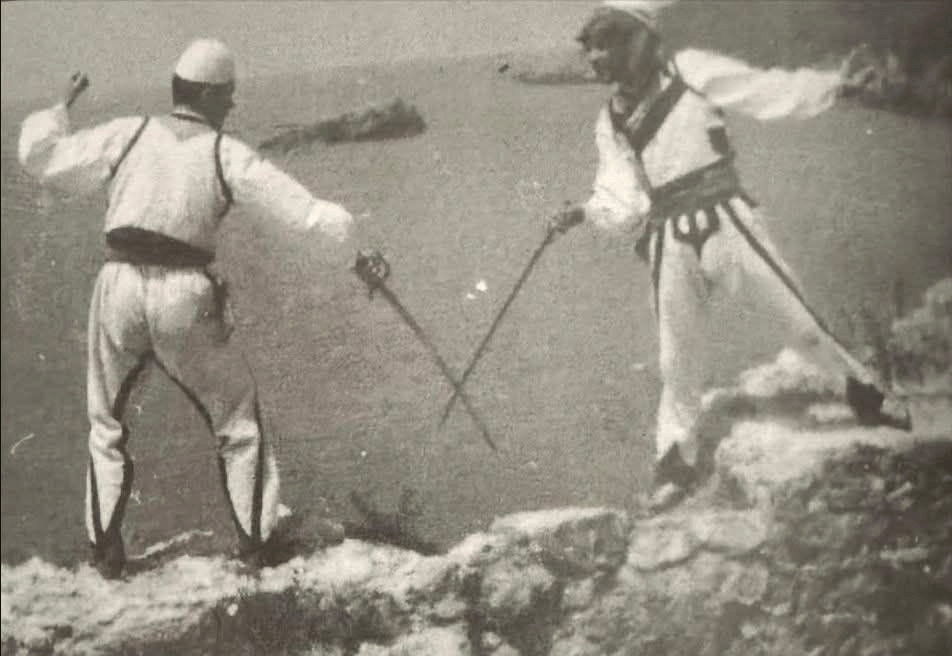

Albanian existentialism is not a school of philosophy written in treatises. It is a lived stance, forged in the highlands of Illyria, carried in the plis, the rifle, and the unyielding refusal to kneel. Where neighboring peoples built empires of stone churches, hierarchical patriarchates, and theocratic legitimacy, Albanians cultivated a different mode of being: free, pagan in spirit, centered on the individual and the mountain, answerable only to an immanent God who needs neither incense nor hierarchy.
Centuries of Orthodox Pressure Without Imperial Ambition
Albanians never constructed expansive imperial projects in the manner of medieval Serbian or Byzantine Greek states. They did not field large armies of conquest aimed at absorbing and converting neighboring populations into a sacralized Orthodox order. Instead, they endured sustained pressure from those who did.
From the medieval Serbian Empires and the lingering Byzantine ecclesiastical networks, Orthodox institutions sought to impose hierarchical Christianity—complete with bishops, monasteries, and the demand for submission—upon the highland tribes of what is now Albania and surrounding Illyrian lands.
This was not mere cultural exchange; it was an attempt at spiritual and political domination that treated the mountain peoples as raw material for conversion and control. Albanians, lacking the imperial machinery of tsars or basileis, met this pressure with endurance rather than reciprocal conquest.
A Different Way of Life
Serbian and Greek societies, especially in their medieval and early modern forms, oriented themselves around Orthodox culture: the liturgy, the monk, the church as the center of communal identity, and the patriarch as a quasi-political authority. Life was measured by feast days, monastic discipline, and loyalty to an ecclesiastical hierarchy that often intertwined with secular power.
Albanian highland society operated on another rhythm. Clan, besa (the sacred word), the pasture, and the seasonal movement of flocks structured existence. Authority was local, personal, and contingent; it did not flow downward from a distant patriarch or a sacralized monarch. The Albanian did not need the monastery as the axis of meaning because meaning was already present in the daily negotiation with nature, kin, and the code of honor.
Free Pagans and the Plis as Symbol
The white plis (qeleshe) is more than headgear. In the existential reading, it marks the free pagan who never fully surrendered the older Illyrian substrate. While Serbian and Greek imperial projects, in their colonial phases over Illyrian territories, relied on systems of subordination—whether through serfdom, military colonization, or ecclesiastical coercion—the Albanian highlander remained outside that logic. He was not a subject waiting to be baptized into obedience. The plis stands for the head that stays upright, the man or woman who does not bow. Freedom here is not an abstract right granted by a ruler; it is the prior condition of the mountain life itself.
God as Fundamental Principle, Not Church Loyalty
Albanian religiosity, in this existential frame, treated God as a fundamental principle rather than a person requiring constant petition or institutional mediation. Prayer, in the formal Orthodox sense, and loyalty to a church hierarchy were secondary or even alien. God did not need the Albanian to perform rituals of submission; the Albanian did not need a priest to validate existence.
This stands in sharp contrast to the Greek-Serbian Orthodox heritage, where the church claimed to be the necessary vessel of salvation and the patriarch a living link to the divine order. For the Albanian, such mediation was suspect precisely because it demanded the bow.
The Mountainous Illyrian Pagan: God Within, No Recognition of External Rulers
The archetype is the highlander who carries God inside. Neither Sultan, nor Tsar, nor Roman (Byzantine) ruler is recognized as possessing ultimate claim over the person. External sovereignty stops at the threshold of the self and the clan. This is not modern individualism; it is an older, harder existential assertion: the person is already complete in relation to the divine principle and the landscape. Subjection to an emperor or a patriarch would be a self-betrayal.
Nature Against the Patriarch
Where Greco-Serb culture centered the Patriarchs of Orthodoxy as the visible face of the sacred order, the Albanian orientation remained closer to nature—pastures, sheep, the cycle of seasons, the stone of the mountains. The institutional God of the patriarchate was experienced as a false God precisely because it required bowing. The Albanian does not bow. The sacred is encountered in the living world that sustains the shepherd, not in the hierarchical apparatus that claims to mediate it.
The Impossibility of Slavery
At the core of this stance is a simple, absolute claim: the Albanian could never become a slave to anyone. This is not a historical absolute (no people is free of all forms of coercion), but an existential self-understanding. To accept the status of slave—whether to an empire, a church, or a foreign despot—would be to cease being Albanian in the deepest sense. Survival itself was framed as the preservation of that refusal.
The Shepherd Archetype
Carl Jung spoke of archetypes that predate particular cultures and return in the collective psyche. The shepherd is among the oldest: the solitary or small-group figure who moves with the flocks, reads the land, and stands outside the walled city and its temples. Albanian highland life preserved this archetype with unusual continuity. Greek and Slavic (Serbian) despots repeatedly attempted to break the pagan shepherd tribes, to fold them into Orthodox structures and sedentary, hierarchical societies.
They failed to eradicate the pattern because the shepherd archetype is not a late invention; it is one of the primary forms through which human civilization first organized itself in relation to animals, landscape, and freedom of movement. The imperial Orthodox projects never fully grasped that they were contending with something older and more resilient than their own institutions.
The Sole Anti-Imperialist Stance and Its Consequence
In the Balkan context, the Albanian position emerges as the consistent anti-imperialist one: neither building empires nor accepting the spiritual-political claims of those who did. This refusal is interpreted, within the existential frame, as carrying a form of divine salvation—not the salvation promised by any church, but the salvation of remaining unowned. By declining both the role of conqueror and the role of the conquered soul, the Albanian shepherd preserved a mode of being that imperial Orthodoxy could pressure but never fully extinguish.
This is the outline of Albanian existentialism as a lived philosophy: freedom as prior condition, God as immanent principle rather than hierarchical demand, the shepherd as enduring archetype, and the mountain as the place where no Tsar, Sultan, or Patriarch holds final authority. It is not a claim of historical innocence or uninterrupted purity. It is a reading of a particular people’s refusal to dissolve into the sacral empires that surrounded them.

