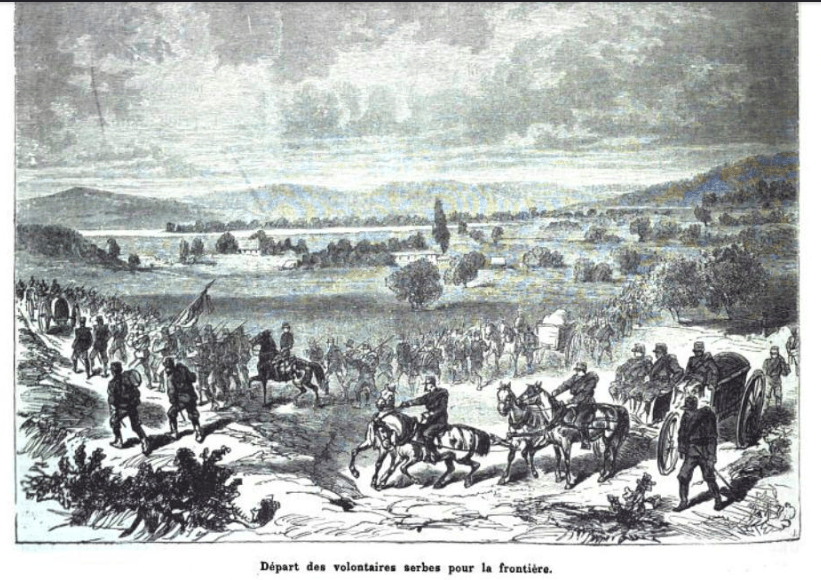

In the summer of 1876, as Serbia and Montenegro declared war on the Ottoman Empire in what became known as the Serbian–Turkish War, a contemporary report from Belgrade captured a striking detail. A correspondent noted that Russian reinforcements brought with them an unexpected element:
“Regarding the war, a correspondent reports from Belgrade (dated the 4th) that the Russian reinforcements introduce a novel element: many priests and monks are arriving alongside the Russian soldiers, intending to serve either as chaplains or as volunteers. This development is also spurring on Serbian monasteries, whose inhabitants are likewise enlisting in Chernayev’s army; almost all the monasteries have emptied, and the monks now stand in the ranks facing the enemy.”
This observation, published in the Südostdeutsche Tageszeitung, points to a notable feature of the conflict: the active participation of Orthodox clergy and monastics in a war framed by many participants as a struggle for the liberation of fellow Orthodox Slavs from Ottoman rule.
Backgound
The year 1876 fell in the middle of the Great Eastern Crisis (1875–1878). Uprisings in Herzegovina and Bosnia against Ottoman authority had escalated, drawing in Serbia and Montenegro. Thousands of Russian volunteers crossed into Serbia, many organized through Slavic Charitable Committees and inspired by pan-Slavic ideology.
Retired Russian general Mikhail Chernyayev assumed a leading role in the Serbian forces. Although the Russian government under Tsar Alexander II did not officially declare war until 1877, popular enthusiasm in Russia—fueled by newspapers, public collections, and Slavophile circles—produced a substantial volunteer movement.
The conflict was widely presented in Orthodox and Slavic circles as more than a conventional war of national liberation. It was described as a defense of Orthodoxy and Slavic kinship against what was portrayed as Muslim domination. Church services in Russia included prayers for Serbian and Montenegrin victory. Funds were collected through ecclesiastical channels, and the cause was linked to the broader “Eastern Question” of the declining Ottoman Empire’s Christian populations.
Clergy and Monks in the army
The Belgrade report highlights two overlapping roles. Some priests and monks arrived to serve as military chaplains, performing traditional functions: celebrating liturgies, hearing confessions, comforting the wounded, and burying the dead. Others, according to the correspondent, came as volunteers prepared to take their place in the fighting line.
Serbian monasteries reportedly emptied as monks joined Chernyayev’s forces. While exact numbers of clerical combatants are difficult to verify from surviving records, the contemporary account indicates that the phenomenon was visible enough to attract notice and was seen as energizing local monastic communities.
This was not entirely without precedent in Orthodox military tradition. Military clergy had long accompanied Russian armies. In the subsequent Russo-Turkish War of 1877–1878, regimental priests played documented roles that sometimes extended beyond spiritual care; accounts describe priests leading or encouraging troops under fire while carrying crosses rather than weapons. The 1876 volunteer episode in Serbia appears as an early, more informal expression of the same impulse, driven by popular pan-Slavic and religious sentiment rather than official state mobilization.
“Holy War” rhetoric vs. Christian teachings on peace
The involvement of monks and priests raised an inherent tension. Christianity, including Orthodoxy, contains strong currents of peacemaking, non-retaliation, and the ideal of the peaceful monastic life. The Sermon on the Mount, the tradition of non-resistance in certain patristic writings, and the monastic vocation of withdrawal from worldly conflict stand in contrast to armed struggle. Yet Orthodox history also contains repeated instances in which wars against non-Christian or “heterodox” powers were framed and rationalized in sacral terms.
In 1876 the language of liberation of Orthodox brethren, resistance to Ottoman rule, and Slavic solidarity provided a ready theological and cultural justification. For many participants the cause was experienced as a righteous struggle rather than ordinary politics. The emptying of monasteries and the presence of priests among the volunteers illustrate how readily religious institutions and personnel could be drawn into this framing.
Wider significance
The episode of 1876 prefigured patterns that reappeared in later Balkan conflicts and in the full-scale Russo-Turkish War that followed. It demonstrated the capacity of pan-Slavic and Orthodox networks to mobilize not only soldiers and money but also clergy and monastics. It also revealed the malleability of religious ideals under the pressure of perceived existential threats to the community of faith and ethnicity.
The Belgrade correspondent’s brief report remains a vivid primary-source indication that, in the heat of 1876, significant numbers of Orthodox priests and monks crossed from the realm of prayer and cloister into the ranks facing Ottoman forces—whether as chaplains or as volunteers. In doing so they embodied a form of sacralized Slavic militarism that sat uneasily alongside Christianity’s teachings of peace, yet proved powerful in its historical moment.

