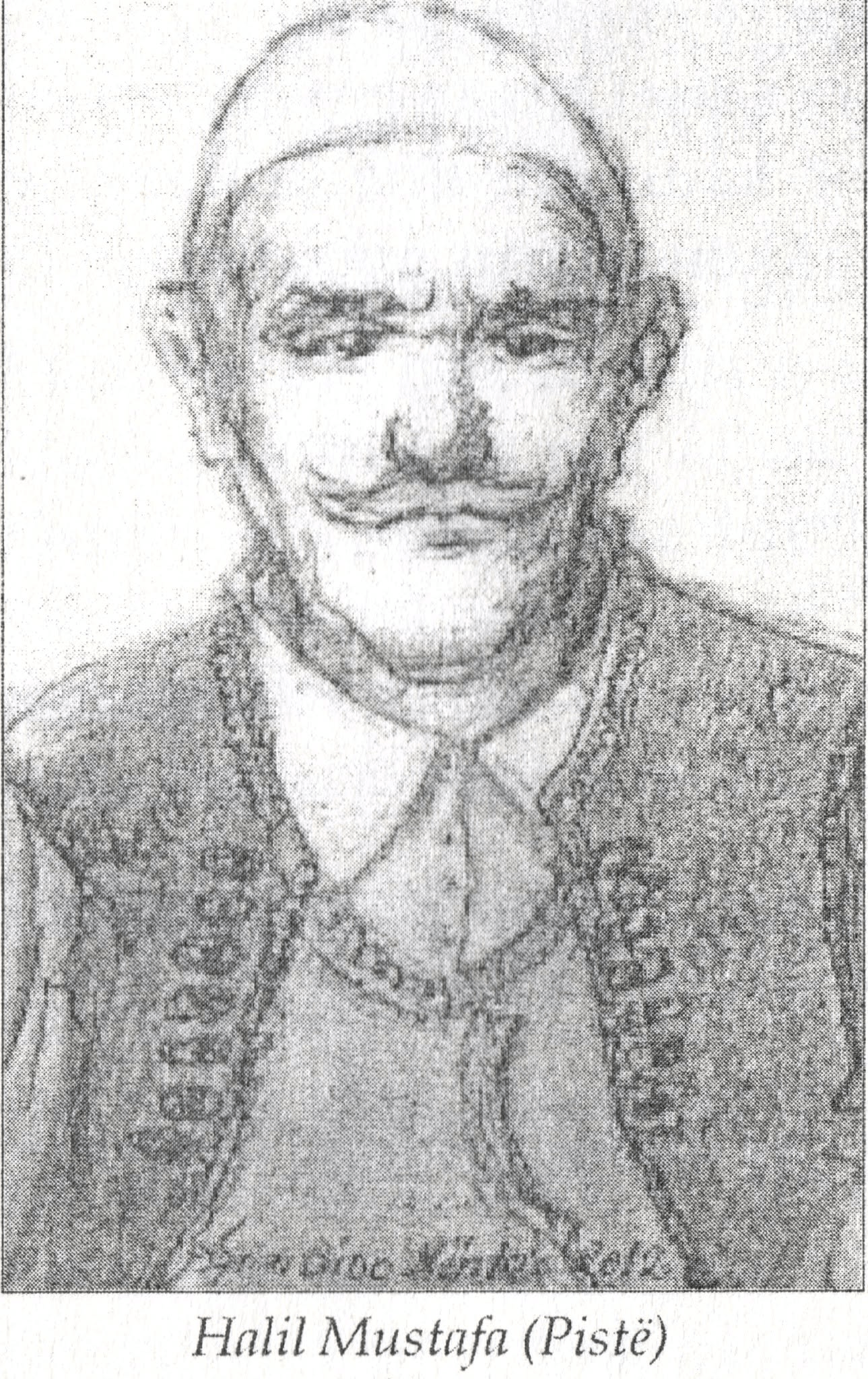

“Halili was born in Pistë, Malziu. His father’s name was Mustafa and his mother’s name was Zarife. His family was a clerical family with patriotic leanings. Halili also had three brothers: Ymer, Maliqi and Hysen. Ymer and Maliqi were educated to be Muslim clerics, while Hysen was engaged in agriculture and livestock farming.
Halil was mobilized three times in the Ottoman army. According to his son, Rahman, he served once for 12 months, once for 6 months and once for 6 weeks as a dummy. During his service he was also an artilleryman. He was married to Hava Arife, from the Haxhi Fetahu district of Spas. Her brother, Ismail Arifi, fought and fell in November 1912 against Serbian forces.
When the Serbian army entered Malzi, in mid-November 1912, the inhabitants of the region organized themselves for resistance. Armed groups and detachments were created in the villages. One of these detachments was led by Halil Mustafa, who collaborated with well-known Malzi leaders and fighters, including Bislim Bajraktari, Beq Hoxha, Sali Aga, Tahir Aga, Ymer Mustafa, Maliq Mustafa, Hysen Mustafa, Sadik Rama, Rexhep Isemi, Rustem Uka, Zymen Velia, Ismail Arifi, Haxhi Fetahu, Rustem Bajrami, Isen Hoxha, Ramadan Sadiku, Dërvish Ramadani, Bajram Doçi, Ali Idrizi, Selman Gjana, Selman Mehmeti, Tahir Sinani, Bajram Jashari, Mustafa Shpata, Sheqer Mula, Syl Tahiri, Sadik Alia, Idriz Zeqa, Avdi Rexha and others.
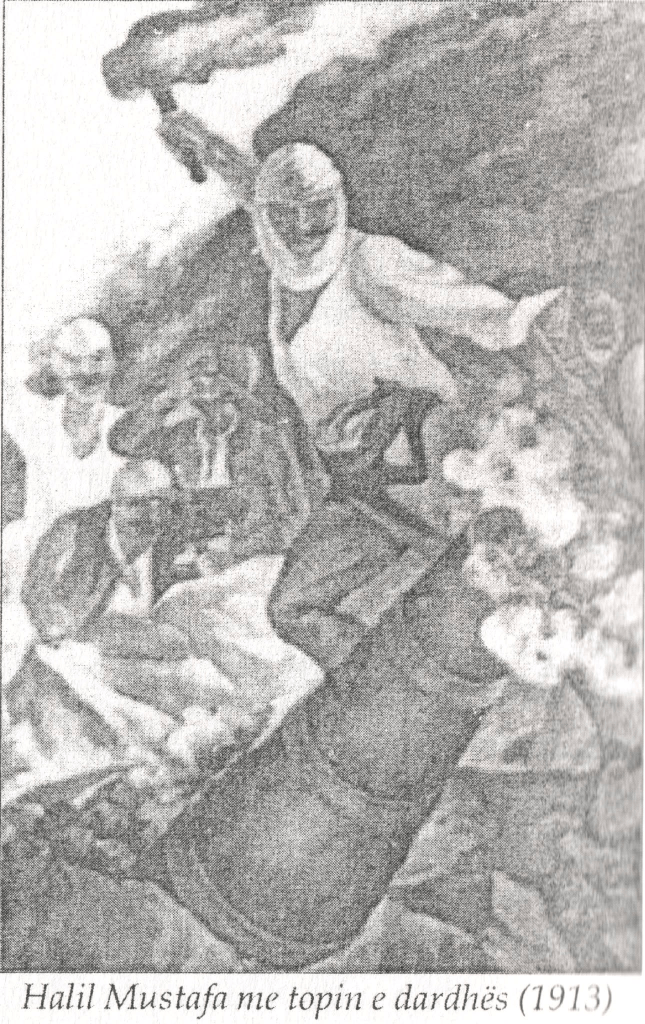
Malziu also contacted the Bajrakis of Thaçi and Puka to coordinate resistance and mutual assistance. One of the main problems was the lack of weapons, especially rifles. To counter the Serbian forces, who had set up outposts throughout the province, it was thought to build a cannon made of pear wood.
For the ball, a pear tree trunk about 1.2 meters long was cut, which was split and hollowed out in the middle. The two parts were fastened with 12 iron rings made in the blacksmith shop of Preng Kovaç, who came from Kryeziu. The iron rod had been brought from Mati with three mules by Bajram Jashari from Mgulla, while pieces of iron and steel cut in the blacksmith shop were placed in the middle of the iron rod.
According to the testimony of Mane Kovaç, the blacksmith’s wife, the pear cannon, after being prepared, was carried on the shoulders of 19 men to the Pistë and placed on the Kuçali Peak, while according to Mane Kovaç in Qafë i Kamthit. Under the direction of Halil Mustafa, the cannon was fired three times during the fighting against the Serbs. The cannon exploded on the last shot.
The people sang songs to this event:
Halil Mustafa, burr’ drague,
The pear ball is finished.
The people of Pista are doing the gairets,
He fought with his own cannon.
For his activity and struggle, Halil Mustafa, guerrilla commander and martyr, was posthumously decorated by the President of the Republic, Sali Berisha, with the Order for Patriotic Activity, first class, in 1992.
Source
Prof. as. dr. Shefqet Hoxha, Malziu (Historical-ethnological-folkloric-linguistic discoveries), p.227–229.

