
Abstract
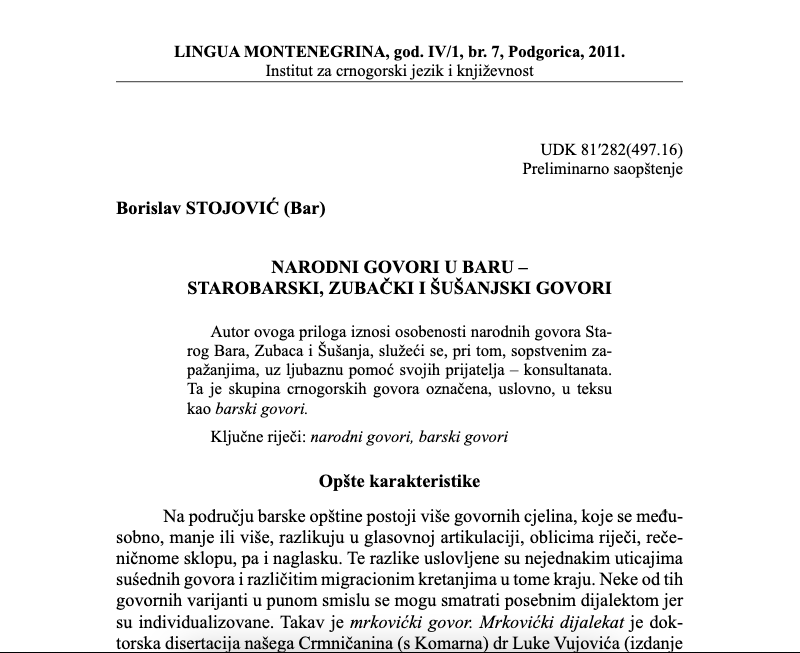
The dialects of Tivari (Bar), Stari Bar, Zupci, Šušanj (Shushanjë), Spič, and particularly Mrkovići constitute an important linguistic zone for the study of Albanian–South Slavic contact in the western Balkans. Borislav Stojović’s study of the Tivari (Antivari) dialects identifies substantial internal differentiation in phonology, morphology, vocabulary, and accentuation and explicitly attributes several phonetic characteristics to Albanian influence. These observations become particularly significant when considered together with Ottoman-period anthroponymy, historical settlement patterns, and modern research on bilingualism in the Tivar–Ulqin region.
This study proposes that some of the unusual characteristics of the southern Montenegrin dialects can be interpreted not merely as superficial Albanian borrowings into an originally Slavic population, but also as possible substratal effects produced by the gradual Slavicization of populations that had previously spoken Albanian or lived in sustained Albanian-speaking environments. Such a process would explain why Albanian influence is visible in phonology and grammatical structure even where Albanian vocabulary has subsequently disappeared.
The argument does not require assuming that every inhabitant of historical Tivar (Antivari) was Albanian, nor that every local place-name has an Albanian etymology.
Rather, the evidence suggests a historically multilingual frontier in which populations, languages, and identities overlapped for centuries. In such circumstances, linguistic assimilation does not necessarily erase the structural traces of the earlier language. The Tivar dialects may therefore preserve a linguistic palimpsest: a Slavic linguistic surface containing older Albanian contact and, in certain localities, potentially Albanian substratal features.
1. Tivari as a Linguistic Frontier
The Tivari region occupies an unusually important geographical position. It lies between the Montenegrin interior, the Adriatic coast, the Lake SHkodër basin, northern Albania, and the Ulqin area. This geography made Tivari not merely a political frontier but a linguistic contact zone.
Stojović emphasizes that the municipality contains several distinct speech varieties whose differences concern pronunciation, word formation, sentence structure, and accentuation. He attributes this diversity partly to migration and to unequal influence from neighbouring dialects. He also treats Mrkovići as sufficiently differentiated to constitute a dialect in its own right.
This observation is important methodologically. If the Tivar dialects were simply branches of a homogeneous Montenegrin linguistic system, their differences would be expected to correspond primarily to ordinary geographic variation. Instead, Stojović describes a mosaic in which different historical populations have left different linguistic signatures.
The historical population movements following the invasion of Tivari into Montenegro in 1878 further complicated this situation. Stojović notes that Stari Bar received settlers from different parts of Montenegro after the Ottoman period, producing a mixture of dialectal characteristics. This means that the modern dialect cannot automatically be projected backwards into the medieval or early Ottoman period.
Consequently, the linguistic historian must distinguish between:
- the pre-Slavic or non-Slavic substrate;
- the Albanian linguistic layer;
- the subsequent South Slavic linguistic expansion;
- Ottoman-period Turkish and other lexical influences;
- later Montenegrin, Croatian, Italian, and other influences; and
- post-1878 internal migration.
This layered model is more useful than treating present-day speech as a direct reflection of medieval ethnic identity.
2. The Crucial Evidence: Albanian Influence on the Sound System
The most important part of Stojović’s article is arguably not its vocabulary but its discussion of phonetics. Stojović explicitly states that: “The influence of the Albanian language is noticeable in the phonetic system of the Bar (Tivar) folk languages.” He then identifies particular changes involving l/lj and the palatalization or softening of consonants.
This is significant because phonological interference is fundamentally different from simply borrowing words. A community can borrow a handful of Albanian nouns without undergoing profound linguistic contact. But when speakers reproduce the articulatory characteristics of another language inside their inherited vocabulary, the situation becomes much more interesting.
In other words:
Albanian = bilingual population = Slavic language acquisition = Albanian articulatory habits retained = localized Slavic dialect
is a plausible mechanism.
This is precisely the kind of phenomenon documented by contemporary
contact linguistics. Morozova’s study of Mrkovići identifies innovations involving the distribution of the Slavic lateral consonants l and lj, and explicitly connects these developments with Northwestern Gheg Albanian. She argues that such changes may have arisen through Albanian–Slavic bilingualism and language contact in the region. This provides an important independent confirmation of Stojović’s observation.
3. From Borrowing to Substrate: An Important Distinction
There are two possible explanations for Albanian characteristics in the Bar (Tivari) dialects.
Model A: Borrowing:
An originally Illyrian population, but slavicized, comes into contact with Albanians. It learns Albanian words and perhaps adopts a few Albanian phonetic characteristics. The underlying population remains essentially Slavic.
Model B: Language shift (Most probable)
A historically Albanian-speaking population gradually abandons Albanian and adopts a South Slavic language.
However, during this process, speakers retain:
- Albanian articulatory habits;
- phonological distinctions;
- syntactic patterns;
- semantic structures;
- family terminology;
- place-names;
- personal-name patterns;
- and bilingual pronunciation.
The resulting language is therefore Slavic in grammatical identity but partly Albanian in its historical formation. The second model is particularly important for the Tivari region. It provides an explanation for why some features occur not merely as isolated loanwords but as structural characteristics of the local dialect.
Modern research on Mrkovići explicitly discusses both borrowing and imposition—the latter referring to features transferred from a speaker’s dominant first language into a language acquired later. Morozova concludes that the historical social conditions of the Mrkovići region were favourable to precisely these processes.
4. The Mrkovići Evidence
Mrkovići provides perhaps the clearest case study. The Ottoman documentation is particularly valuable because it provides evidence from before the modern national categories of the region had fully developed.
Research on the 15th- and 16th-century Ottoman records shows that the Mrkovići community contained both Slavic and Albanian elements. The 1485 material contains predominantly Slavic Christian names but also identifiable Albanian names. Particularly important are names such as Dabza, Nuliçi, Bukmir, and Lekëza. The Albanian diminutive suffix -z(ë) is also found in the material. This is crucial.
The evidence does not support a simplistic statement such as: “The Mrkovići were entirely Albanian.” Nor does it support the opposite assumption: “The Mrkovići were originally entirely Slavic and merely borrowed some Albanian vocabulary.” Instead, the documentary material points towards a mixed and multilingual population.
That is precisely the environment in which language shift can occur. Morozova notes that the Albanian element probably existed in the Mrkovići community at least from the beginning of the Ottoman period and that Albanians subsequently became assimilated and intermingled with Slavic speakers. A later study likewise identifies an Albanian element throughout the Mrkovići region in the 15th century and suggests that the bilingual situation documented in Velja Gorana may represent a continuation of an older regional pattern.
5. The Importance of the Albanian Suffix -z(ë)
The onomastic evidence deserves particular attention. Morozova cites earlier research noting the Albanian suffix -z(ë) in place-names and personal names in areas of historical Albanian–Slavic contact, including the regions of Piperi, Kuči, Zeta, Krajina, and Mrkovići. Examples from Mrkovići include Dabezići, as well as personal names/patronymics such as Nikezić and Kalezić. This is important because surnames and village names can preserve historical linguistic structures after the language that created them has disappeared.
A population does not have to continue speaking Albanian for an Albanian morphological element to survive. The chronological sequence may therefore be: Albanian personal name = bilingual community = Slavicization = Slavic grammatical ending added = fossilized hybrid surname Such forms should not automatically be classified as either purely “Albanian” or purely “Slavic.” They may instead represent contact formations. This is one of the strongest reasons to treat onomastics and dialectology together.
6. Toponymy as a Linguistic Palimpsest
The same principle applies to place-names. A modern Slavic-looking toponym cannot automatically be assumed to have been created by Slavic speakers.
A place-name can undergo:
- phonological adaptation;
- morphological reinterpretation;
- translation;
- Slavic suffixation;
- semantic reinterpretation;
- orthographic normalization;
- and popular etymology.
The original form can therefore disappear beneath successive linguistic layers. The Tivari (Bar) region is particularly suitable for this type of investigation because medieval and early modern documentation preserves several different linguistic forms of local names.
Stojović notes, for example, the historical attestations of Zupci/Zubor and Šušanj/Sušica, while relating these settlements to Venetian and Ottoman-era documentation. These examples should not automatically be declared Albanian. That would exceed the evidence. Instead, they illustrate the methodological problem:
A modern South Slavic form represents the endpoint of a historical process, not necessarily the linguistic origin of the name. Every important Tivar (Bar) toponym should therefore be investigated through its earliest attested form, rather than through its modern spelling.
7. Stari Bar and the Catholic Albanian Layer
Stari Bar is especially interesting because Stojović identifies a distinct Catholic variety, which he calls the Gretva variety. He observes differences in pronunciation and vocabulary and specifically notes that the Catholic population retained more Croatian vocabulary, partly through ecclesiastical usage and the language of the Catholic liturgy.
This should not be interpreted as evidence that the Catholics were necessarily Croatian in origin. Religious vocabulary can enter a language through liturgy without reflecting the ethnic origin of its speakers. Indeed, the historical Tivari region was a Catholic ecclesiastical centre for centuries. Antivari was the seat of an archbishopric, and the city existed within a multilingual Adriatic environment involving Romance, Slavic and Albanian-speaking populations..
Thus, the Catholic speech of Stari Bar (Tivari) potentially represents another layer in the linguistic palimpsest: Albanian substrate + Romance ecclesiastical influence + Slavicization + Catholic Croatian/Italian liturgical vocabulary. Such a combination is exactly what one would expect from an Adriatic frontier society.
8. Albanian Influence Is Not Restricted to Vocabulary
One of the most important conclusions of the material is that Albanian influence cannot be reduced to lexical borrowing.
The evidence potentially operates on at least four levels:
| Level | Possible Albanian contribution |
| Phonology | l/lj distribution, lateral articulation and other consonantal features |
| Morphosyntax | structural patterns and grammatical constructions |
| Lexicon | Albanian loanwords and shared contact vocabulary |
| Onomastics | personal names, suffixes and place-names |
Morozova specifically identifies structural influence from Northwestern Gheg Albanian in Mrkovići, including phonological and syntactic phenomena. This is theoretically important. If Albanian influence occurs simultaneously at several linguistic levels, the explanation of simple “borrowing from neighbouring Albanians” becomes less satisfactory. A history of prolonged bilingualism and language shift becomes a more powerful explanatory model.
9. The Kuči Connection
Stojović makes another significant observation: he connects some of the Albanian-influenced phonetic characteristics of Stari Bar with Kuči. He describes the relevant phonetic phenomenon as having been transferred from Kuči, where a similar Albanian influence was present. This also is important because it broadens the geographical picture.
The Albanian linguistic influence should not be imagined as a narrow line running directly from modern Albania into Tivari. Rather, the historical zone appears to have consisted of interconnected contact communities extending through: Northern Albania = Krajina = Kuči = Zeta = Mrkovići =Tivari = Ulqin.
This corresponds closely with the wider contact zone identified by historical and contemporary contact linguistics. Modern scholarship explicitly treats southern Montenegro as an important region of Albanian–Slavic symbiosis and identifies Mrkovići as one of the principal areas in which contact-induced changes can be observed.
10. Slavicization Rather Than Simple Migration
This leads to the central historical interpretation. The linguistic evidence is compatible with a process in which populations did not necessarily disappear and get replaced, but instead changed language. This distinction is fundamental. Suppose Population A speaks Albanian. Population B speaks a South Slavic dialect. Over several generations:
- intermarriage increases;
- bilingualism develops;
- Slavic becomes economically or politically advantageous;
- Albanian gradually retreats;
- children increasingly acquire Slavic as their principal language;
- older Albanian phonetic habits remain;
- Albanian names survive;
- Albanian place-names are adapted into Slavic;
- Albanian vocabulary declines;
- eventually the community becomes Slavic-speaking.
After several centuries, an observer encounters a population speaking a recognizably South Slavic dialect. But the dialect is not necessarily the same language that would have developed had its speakers been Slavic-speaking from the beginning. This is the concept of a substratum. The historical population has changed language, but its former language continues to influence the new one.
11. Why Dialectal Irregularity Matters
This perspective also changes how dialectal irregularities should be interpreted. Features that appear geographically isolated or difficult to explain through ordinary Montenegrin dialect geography may represent the residue of earlier contact. Stojović’s own description is revealing: the Tivari speech varieties differ considerably even over relatively small distances. This is precisely what one expects in a region where different communities underwent language shift at different speeds.
One village may have retained Albanian longer, another may have become bilingual, another may have shifted completely into Slavic while another may have received later settlers from Montenegro.
The resulting dialect geography would consequently be patchy rather than linear. This may explain why Stari Bar, Zupci, Šušanj, Spič and Mrkovići cannot simply be treated as interchangeable varieties.
12. The 1878 Turning Point
The year 1878 is particularly important. Stojović explicitly emphasizes the influx of Montenegrin settlers into Stari Bar after liberation from Ottoman rule. This means that the modern speech of Stari Bar is potentially less representative of its earlier population than the dialect of some surrounding communities.
The chronology therefore matters: pre-Ottoman population = Ottoman multilingualism = gradual Slavicization = 19th-century demographic transformations = Montenegrin settlement → modern dialect leveling
The final stage can obscure the earlier ones. Consequently, modern dialect surveys should not be used uncritically to reconstruct medieval ethnicity. Instead, they should be combined with Ottoman defters, Venetian records, ecclesiastical records, medieval charters early travel accounts historical maps, personal names, place-names, dialectological studies and archaeological evidence.
13. The Mrkovići Case as a Model
The Mrkovići evidence is particularly valuable because several independent forms of evidence converge:
Historical evidence
Mrkovići is documented as a distinct community by the 15th century.
Onomastic evidence
Ottoman records contain both Slavic and Albanian personal names.
Morphological evidence
Albanian suffixes appear in personal and place-names.
Linguistic evidence
The dialect contains phonological and structural features associated with Northwestern Gheg Albanian.
Sociolinguistic evidence
Modern fieldwork documents bilingualism, mixed marriages and continuing Albanian–Slavic contact in the wider area.
Historical continuity
The Albanian element is documented in the region long before the modern national identities of Montenegro and Albania acquired their present forms. Taken together, these facts make historical Albanian–Slavic bilingualism and subsequent language shift a much stronger explanatory framework than a model based exclusively on recent Albanian immigration into an otherwise linguistically homogeneous Slavic population.
14. What Can and Cannot Be Reconstructed
There is, however, an important methodological limitation. The evidence does not permit us to reconstruct every medieval inhabitant of Tivari as Albanian. Nor can every unusual Montenegrin word be “de-Slavized” into Albanian. Such an approach would risk circular reasoning: unusual Slavic form = presumed Albanian origin = therefore Albanian population = therefore unusual form is Albanian.
That is not sufficient. A convincing reconstruction requires several independent indicators. The strongest cases are those where toponymy + anthroponymy + phonology + historical documentation + geographical distribution converge. The weaker cases should remain classified as possible rather than certain. This distinction is particularly important in the Tivari region because Albanian, South Slavic, Romance and Ottoman Turkish have all influenced the linguistic landscape.
15. A Revised Model of the Tivar Linguistic Landscape
The evidence therefore permits the following historical model:
Layer I — Pre-Slavic / Paleo-Balkan
An older population landscape predating medieval Slavic expansion.
Layer II — Albanian
The emergence and consolidation of Albanian-speaking communities in the wider northern Albanian–southern Montenegrin zone.
Layer III — South Slavic expansion
Increasing South Slavic political, demographic and linguistic influence.
Layer IV — Bilingual frontier
Communities such as Mrkovići develop sustained Albanian–Slavic contact.
Layer V — Language shift
Some Albanian-speaking or mixed communities increasingly adopt Slavic.
Layer VI — Ottoman multilingualism
Albanian, Slavic, Turkish and Romance elements coexist.
Layer VII — Montenegrin consolidation
After 1878, migration from the Montenegrin interior accelerates dialect leveling and changes the demographic composition of Stari Bar and surrounding settlements.
Layer VIII — Modern linguistic erosion
Urbanization, schooling, migration and mass communication reduce the older dialect differences. The dialects documented by Stojović therefore represent not simply “Montenegrin dialects,” but the final visible surface of a much older multilingual contact zone.
16. The Significance of Stojović’s Evidence
Stojović’s work becomes particularly valuable when read retrospectively through modern contact linguistics. His observation that Albanian affected the pronunciation of the Tivari dialects is not an isolated antiquarian claim. Modern research on Mrkovići independently documents Albanian-induced phonological and syntactic changes.
This creates an important scholarly convergence:
Stojović’s dialectological observation = documented Albanian phonetic influence = modern contact-linguistic confirmation = Ottoman-period Albanian anthroponymy = evidence of bilingualism and mixed marriage = historical possibility of language shift The cumulative result is considerably more significant than any individual Albanian loanword.
17. Conclusion
The Tivari region should therefore be approached as a linguistic palimpsest rather than a linguistically homogeneous Montenegrin territory. The surviving Slavic dialects of Stari Bar, Zupci, Šušanj, Spič and especially Mrkovići contain features that cannot be adequately understood solely through the internal development of South Slavic.
Stojović explicitly identifies Albanian influence in the phonetic structure of the Tivar dialects, while later research demonstrates Albanian influence on the phonology, morphology, syntax and vocabulary of Mrkovići.
The Ottoman onomastic evidence adds another dimension: Albanian personal names and Albanian morphological elements existed alongside Slavic names in the historical population. The most productive interpretation is therefore not that “Montenegrins borrowed some Albanian words,” but that parts of the region experienced long-term Albanian–Slavic bilingualism, demographic intermixture and, in some communities, gradual language shift from Albanian toward Slavic.
Under such circumstances, the disappearance of Albanian as a spoken community language does not mean the disappearance of its linguistic influence. It may survive in those dialectal characteristics that later observers perceive as unusual within the broader Montenegrin linguistic system.
The Tivar dialects can consequently be understood as Slavic-speaking varieties shaped by a historically deeper Albanian contact environment, with Mrkovići providing the clearest documented case.
The broader proposition—that substantial parts of the Tivari hinterland were historically Albanian-speaking before becoming Slavic-speaking—remains a research hypothesis whose strength varies geographically, rather than a conclusion that can presently be demonstrated for every settlement. But the convergence of dialectology, onomastics, Ottoman documentation and modern contact linguistics makes the question legitimate and worthy of systematic investigation.
Bibliography
Čirgić, Adnan. “Luka Vujović kao proučavalac crnogorskih govora.” Arhivski zapisi 2 (2016).
Katić, Tatjana. “The Settlements of Mrkovićs – the Sons of Mrko in the Light of 16th-Century Tapu Tahrir Defters.” Miscellanea 45 (2024).
Morozova, Maria S. “Balanced Language Contact in Social Context: Velja Gorana in Southern Montenegro.” In Between Separation and Symbiosis: Southeastern European Languages and Cultures in Contact, edited by Andrey N. Sobolev, 89–134. Berlin and Boston: De Gruyter Mouton, 2021.
Morozova, Maria S. “Language Contact in Social Context: Kinship Terms and Kinship Relations of the Mrkovići in Southern Montenegro.” Journal of Language Contact 12, no. 2 (2019): 305–343.
Sobolev, Andrey N. “Albanian and Slavic Symbiosis through the Lens of the Balkan Contact Linguistics.” Shejzat – Pleiades 2020.
Stojović, Borislav. “Narodni govori u Baru – starobarski, zubački i šušanjski govori.” Lingua Montenegrina 4, no. 7 (2011).
Ylli, Xhelal. “Albanian and Slavic Contact.” Encyclopedia of Slavic Languages and Linguistics Online.

