

Luka Panetti of Ulqin, also known as “Ulcinjanina Luke Panettija”, “Luca Panetti (Panezio)”, “Lucam Panetium” or “Loukas Panaitios” was an author and humanist from Ulqin who lived in the 16th century. He was most likely of Albanian origin. Panetti explicitly referred to himself as Olchinensis ( “Olchiensis” or “Dulchinensis” meaning “Ulqinak), which was the customary way during the Renaissance to indicate one’s geographical and local origins. His Albanian name could have been “Lukë Pani” or “Lucë Pani”.
Cited:
“While public oratory was the dominant genre among East Adriatic philosophers in the 15th century, Sylvius’s work—as previously noted—reveals a clear focus on the individual. Within the scope of his intellectual inquiries, Sylvius drew upon both Cicero and Seneca. The choice of authors he references aligns with the editorial, publishing, and printing activities of his immediate compatriots: the canon and Doctor Artium et Legum Luka Panetti of Ulqin, and Damian di Santa Maria of Spič.”
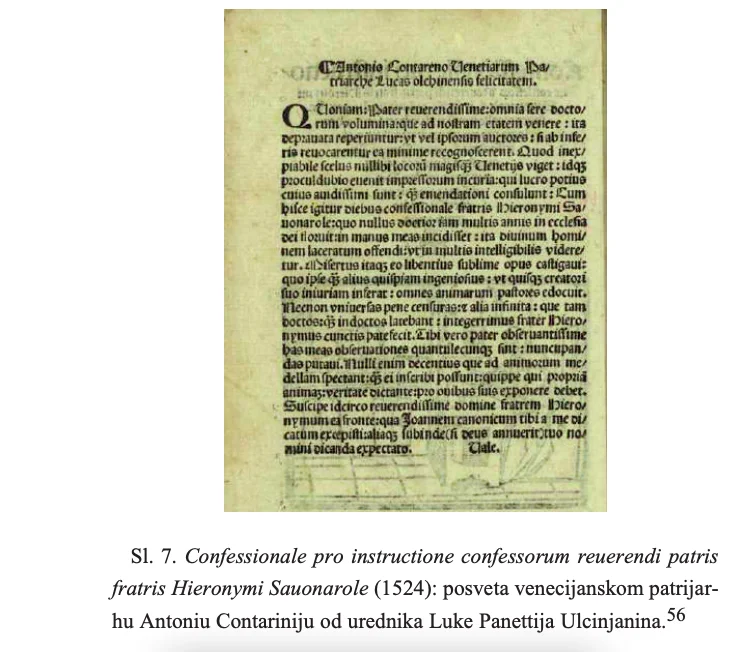
Fig. 7. Confessionale pro instructione confessorum reuerendi patris fratris Hieronymi Sauonarole (1524): dedication to the Venetian Patriarch Antonio Contarini by the editor, Luka Panetti of Ulqin.
Background
As a publisher, he is known to have appeared as early as 1501 (“Albertus Magnus De secretis mulierum cum commento. Nouissime: inifinitis pene erroribus emendatus. Tractatus Henrici de Saxonia, Alberti Magni discipuli…”); he published the Commentaries of Gaius Julius Caesar in 1511, and in 1516 Tusculanae quaestiones by the foremost Roman orator, Cicero, appeared, in whose colophon the errors and alterations that Lucas Olchinensis, “artium et legum professor,” had most accurately identified and made are indicated.
His legal education is also indicated by other legal treatises that he edited and published (civil-law and canon-law works), including the Novels of the canonist Giovanni d’Andrea (Venice, 1524), a compendium by Bartolomeo Cipolla of Verona (1535), and Repertorivm domini Philippi Decii, per Lucam Panetium Canonicum Olchinensesem artium & legum praeclarem doctorem fideliter concinnatum (Iacobus Giunta, Lyon, 1544).
Luka Ulcinjanin is also mentioned as the editor of Orlandini Rodulphini Bononiensis, … In artem notariae ordinatissimmæ summulæ. As a printer, Luca Olchiense appears in 1517/18. In Venice he published Fratris Hieronymi Sauonarolae Ferrariensis, Ordinis prædicatorum, Trumphus crucis, de fidei ueritate (“Impressumque Venetiis accurata diligentia per Lucam olchiense artium & legum professorem. Anno domini M.CCCCCXVII. Die uero octauo mensis Iunii.”).
Luka continued editing Savonarola’s works (delle lettere sacre professore, Luca Panetio canonico Olchinense: delle arte & lege minimo discipolo, 1524, 1528). Marci Actii Plauti linguae latinae principis: Comoediae viginti: viuis pene imaginibus recens excultae … the Ulcinj canon and student of the philologist Giorgio Valle (the initiator of Hellenistic influence on Renaissance medicine, who in 1485 took over the newly established humanist chair in Venice) prepared this work for printing in 1518.
The fact that Luka, in addition to Latin, was also familiar with Greek is suggested by his name in Greek transliteration: Loukas Panaitios. He edited and prepared for printing the works of the Florentine Neoplatonist Marsilio Ficino in 1518, and in 1524/25 the work Platonica theologia de immortalitate animorum, through which an attempt was made to revive Hermetic philosophy.
He edited for publication in 1523 the works of the Sienese philosopher and physician Hugo Bentius, based on the medical Canon of the Neoplatonist Avicenna, as well as an edition of Bentius’s Commentaries on the work of Galen. This was followed by Luka’s editorial work on Conciliator: eminentissii philosophi ac medici Petri Aponensis… – the writings of the “reconciler” of Western science and theology with the Arabic teachings of Peter d’Abano and others (1526), followed by Terrapeutica. Galeni Methodus medendi: vel de morbis curandis. Thoma Linacro Anglo interprete… – based on Galen’s physiology in the translation of Thomas Linacre (1527).
The literature states that Olchinensis also edited an edition of Virgil’s works dedicated to the humanist Marin Bečić; the letters of Ovid; the works of Valerius Maximus; those of John the Canonist; a 14th-century Aristotelian; the exposition of the Parisian professor and Thomist Johannes Versor on the logician Peter of Spain; the works of Livy; those of the English scholastic philosopher and logician Walter Burley, together with texts by Aristotle and the Neoplatonist Porphyry (1520); De philosophica consolatione and other works by Boethius (1523); the works of the theologian, philosopher, and logician Duns Scotus (1525); Giles on Aristotle’s final book (1530); as a bene docto philosopho, Commentaries on Aristotle’s Ethics by Thomas Aquinas (1539); expositions and commentaries on Aristotle’s books by the Italian philosopher Agostino Nifo; and works by other authors.”
Reference
Savo Marković, “Luca Panetti (Panezio) Ulcinjanin, zaboravljeni korifej izdavaštva epohe humanizma i renesanse,” Matica, Časopis za društvena pitanja, nauku i kulturu, Year XII, No. 48, Cetinje–Podgorica, Winter 2011, pp. 201–218.”
Source
CRNA GORA U EPOHI GEOPOLITIČKIH PROMJENA (1988–2018) Radenko Šćekić. “MATICA, br. 74, ljeto 2018”. https://maticacrnogorska.me/wp-content/uploads/2018/12/MATICA-br.-74-ljeto-2018.pdf

