
Abstract
The text is a 19th-century argument that Albanians are descendants of the ancient Illyrians and that the Albanian language is a surviving remnant of the language spoken by the Illyrians and, further back, by the Pelasgians. The author, S. Ljubić, cites several European historians and linguists, including Linhart, La Saye, Balbi, Cantù, Xylander, and especially Johann Georg von Hahn, in support of this view. Linhart is presented as arguing that the Skipetars, meaning Albanians, are descendants of the ancient Illyrians rather than Slavs. At the same time, the author claims that earlier Slavic historians in Slavonia, Croatia, and Dalmatia had incorrectly called the Slavs “Illyrians,” thereby giving the Slavic population, in his view, an undeserved claim to an ancient and prestigious ancestry.
A major part of the argument is linguistic. La Saye and Balbi are said to have regarded the ancient Illyrians as speakers of a language closely related to Albanian, and therefore to have regarded Albanian as a surviving remnant of the Pelasgian language. Xylander receives particular attention because he compared around 3,500 Albanian words with words from other languages. He considered roughly 1,800 of them to be foreign loanwords, including Turkish, Greek, Latin, German, and Slavic words. The author presents the remaining vocabulary as evidence for the great antiquity of Albanian and for its Indo-European character.
The article then turns to Johann Georg von Hahn, whose Albanesische Studien is presented as especially important. Hahn is quoted as arguing that the Albanians were neither Slavs nor closely related to any other known people and that, because there was no sufficiently large migration recorded in the available sources, the Albanians could be regarded as descendants of the pre-Slavic inhabitants of the region. He further argued that the Pelasgian population of Epirus, Macedonia, and Illyria had retained its ancestral language until Slavic migrations occurred, while in Albania the older population survived and absorbed or resisted the newcomers. For this reason, Hahn called the Albanians “Neo-Pelasgians.”
The author also cites G. P. Nisiteo, who compared the customs of the ancient Illyrians and Slavs, including funeral practices, marriage customs, the kolo dance, and religious practices. Because he considered these customs substantially different, Nisiteo concluded that the Illyrians and Slavs were distinct peoples and that the earliest population of the region was therefore not Slavic but Pelasgian, with Albanian representing the surviving Pelasgian language.
Finally, the text explains why Albanian disappeared from Dalmatia. It attributes this disappearance to the enormous losses caused by Roman wars, military recruitment, invasions, depopulation, and internal conflicts during the Roman and later imperial periods. The author argues that these catastrophes drastically reduced the ancient Illyrian population.
According to his interpretation, the small portion of the ancient Illyrian population that survived eventually remained among the Albanians, while other remnants were absorbed into later immigrant populations. Thus, the overall thesis of the article is that the Albanians preserve the surviving population and linguistic heritage of the ancient Illyrians/Pelasgians, whereas the Slavic population arrived later and replaced or absorbed much of the earlier population in parts of the Balkans.
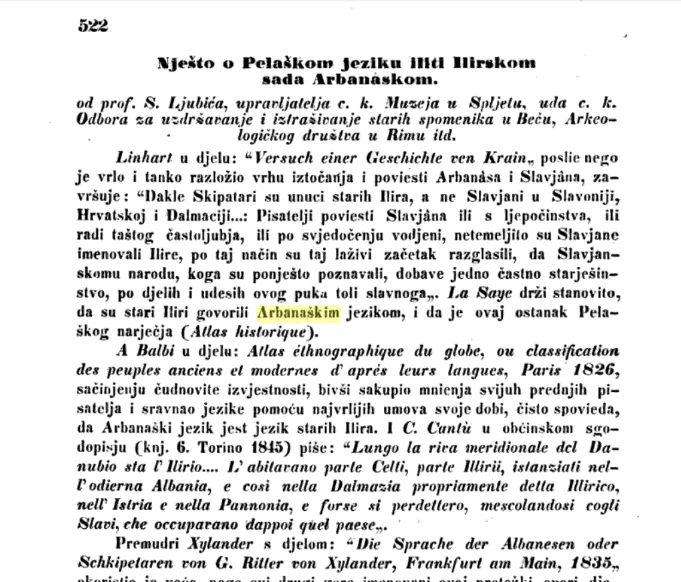
By Prof. S. Ljubić, director of the Imperial-Royal Museum in Split, member of the Imperial-Royal Committee for the Preservation and Investigation of Ancient Monuments in Vienna, of the Archaeological Society in Rome, etc.
Linhart, in his work Versuch einer Geschichte von Krain, after he had very carefully examined the origin and history of the Albanians and Slavs, concludes:
“Therefore, the Skipetars are the descendants of the ancient Illyrians, and not Slavs.”
In Slavonia, Croatia, and Dalmatia, writers of Slavic history, either out of flattery, or from vain ambition for honor, or because they were led astray by testimony, improperly called the Slavs “Illyrians.” In this way they spread the false idea that they could give the Slavic people, whom they knew to some extent, an honorable antiquity through the deeds and fortunes of this people, so renowned.
La Saye holds it certain that the ancient Illyrians spoke the Albanian language, and that this is a surviving remnant of the Pelasgian dialect.
Balbi, in his work Atlas ethnographique du globe ou classification des peuples anciens et modernes d’après leurs langues (Paris, 1826), having compiled the opinions of all the foremost writers and compared languages with the help of the greatest minds of his age, plainly declares that the Albanian language is the language of the ancient Illyrians.
C. Cantù likewise writes in his Universal History, Book 6 (Turin, 1845):
“Along the southern bank of the Danube lies Illyria. It was inhabited partly by Celts, partly by Illyrians, established in what is now Albania, and likewise in Dalmatia properly so called, in Illyria, in Istria, and in Pannonia; and perhaps they were lost by mixing with the Slavs who afterwards occupied that country.”
The learned Xylander, in his work Die Sprache der Albanesen oder Schkipetaren by G. Ritter von Xylander (Frankfurt am Main, 1835), made greater use than all the aforementioned writers of this exceedingly difficult and laborious field of native history.
At the end of the grammar mentioned above, he gives 48 pages in the form of an appendix, under the title Andeutungen über Verwandtschaft und Abstammung der albanesischen Sprache (“Observations on the Relationship and Descent of the Albanian Language”).
Here, after presenting the opinions of the most distinguished linguists, in order to show that the Albanians of today are descendants of the ancient Illyrians and that their language is actually the ancient Pelasgian, he says what he himself has learned from this.
He states that in the language of the Skipetars there are some words without any clear distinction [from other languages], and others whose roots and forms are now found in use in certain languages.
In addition, he produces 3,500 Albanian words, collected and compared by him in the manner of a lexicon, and compares them with equivalent words taken from various other languages.
Through such comparison he discovered that of those 3,500 words, almost 1,800 are foreign words. Of this number there are 190 Turkish, 400 Greek, 650 Latin, 500 German, and 60 Slavic words.
He further considers that those 1,800 words which remain unassigned, but which belong to the Indo-Germanic language family, would be reduced if the words belonging to the Basque and Chudic [Finnic/Uralic] dialects were also removed; and in this way, the great antiquity of the Skipetar speech would become still more firmly established.
Then, by a systematic etymological examination, he demonstrates the character of certain Albanian words by comparing them with corresponding German and Sanskrit words, selected from among the names of various things necessary to a person living in a primitive state of simplicity. He also draws conclusions from the similarities in the forms of writing among these languages.
From all this he concludes that Albanian is a branch of the Indo-Germanic [Indo-European] language family and therefore belongs to an ancient people.
Finally, he concludes that the Albanians of today are descendants of the ancient Illyrians, and, more generally, of the prehistoric Thracians.
Above all, we shall add the judgment of the most distinguished man who has recently devoted himself greatly to this subject and raised it to the highest degree of illumination: Dr. Johann Georg von Hahn, Albanesische Studien (Vienna, 1853).
He writes, after a long and profound examination of various linguistic and historical proofs:
“The Albanians are not Slavs and show no closer relationship with any other known people. Since the admittedly scanty sources, apart from the Slavic ones, report no immigration significant enough to have created a large people, one may assume that the Albanians of today are the descendants of the pre-Slavic original inhabitants of the country.”
— p. 213
A little later he adds:
“The northern relatives of these Pelasgians, who lived in Epirus, Macedonia, and Illyria, retained their ancestral idiom until the Bulgarians immigrated into Macedonia and the Serbs into Illyria, and whatever may have remained there of the Pelasgian remnants was linguistically absorbed into the immigrants. Albania, too, was overlaid by Serbs and Bulgarians; but here the old ethnic element succeeded in overcoming the immigrant element and surviving linguistically as well. According to this view, the Albanians deserve the name ‘Neo-Pelasgians.’”
— p. 224
In addition to the testimonies so far drawn from the books of the most renowned European linguists, who are particularly qualified to judge this subject, we must add the researches of our friend and countryman G. P. Nisiteo, who has taken great pains to clarify this aspect of our native history.
He carefully described the customs of the ancient Illyrians and Slavs and then compared them, in order by this means to determine the degree of their national relationship.
First, he considered separately their funeral observances, wedding customs, the kolo dance, forms of worship, and so forth, which were found in use among the Illyrians and Slavs, particularly according to Linhart’s work. Having compared them and found them to be greatly dissimilar, he concluded that the Illyrians and Slavs are entirely different peoples.
Therefore, he concluded that our earliest origin is not Slavic but rather Pelasgian, and that the Albanian language, being the sole surviving remnant of the Pelasgian language, was the first language spoken in this region.
Here is how this writer of ours expresses himself when he explains how the Albanian language disappeared from Dalmatia:
“If someone were to undertake to count the people killed during the time of the Roman wars—which, according to the testimony of the Roman historians, were more costly to Rome than all the Punic wars, and which brought almost complete devastation upon Illyria; if one were to set out the decline in population that occurred in Dalmatia when it was required to provide the Empire with 70,000 soldiers every year, who nevertheless went to fight far away, even as far as the Arab lands; if one were to take into account the number of people killed, many times numbering in the thousands, during the time of the Western and Eastern Empires by invading peoples who at times turned this state, disarmed and weakened, into a wasteland; and those who perished through the terrible internal rebellions caused by ruthless usurpers who, in their various attempts to attain the kingdom, repeatedly devastated these regions wherever their pride and ferocity spread; if our historians were to take the trouble to write the native history in this manner…”
“…the cause of the devastation of Illyria would easily be understood, and it would be seen that, after such calamities, whatever little remained of the ancient Illyrian population survived down to the present day among the Albanians, apart from those who merged with the more recent settlers.”
The End.“
Source
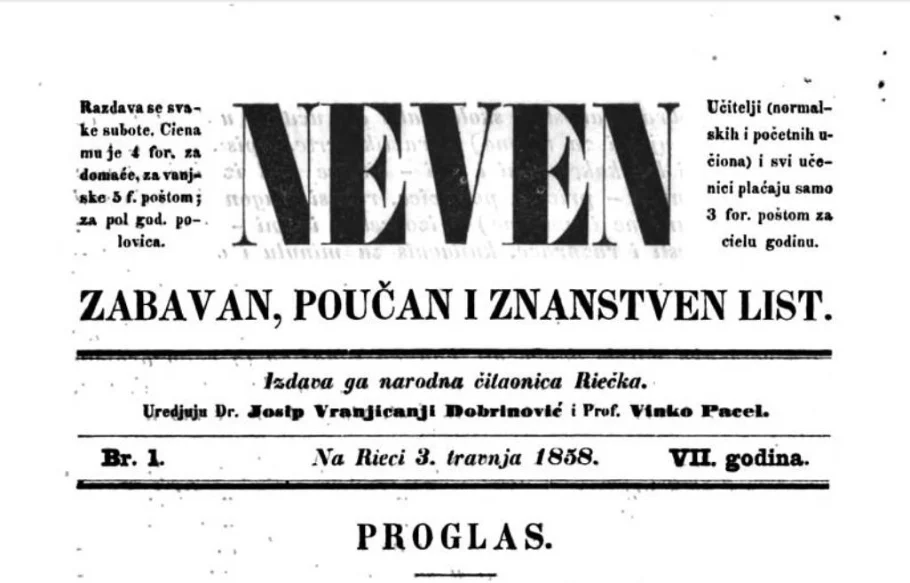
Neven. Volume 7. 1858. Bèrzotiskom narodne tiskarne. (in Croatian). Indiana University.

