
Summary
An older philological account argues that, although Albanians lived for centuries in close contact with various Slavic-speaking peoples, Slavic influence on Albanian was primarily lexical rather than structural. The presence of Slavic loanwords demonstrates extensive contact, but, according to the interpretation presented in the source, these words were incorporated into Albanian without fundamentally changing its morphology or syntax.
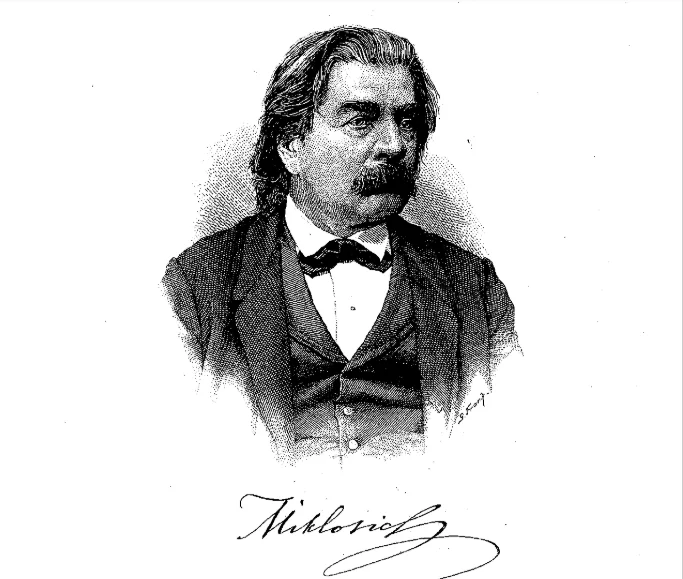
The account cites the 19th-century linguist Franz Miklošič, who identified 317 Slavic elements in Albanian, compared with 930 elements of Italian and Latin origin. The figures reflect 19th-century scholarship and should not automatically be treated as definitive by modern standards, but they illustrate the linguistic argument: Albanian borrowed vocabulary from neighbouring Slavic languages while retaining its own grammatical structure.
This is particularly interesting in relation to Albanian communities such as the Arbanasi near Zadar, who lived in a strongly Slavic-speaking environment. The linguistic evidence was interpreted as showing that prolonged contact did not necessarily lead to structural assimilation.
The broader significance is that loanwords can reveal historical contact even when written historical sources are scarce. The Slavic elements in Albanian therefore provide evidence of centuries of interaction between Albanian- and Slavic-speaking populations, while the survival of Albanian’s distinct grammatical system demonstrates that linguistic contact and structural transformation are not necessarily the same thing.
Slavic Influence on Albanian: What an Early Philological Account Reveals
The history of contact between Albanians and their Slavic neighbours is one of the important questions in the study of the Albanian language. Albanian developed for centuries in a multilingual environment in the Balkans, in close geographical proximity to South Slavic-speaking populations. Yet an early philological account makes an intriguing observation: despite prolonged contact, Slavic influence on Albanian was, in its assessment, largely confined to vocabulary rather than extending deeply into the grammatical structure of the language.
This observation appears in a discussion of the Albanian communities of the Balkans and Adriatic region, including the Arbanasi near Zadar. The author notes that the geographical distribution of these communities demonstrates that Albanians had long been in contact with different Slavic peoples. The linguistic evidence, however, was interpreted as suggesting that this contact had not fundamentally altered the internal structure of Albanian.
The key argument concerns loanwords.
According to the account, the presence of Slavic vocabulary in Albanian should not automatically be interpreted as evidence that Albanian itself had become structurally Slavic. Rather, Slavic words had been incorporated into Albanian while the underlying grammatical system remained recognisably Albanian.
The author goes so far as to state that there was “no trace of any Slavic linguistic feature in Albanian syntax.” This was presented as evidence that the Slavic element had entered Albanian primarily through vocabulary, without penetrating the fundamental grammatical organisation of the language.
Miklošič and the Slavic elements in Albanian
The principal scholar cited in this connection is Franz Miklošič, the eminent 19th-century Slavic philologist.
Miklošič devoted a specific study to the subject, Die slavischen Elemente im Albanischen (“The Slavic Elements in Albanian”), published in 1870 as part of his Albanische Forschungen. The work was an important early systematic investigation of Slavic loanwords in Albanian.
The account discussed here attributes 317 Slavic elements to Miklošič, while contrasting them with 930 elements of Italian and Latin origin.
These figures should be understood within the methodology and scholarship of the 19th century. They are not necessarily equivalent to the numbers that a modern historical linguist would produce today. Nevertheless, they reveal how one influential scholar understood the composition of Albanian vocabulary and, more importantly, how contemporaries interpreted the significance of those borrowings.
The numerical comparison is striking. In this particular account, the Slavic contribution is presented as considerably smaller than the combined Italian and Latin contribution.
Borrowing words without transforming the language
The distinction between lexical borrowing and structural influence is central to the argument.
Languages can borrow large numbers of words from neighbouring languages without necessarily adopting their grammatical systems. A language may acquire words for objects, occupations, agriculture, administration, religion or everyday activities while retaining its own morphology and syntax.
The argument presented in the source is that something of this kind happened in Albanian’s relationship with its Slavic neighbours.
Slavic vocabulary entered Albanian, but, according to this interpretation, Albanian did not become structurally Slavic.
This is particularly significant because the geographical circumstances would have made intensive contact possible. Albanian-speaking communities existed alongside Slavic-speaking populations in several parts of the Balkans and Adriatic region. The author therefore sees the survival of Albanian’s grammatical structure despite this prolonged contact as an important historical fact.
The Arbanasi of Dalmatia
The source pays particular attention to the Arbanasi near Zadar, an Albanian-speaking community in Dalmatia.
The Arbanasi were traditionally identified as Gheg-speaking, while the source describes other Albanian communities mentioned in its geographical survey as Tosk-speaking.
Their presence on the Adriatic provides an especially interesting case for studying language contact. The community existed in a region surrounded by Slavic-speaking populations, particularly speakers of varieties of Croatian and related South Slavic languages.
If prolonged geographical contact necessarily produced deep structural transformation, one might expect particularly strong Slavic grammatical influence in such communities.
Yet the older philological argument presented here points instead toward a different model: substantial contact did not necessarily mean structural replacement.
What the evidence can — and cannot — show
The argument should not be taken to mean that Slavic influence on Albanian was insignificant.
Three hundred or more Slavic-derived elements would themselves constitute an important layer of Albanian vocabulary. Moreover, modern historical linguistics has developed considerably since Miklošič’s time, and individual etymologies and estimates can be revised.
The important point is more precise:
Lexical influence and grammatical influence are not the same thing.
The existence of Slavic loanwords demonstrates contact. It does not, by itself, demonstrate that Albanian lost or fundamentally altered its grammatical identity.
This distinction is especially valuable when discussing the history of Albanian, because Albanian has existed for centuries in an extraordinarily complex linguistic environment. It has been in contact not only with South Slavic languages, but also with Greek, Latin and Romance languages, and later with Turkish and other languages.
The older philological tradition therefore regarded Albanian as a particularly revealing language for reconstructing the linguistic history of the Balkans.
A window into a period where written history is limited
The author makes an even broader claim about historical linguistics. By analysing borrowed vocabulary, scholars such as Miklošič believed that philology could illuminate periods for which conventional historical sources were scarce.
Words can preserve evidence of contact that chronicles and political documents never recorded.
A borrowed word can indicate that two communities interacted, traded, lived near one another, or shared particular institutions or technologies. A sufficiently old layer of loanwords can therefore provide clues about historical relationships that would otherwise be difficult to reconstruct.
In this sense, the Slavic elements in Albanian are not merely vocabulary. They form part of the evidence for reconstructing the history of contact between Albanian-speaking and Slavic-speaking populations in the Balkans.
A broader historical significance
The argument presented in this older source is therefore more nuanced than simply saying that “Slavs influenced Albanian” or that “Slavs did not influence Albanian.”
Both statements would be incomplete.
The evidence points to contact without necessarily implying structural assimilation.
Albanian absorbed words from its Slavic neighbours, just as it absorbed words from other languages. Yet the older philological interpretation maintained that Albanian’s basic grammatical structure remained distinct.
This makes the Albanian language particularly valuable for studying the linguistic history of the Balkans. Its vocabulary contains layers reflecting centuries of interaction, while its grammatical system preserves the identity of an independent Indo-European language.
The observation attributed to Miklošič and his contemporaries therefore remains historically interesting: the presence of Slavic words in Albanian demonstrates centuries of contact, but the mere existence of those words does not mean that Albanian itself became structurally Slavic.
The study of those borrowed words can, in turn, provide a window into a period of Balkan history for which the written record is often fragmentary.
Source
The passage discussed here appears in Letopis Matice srpske, in a discussion of the Albanian population and the linguistic significance of Slavic vocabulary in Albanian. The author cites Franz Miklošič’s research and gives the figure of 317 Slavic elements.
For Miklošič’s original study, see:
Miklošič, Franz. “Die slavischen Elemente im Albanischen.” Denkschriften der philosophisch-historischen Classe der kaiserlichen Akademie der Wissenschaften 19 (1870): 337–374. The bibliographic record for the work is independently preserved in modern scholarship on Miklošič and Albanian linguistics.
The Google Books copy of Letopis Matice srpske containing the passage is available here: Google Books — Letopis Matice srpske

