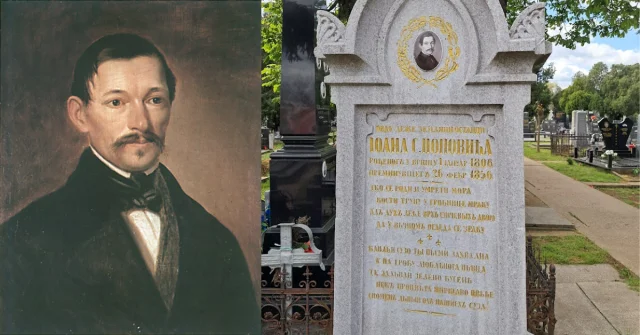

Image from vecnost.com.
In a German publication from 1931 we can read a critical analysis of the Serbian playwright, poet, lawyer, philosopher and pedagogue who “lacking inventive imagination” borrowed from Shakespeare, Molière, Weisse and Kotzebue. The author states that Popovic “Serbianized” (Slavicized) models and figures from other authors.
Cited:
“Jovan Sterija Popović (1806–1856)—the son of a Greek merchant and a Slavo-Serbian-educated Serbian mother from the Banat—found his voice through the clash of these races and cultures and the novels of Vidaković.
He began as a writer of high-flown Slavo-Serbian drama and, despite an early ode to Vuk, remained throughout his life a spirit of the Enlightenment, viewing the stage as an institution for moral edification. Popović penned a long series of so-called “melancholy plays”—high-flown, pseudo-historical, fantastical, and sentimental dramatizations of folk epics, featuring interesting borrowings from the Baroque novel and Shakespeare.
While these plays’ only real merit lies in having established a popular repertoire, he achieved immortality through his comedies—a body of work in which, with the mature gaze of a keen observer of human nature (and later, a misanthrope), he singled out superb types and characters from the teeming bourgeois life of the Hungarian-Serbian provinces.
The value of these plays is not diminished by the realization that the author—lacking in inventive imagination—relied heavily on foreign models; he “Serbianized” them so thoroughly (including Molière) and so effectively improved upon writers like Weisse and Kotzebue—replacing their culturally bland figures with such authentic Serbian types—that his lack of external inventiveness pales beside the richness of the national truth they portray. “
Source
Handbuch der Literaturwissenschaft: Literaturen der slawischen Volker: Die tschechische Literatur, von Dr. Arne Novak. Die serbo-kroatische Literatur, von Dr. Gerhard Gesemann. 1931. p.28.

