
Summary
This passage from 1868 describes the decline of the Serbian Empire after Tsar Dušan’s death. Under Dušan, Serbia reached some power but his son Uroš was too weak to maintain his father’s authority. Powerful governors and nobles began fighting among themselves, reducing the central monarchy to impotence.
After Uroš’s death, Serbia descended further into intrigue, treachery, fragmentation, and dependence on foreign powers. Even rulers such as Lazar and Stefan could not reverse the decline. The author presents this collapse as a striking example of the fragility and transience of medieval political greatness.
Cited:
“At that time, the reputation of Dušan’s power and glory was spread throughout all Europe. In 1350 he sent his Protovestiarus, the chief keeper of the wardrobe, to King John of France to ask for a princess for his son Uroš. But, as he was a non-Catholic, he received a refusal.
When we pass from this splendor of the father’s power to the disgrace and ridicule in which the son lived, and to the shameful death that befell the unfortunate and powerless man, we can hardly help being prompted to serious reflections upon the transience of earthly greatness. Instead of pursuing further reflections, let us first set down a bare fact.
Two governors of the realm, probably Vukašin and Lazar, had a dispute with one another. When the King of Rascia had long attempted to reconcile them without success, he became enraged and ordered them to withdraw and to pursue one another by war. Thereupon, when the one, being the more powerful in strength, turned his hostile forces against his rival, the other, unequal to the war, called in Hungarian troops from the banks of the Danube, with whose aid he defeated his adversary.
What had to follow from this, anyone can guess.
Soon afterwards, King Louis of Hungary, having gained control of the crossing of the Danube, marched victoriously through Rascia wherever it opened out into level country, while the Serbian king, fleeing, took refuge in the mountains and the recesses of the forests.
Before long, the unfortunate Tsar Uroš had reached such a state that he travelled from one of his governors to another and had to rely upon their mercy even for his food. His end is well known.
From that point onward, Serbian history assumes its most repulsive aspect. We are dealing with a state and nation physically and morally exhausted, enfeebled, disintegrated, and already in the process of complete dissolution.
After Uroš’s death, the court of the Serbian princes and bojars became the scene of the basest intrigues and the most shameful treachery. A few better men, such as the pious and courageous Lazar and his learned son Stefan, were unable to stem the tide.
The latter seems to have been turned away by the general misfortune of his homeland from heroism and other princely virtues, and converted instead to a pious superstition and a quiet monastic life. He was weak enough to believe that the salvation of himself and his nation could be obtained from a foreign people.”
Source
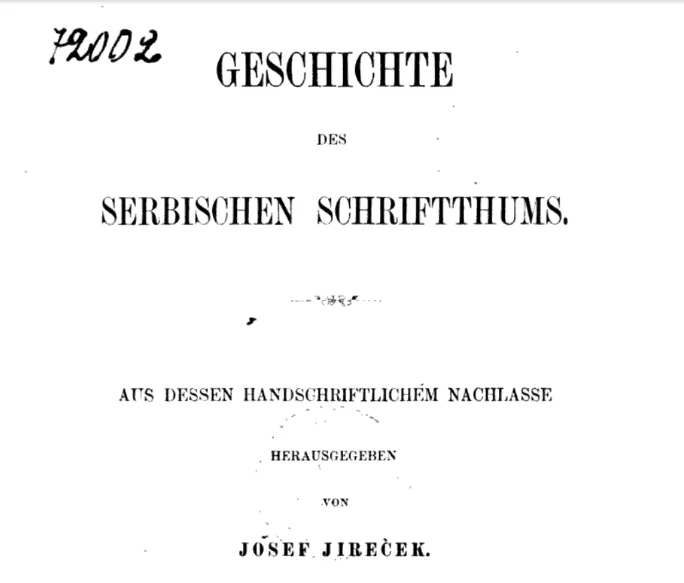
Paul Jos. Šafařík’s Geschichte des serbischen Schriftthums aus dessen handschriftlichen Nachlasse. Pavel Josef Šafařík. 1865.

