

Published on September 9, 2014 at 19:50. by Isa Mulaj
Summary
Albanian is the oldest Indo-European language, not merely among the top three as Albanian media claimed from a New York Times report on a language-family study. That study placed Albanian third among survivors; a 1985 Swedish Institute map (via Arben Llalla) correctly ranks it first at the root, with Armenian nearby and ancient Greek as its direct branch—while modern Greek is essentially Latin.
Albanian etymologies of classical names and places (Aphrodite = “Afër Dita,” Dardania from pears, Mollos from apples, etc.) confirm this origin.
Albanians themselves have been the language’s main destroyers: medieval Slavic influence (including under Skanderbeg) nearly erased it, and today governments invest nothing in language, literature, or history while flooding colleges with economics and law.
“If you want to discover the history before Christ and the sciences of that time, you must study the Albanian language”, Gottfried Wilhelm Leibniz (1664-1716)
Two weeks ago, an article in the American newspaper “The New York Times” was making a boom by conquering many internet portals and Albanian newspapers, on the topic of the Albanian language, which it listed among the three oldest languages in the world. It is about the spoken language, the words of which can be found in documents of different peoples with their alphabet.
Since the Albanian alphabet was created relatively recently (in 1908) and it is borrowed by adapting from the Latin alphabet, Albanians and their ancestors who were previously known by other names such as Arbën, Albanë, and Illyrians, have written Albanian words and texts with other alphabets.
For example, Naim Frashëri wrote the poem “Bagëti e Bujqësi” with Arabic letters. An Albanian today who does not know the Arabic alphabet may say that he does not understand anything from what is written, but when someone who knows Arabic reads it, then the Arab says that he cannot understand anything from what is being said.
The Albanian language is not “among the three oldest languages in the world”, but in fact the oldest.
This is an important distinction, because when it is said to be among the three oldest, it is not known whether it is the first, second, or third. When “The New York Times” makes this statement, it seems to be based on the Indo-European language family and the languages that have prevailed to this day. Let us see below the language family to which it refers:
For this more recent study, “The New York Times” reports that the Indo-European language family originated in Anatolia or present-day Turkey.
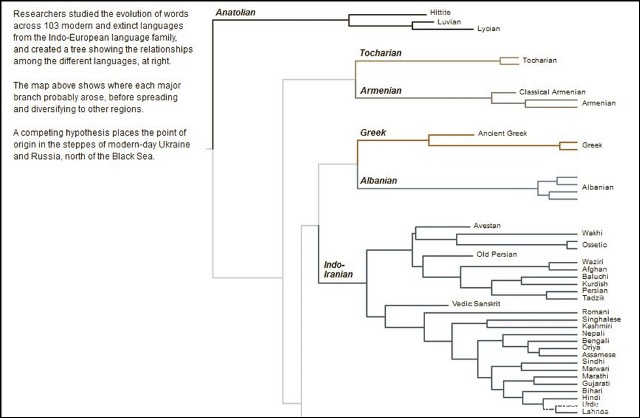
From Figure 1, we can see a branch of the language called “Anatolian”, from which the Hittite and Luwian languages originated, and from this latter the Lycian language. Since these languages do not exist today, the study that the newspaper presents in the form of a language family tree seeks the origin of the languages among the Indo-European languages.
There you can see this ranking of languages according to their antiquity: Tocharian, Armenian, Greek, Albanian, and their branches. The Tocharian language disappeared in the 9th century BC. Armenian, Greek, and Albanian remain today. Here is the core of the origin of the Indo-European languages. Albanian is in third place, and most Albanian media were very happy about this, making it the main news of the day, but also of the week, and maybe of the year.
They even put such headlines and descriptions to this news as “According to the prestigious newspaper, the New York Times, the Albanian language ranks among the two or three oldest languages in the world.” In fact, the newspaper does not say such a thing; it only refers to the study and is expressed as follows:
“A new study suggests..” which in Albanian means: “A new study suggests…” So, we are not dealing with the newspaper’s findings at all, but you should know that the way the Albanian media reports, as well as the way readers understand it, is very deficient, unfair and distorted.
Figure 1: Searching for the Origins of Indo-European Languages
Original source: http://www.nytimes.com/interactive/2012/08/24/science/0824-origins.html?smid=fb-share&_r=3&
These media and this Albanian public know nothing about the study that has been done, and they are not even interested in it, but only what “The New York Times” posts, they take it as absolute truth and say “According to the prestigious newspaper…” Even if these media and the Albanian public are served outright lies, they take them as indisputable truths just because someone “prestigious” (famous) said this.
This is the reason why the Albanian media, researchers and the public in general, with very small and insignificant exceptions, are the product of rumors. In addition, the biggest destroyers of the Albanian language and cultural heritage are the Albanians. We will describe this in the last subtitle of this article.
Ancient Greek is today’s Albanian language, today’s Greek is Latin
It is not quite as in this claim since today’s language has developed significantly and has flowed. However, when we talk about origin, then the order of languages is the opposite of what the Albanian media reported from a reference in the “New York Times.” The real order is this: first, the Albanian language; second, Armenian but in another branch, and third, ancient Greek which is a branch of Albanian.
Where do we base this? Of course, on studies and facts from reality. You will be convinced that this or the 1st paragraph that you received from the New York newspaper is a not-so-accurate or incomplete study. Unlike you media who open your eyes and get news from someone else, I had the opportunity to touch the most original study on the origin and trunk of languages.
That study in the form of a map like this published in the “New York Times” was by historian Arben Llalla. It is a study by the Swedish Institute for Foreign Languages, published in Athens in 1985, in Greek letters, but which also contains text in Albanian such as “This Arvinian gluha…” in Greek letters or as I emphasized earlier, that Albanian words are also found in the alphabets of other peoples who do not understand it because the text is in Albanian. They can read it, while we understand their reading.
How that map came into the hands of historian Arben Llalla, I was not that interested in knowing. I was only interested in the document, and not the very enigmatic and dangerous way in which such a document was smuggled out of the Greek archives to be preserved. Remember well and keep in mind that this document was published in a state which in its official policy not only does not accept that the Albanian language is ancient, but tries to present it as if it does not exist at all in the trunk of Indo-European languages.
There are also agencies on that side that have tried to destroy such evidence, and to eliminate people who try to make such facts public. When I found out and became sure that Arben Llalla had it, I got on the bus just to see the study “live”, and not like the Albanian media and you their readers who receive copies of foreign news. Here is the evidence:

Photo 1: Author with map of the Swedish Institute for Foreign Languages study, original from 1985. © Isa Mulaj and Arben Llalla, September 2014.
In photo 1, the original color edition is seen, and the text is in Greek letters. The trunk and the tree of languages are not clearly visible. So, look at this next one for the truth of the three languages ”competing” for antiquity in the trunk of Indo-European languages:

Photo 2: Indo-European language tree and Swedish naming. © Isa Mulaj and Arben Llalla, September 2014
How do you think this looks? What is the oldest language here? I don’t know Swedish, but this first one, Albanska, the only one highlighted in red, I’m sure means Albanian. Therefore, this Albanian language is not among the three oldest languages, but the oldest or the first. The second one is Armeniska (Armenian), not far from Albanian but on the other side of the trunk.
This means that Albanian and Armenian were close to each other at that time. The third one is Gerkiska (Greek, ancient, not modern), next to Albanian. What does this show? That ancient Greek was derived from, or is a branch of, Albanian. It seems very clear, doesn’t it? What you see shows that ancient Greek is after Albanian.
You may be wondering whether these two studies, the one you saw in the New York Times and the one you see here, have discrepancies in the ranking of the three oldest Indo-European languages. Although the results are similar, they differ significantly in principle. In the vernacular, many would say:
Someone is lying here; here is that study in the New York Times, here is this one by the Swedish Institute for Foreign Languages published in Athens. And you are right in this question, because, if you look at the trunk of languages in Figure 1, the modern Greek language emerges as a result of ancient Greek from which no other language has branched, while in the Swedish study, ancient Greek emerges as a branch after Albanian. This is a fundamental difference that requires clarification since they do not match.
To prove that ancient Greek is modern Albanian, and modern Greek is Latin, extensive, long, and special research is needed. However, I will try to summarize the study by the Swedish Institute and show that it is more accurate, more in line with reality, and that it is supported by facts from the names of the old Greek (Albanian). Many foreign scholars also know these things in secret, but their task is not to rack their brains more than the Albanians about the Albanian language.
When Eduard Kardel (a Slovenian politician) and a Serbian diplomat meet with Stalin, the latter asks them to tell him something about the Albanians. Kardel answers approximately like this: “They (the Albanians) are the most ancient people in the Balkans. Aphrodite is theirs. Aphrodite in Greek means nothing.” If you look for literature on the figure of Aphrodite, most sources in Western languages tell you that, according to Greek mythology, she was the Goddess of Love, whom the Romans adopted as Venus. Aphrodite or Aphrodite has nothing to do with mythology, whatever language or culture it may be, but with astrology and in Albanian it means Afer/Afro Dita, which has to do with the Morning Star, or the Dawn of Day.
Many foreign historians say that you Albanians of today have tried to build a false identity from the Illyrians by naming your children Teuta, Agron, Ilir, Iliriana; we as Anglo-Saxons can also give our children these names and say that we are of Illyrian origin. Then, they claim that Dardania and some toponyms are coincidences with other languages and do not have the meaning you think. Buk in Albanian is called food for people, but in English the same name as pronounced means book, in Russian beech (a type of wood).
Arizona can also be the gold zone (fluoride), the bear zone, or the gold zone (a unit of measurement of land). Go ahead and figure out what the Albanians and their Albanian language are talking about.
Okay. We understood these coincidences when the name of a language has a completely different meaning in a foreign language. We are starting with many more that it would take us days and nights to collect, and we are stopping at a few. We understood about Aphrodite. There is no doubt about it. World literature knows Dardanus as Dardanos from Greek mythology.
This has nothing to do with mythology since “d” from old Albanian becomes “dh” in today’s language. Dardania was (and still is) a land of pears, not dates or bananas. Apples – Mollos means people of apples, or those who cultivate apples, not cacti and pineapples. The Mollos were located in Epirus and present-day southeastern Albania. When I mentioned this name to a friend, he said:
Here I trust you more than for Dardania because there are still many apples from there, towards Pogradec and below, even today. Epiros means the land of Pyrrhus. The letter “e” is the front participle for feminine nouns. Land or field is a feminine noun. If it were a meadow, we would say Ipiros. Pay close attention to these Albanian names that have the suffix “os” added to them. Lis-Lisos was the city of Lezha. In the southeastern part of the Balkans, most names are given the suffix “os”, while further north and northwest of the Balkans, without this suffix “os”.
Delmats mean people or fathers (lords) of the sheep, Deshidiats lords of the sheep, Ardians were Ardh-janë (people who have come; remember that “d” from antiquity becomes “dh”, e.g. Bardylis – today’s Bardyli, etc., etc.).
The name Ardhacakë in today’s language is a mispronunciation. Ardhjanë is in the Gheg dialect and is understood better, easier, more directly, and more beautifully. Lombardy is a very large plain in northern Italy through which the largest river in Italy named Po passes. Lombardi means Lombard/Lumbardi (remember once again that the “d” from antiquity becomes “dh”).
Are all of these things I mentioned, and many others that I know of, coincidences or coincidences with some language? Why didn’t the ancient Greeks and Illyrians name these places with names like, silicon valley, steel tower, glass pyramid, but after pears and apples, sheep and rams, earth, stars? Why? Can you imagine that at that time they should have called these places sugar factory, tobacco combine, filter cigarettes?
The suffix “os” from ancient Greek becomes “us” in Latin, for example, Lisos – Lisus, while the suffix “om” in Latin becomes “um”, aquarios-acquarium, etc. Then, research general medicine and you will notice where today’s Latin and Greek are.
The Albanian language today and its defenders are destroying only Albanians
The old Albanian language was in danger of disappearing and not coming to this time during the Middle Ages, especially during the rule of the Serbian kingdom. The Serbian cultural influence of the Middle Ages or Byzantium was very great against the Albanian language. Serbian toponyms have remained even today from that time in Albanian lands. The stoppage of the Slavization of Albanians was made by the arrival of the Ottomans and the destruction of the Serbian kingdom.
Skanderbeg tried for a short time to renew the continuity of the Slavization of toponyms, but fortunately the Albanians fought, defeated, and destroyed him to the core. If someone is interested in the typical identity of Serbs, they can find this in the family of Skanderbeg and his exploits. Almost all of those names today have been inherited only by Serbs as sacred names, which have meaning only in Serbian.
The city with the pure Albanian name Lisos during his short reign becomes Lezhë (perhaps inherited from the Serbian kingdom) which has no meaning, except that it is a Serbized name. Today’s Serbs call it the same as the Albanians except that they write it Lezhë.
When he takes a castle or city near Dibra which was named Siderokastron by the Greeks, Sancta Civitas by the Latins, Sveti Grad by Tsar Dushan, all meaning “Holy City”, and Demir Hisar in Turkish (Iron Tower), Skanderbeg returns the Slavic name Svetigrad or the name of his identity, culture and cause. When Skanderbeg returned to Krujë, he raised the flag, not Byzantine as world historiography thinks, but Slavic with the double-headed eagle.
The black double-headed eagle has the name Kosovo, which in Old Slavonic means black bird. If you haven’t seen the “national” flag of the Albanians yet, look at it and see that the bird with two heads is black, that is, Serbian. If it were any other color, we wouldn’t be able to say that it is Serbian. Skanderbeg, besides being ethnically with a family fundamentally oriented towards the Slavs, also the cause for which he fought had to do with the Byzantine-Slavic heritage.
He aimed to take Belgrade (Berat) from the Ottomans and Albanians because Belgrade was (and still is) Serbian culture which means White City (so there was no need to change its name) but he was defeated. Those who fought and “betrayed” Skanderbeg were Albanians (Lekë Dukagjini, Ballaban Badera, Jakup Arnauti, Januz Badera, Moisi Golemi, Hamza Kastrioti, etc.).
Albanians today mainly accuse only the Ottoman rule of not having developed their language, not knowing that at that time the Albanian language did not exist at all in an organized form. Just look at what Skanderbeg was fighting for, then you will never complain about the language. The fate that the Albanians destroyed him to the core as the most tragic Serbian figure of the Middle Ages, the Albanians have woken up, risen, and are where they are today.
Today, who cares about the Albanian language? Nobody. How many hundreds of millions of euros do the governments of Kosovo, Albania, Macedonia invest in the development of the language? Not a cent except for the salaries of workers that they give to teachers and institutions.
The British government has invested over 2 billion pounds to preserve and develop the Welsh language, even though English is being taught all over the world. Why did I go from Kosovo to Tetovo just for a document related to the language, and why do Kosovo government officials and employees in public institutions go even further for pleasure – to Ohrid – just to eat, drink and have fun with the taxes I pay?
Because they are smart, and I am stupid. Are there more cursed people than me and Arben Llalla among these Albanians? No, there are not. I am not talking about those many friends who “want the best” for us and “their nation” with their folkloric patriotism and nonsense.
In Kosovo there are over 30 private colleges, all focused on studies in economics, business, law, political science. The economy is known where it is, so there is no economy at all. There is little business and it is criminalized. You find better justice in Nazi concentration camps than in Kosovo.
And, politics is known who it is; we are not talking about it anymore because it not only makes us vomit, but also makes our intestines laugh. Not a single college for language, literature, history, archaeology. Where is the Albanian identity? Why do you bother and slander about the past when you do not want to accept things in the current reality that even a cow can see? Why?
The times of Roman, Byzantine, Serbian, Ottoman rule are gone. What are you babbling about in the form of complaints about what they have done to us? Doesn’t the world see what Albanians are doing to their fellow countrymen TODAY? The solution and consolation for the endless lamentations about Roman, Turkish, Serbian, Greek rule is this: Lock down 30 colleges at once, and say that we are Albanians who will only learn the Albanian language, which was forbidden to us in the past.
I recommended such an option to an ardent patriot, while I honestly accuse him of being impossible; there is no perspective, it is better to have such colleges, even only in foreign languages, mainly in English, German, Turkish, Italian, because there is nothing from the Albanian language.
There is nothing because you do not invest a single cent, and you complain to me here that 500 years ago the Ottoman Empire did not let you because you would have had to deal with this language which did not exist and was not organized at that time. When you are harsh and strict against investments in the language, then you come to the conclusion that if the Ottomans had any sense and if they knew how Albanians would evolve to this day, they should have exterminated them. Who is to blame for the Albanians today who do not invest in research and development of the language? No one in this world except the Albanians.
Article

