
by Dr. Qazim Namani
Summary
The territory of the city of Prishtina was inhabited 7000 years ago. During the excavations in the city, traces of civilization from the Starqeva culture were found: Prishtina Hospital Complex, Glladnica to Graçanica. Vinca culture – New Neolithic: at the spinning mill, Brërrnica, Matiqani. In 2012, a new Neolithic settlement was discovered in the village of Dardhishte. Bronze material culture: Fusha e Badoci, Brërrnica e Poshtme, Kolovica, Grashtica, Keqekolla. Iron Age: Badoc, Matiçan, Tauk-Bahçe, Shkolla normale. Roman period: Ulpiana, Grashtica, Siqeva, Keqekolla, Matiqani – Byzantine period – early Middle Ages.
Introduction
Near Pristina, the Gracanica Monastery is built on the foundations of an earlier church, as a monument of special cultural importance. The presence of these cultural monuments, in terms of artistic values, enter the most perfect creativity of Europe and the world.
In Pristina, in the 14th and 15th centuries, in addition to local merchants, a large number of Dubrovnik merchants also operated, who traded with the most developed cities in the region. Also in the 15th century, the most widespread craft in Pristina was that of goldsmithing.
After the Ottoman conquest, several sacral and profane objects of oriental style were built in Pristina, such as mosques, hammams, tekkes, tombs, fountains, etc. During the late Middle Ages, many well-known personalities of the time stayed and wrote in Pristina, such as; Jovan Kontaguzeni, the Hungarian king Vladislav II, Peter Bogdan, Haxhi Kallfa, Evlija Çelebi, etc.
Pjetër Bogdani, an Albanian cultural and religious figure, archbishop of Skopje and Sofia, reported to the Vatican that Pristina had 3,000 houses. Evlija Çelebi wrote at that time about 2,600 large and beautiful houses, highlighting the Allaj Beg palace and the courthouse, the two large hammams, hospitality and civic culture. There are 11 inns in Pristina, among which the most famous is the Haxhi Beg inn.
The city has two baths, one is the Fatih bath in the market, and the other is the old bath. In a corner of the Fatih bath there is a sign, for this reason this bath is considered sacred and is visited a lot. There are 3,000 shops in Pristina, which is few for this city, there are very good grapes and pears here.
Pristina in the second half of the 16th century was the administrative center of the Morava District, and at that time, in terms of the number of houses, it was the largest center among all the cities of the present-day territory of Kosovo.
Prishtina was weakened during the Austro-Turkish War, when Prishtina became the headquarters of the Austrian General Piccolomini. This city was ruled by the Gjinolli during the 18th and 19th centuries. After the assassination of Maliq Pash Gjinolli in 1809, one of his chambers became a museum. Prishtina is also mentioned by Felix De Bozhur, according to whom in 1812, Prishtina had two fairs, autumn and spring, where many merchants from the east and west participated.
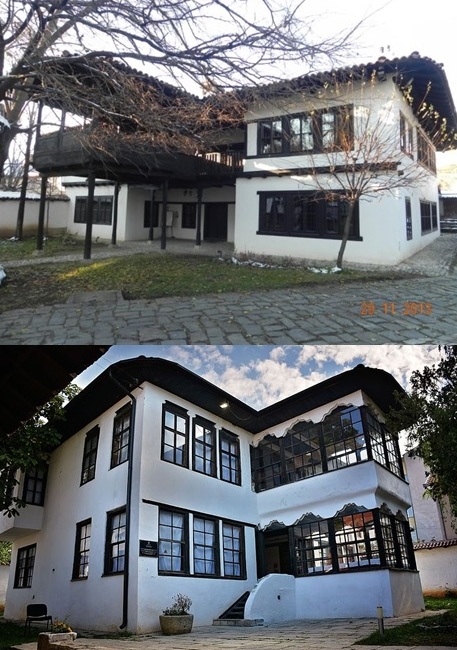
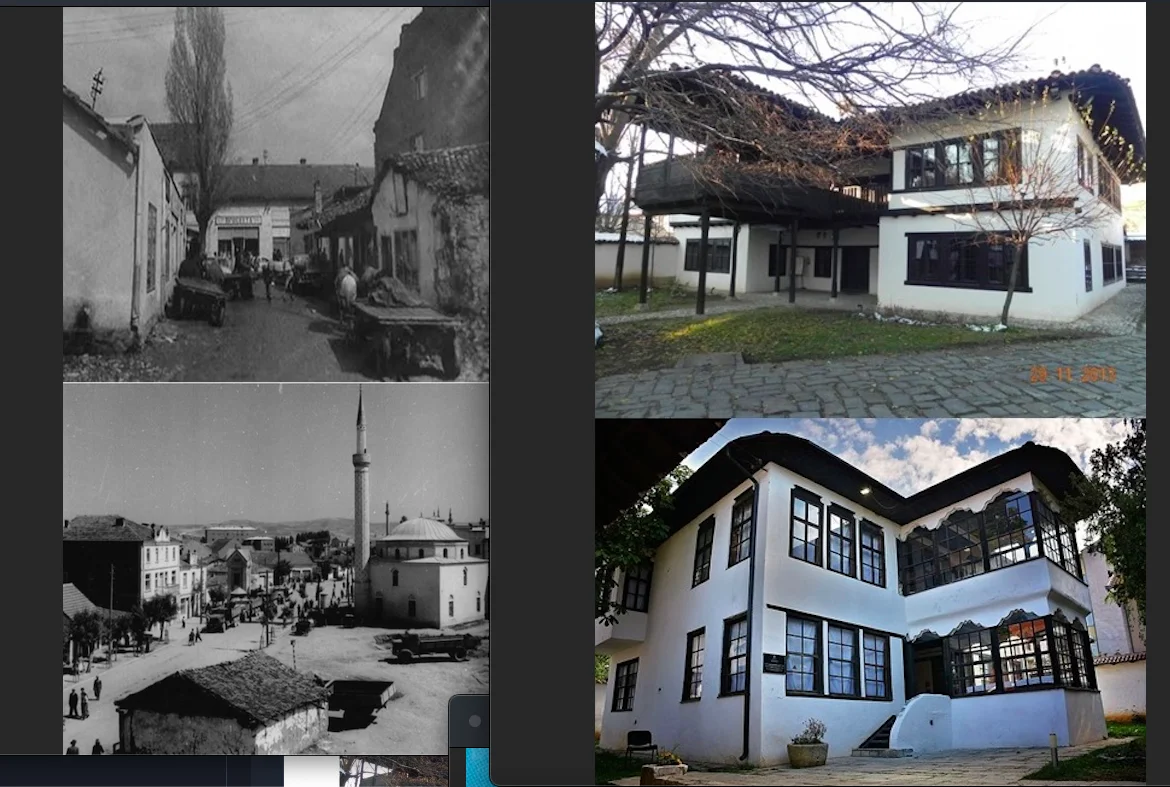
Old civic houses: The building where the Institute for the Protection of Kosovo Monuments and the Ethnographic Museum Complex-Emin Gjikut are located.
Noble games were cultivated in Prishtina in the field called Poteçishte. These competitions were organized every year similar to the Sinj ring – only with one difference, instead of the ring, a glove was used, which the knights had the task of hitting with a sword, arrow or mace. Various beylegje (duel fights) were also held in Prishtina. Prishtina was hit by two major fires in 1859 and 1863.
According to resident Gamer, Prishtina is the largest city located between Thessaloniki and Sarajevo. According to Cvijiq, Prishtina had 4000 houses at the beginning of the 20th century.
At the end of the 19th century, the first enterprises had begun to emerge in Prishtina, two flour factories had been opened, one of the mills was working regularly and had 25 employees. This mill supplied flour to the Turkish army from Pristina to Crete.
Craftsmen of various branches were organized into guilds or guilds, but in 1861, the Turkish government decreed a law according to which guilds were no longer recognized as production organizations and with this all old privileges were canceled.
Pristina was a city of beylers and agallars, the center of the multezims of Kosovo. It had a rich market for animals and livestock products that it exported to other cities. From the crafts in this city there were tailors, guards, shoemakers, tinsmiths, leatherworkers, bakers, coppersmiths, painters, potters, watchmakers, opingaxhinj, blacksmiths, carpenters, mat makers, candy makers, etc.
In Pristina there were 500 shops that sold consumer products, which were brought here from Thessaloniki. Pristina also had the old covered bazaar. Among the public buildings in Pristina, the building where the Kosovo Museum is now located, the building where the Institute for the Protection of Kosovo Monuments is located, the Great Hamam, the Clock Tower, the Emin Gjikut Ethnographic Museum Complex, etc. Among the sacred buildings, the following are highlighted: the Bazaar Mosque, the Great Mosque, the Jashar Pasha Mosque, the Llapi Mosque, the tekke, etc.
Pristina was badly damaged during the Balkan War, when Serbian forces entered the city. Between the two wars, there was no rapid development. Many settlers settled in Pristina and its surroundings, the Orthodox cult objects were completely appropriated, and the Albanian population began to emigrate to Turkey. Between the two world wars, buildings were built for Serbian rulers and their entertainment.
Many Albanian civic houses became the property of Serbian settlers. The current “Union” building was built in 1927, in the Western Baroque style, and was used as a hotel for the entertainment of rulers by the military musical guard of the Serb-Croat-Slovene Kingdom. According to many citizens of Pristina who experienced the violence at that time, in the back part of this building, Albanians were tortured to death.
Pristina became the administrative center of Kosovo in 1947, and developed rapidly, not preserving the traditional objects of the Ottoman period. Today, Pristina as an urban city of this period has completely changed, with the exception of a few narrow streets, where a few rare buildings of architectural value from the Ottoman period remain.
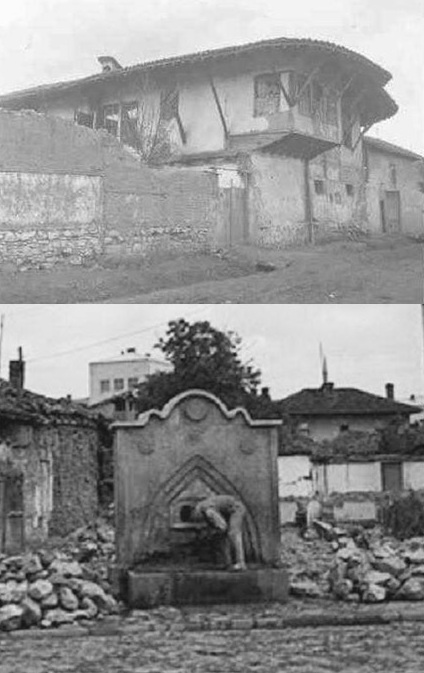
The civic house of Mujec and Çeshme in the Tophane neighborhood.
In Pristina, after World War II, the institutional and urban infrastructure began to be built, with the motto of building a city with a contemporary appearance.
With the urban plan of the city of 1953, entire neighborhoods were demolished along with the old bazaar, destroying the Albanian folk architecture of the Turkish period. During this period, very few civic houses managed to escape the deliberate urban plans, elaborated in Belgrade. With this plan, the Catholic Church of Pristina, the Llokaqi Mosque, the Jewish Synagogue, etc. were demolished. In place of the mosque, the Kosovo Theater was built according to the Slavic-Russian architecture and model.
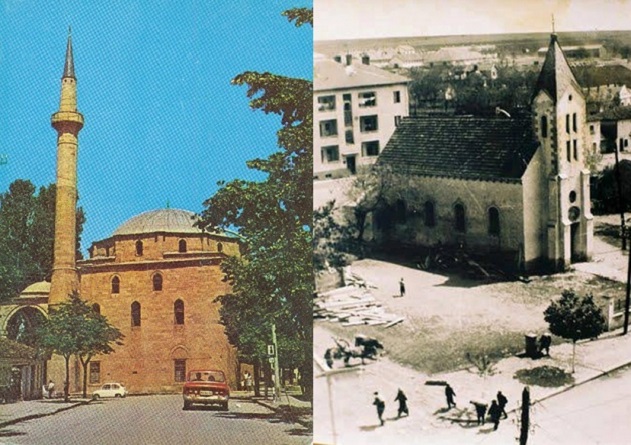
The Great Mosque and the Stakaj Catholic Church in Pristina, demolished in the 1950s
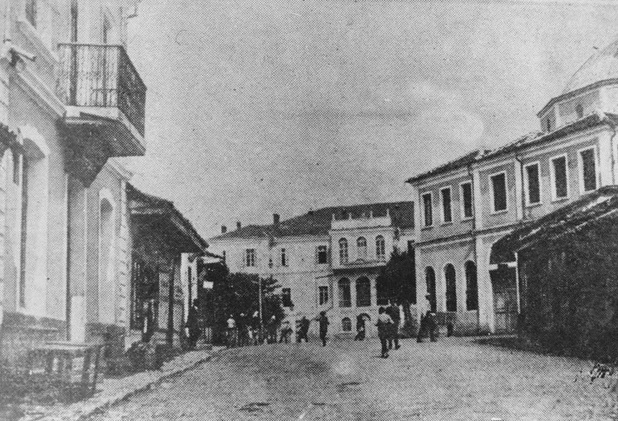
The current building of the Kosovo Museum and the Stone Mosque in Pristina, the mosque’s courtyard destroyed during conservation in 2012
The Covered Bazaar of Pristina (Kapali Çarshi), which was located in the central part of the city, was called the Covered Bazaar because its main entrance, about 20 m long, was covered. The bazaar consisted of an entire complex of shops and craft and service workshops that were accompanied by a number of public buildings.
A large number of crafts operated in the bazaar, where the crafts of saddlers, shoemakers, leatherworkers, cafes, barbers, etc. stood out. In addition to craft premises, the bazaar also sold movable goods, handicrafts, livestock products, various textile clothing, boilermakers and other industrial products of the time.
The interior of the bazaar was very attractive, so it resembled in many respects the bazaars of some oriental towns. It is important to note that the most developed trade was carried out by the Jews, who were more educated and true masters of the craft. In the lower part of the bazaar there was a fountain near the Llokaq mosque.
Around the bazaar there were also several cult objects, where the mosques of this area, the Catholic church and the Jewish synagogue stood out. The old bazaar of Prishtina lost its features immediately after the Second World War, when many architectural objects in its complex began to be demolished. The ruins in the bazaar were made official in 1953, when the urban spatial plan of the city was drawn up for the first time.
The plan was drawn up by foreseeing urban life for 50,000 inhabitants on an area of 505 hectares and 76 acres. The author of this plan was prof. Partonić from Belgrade. The demolition of old buildings in the bazaar complex was carried out with great enthusiasm, with the voluntary work of the youth and the Popular Front. In this complex, several old buildings were also demolished that today would be of great cultural and historical value for the cultural and historical heritage of the country.
According to the plan in 1954, the following were demolished: the Llokaqi Mosque, the Covered Bazaar, the Electric Mill, while the Catholic Church was demolished in 1957. At the same time, the Jewish synagogue was also demolished.
The Llokaqi Mosque, which during the Ottoman period was called “Jonuz Efendi Moflezi”, took the name Lloka from the Turkish words “Lloka tykry da kaq”, which in translation means “spit and run” since this part of the city was full of mud and dust. Within this mosque, a mejtepi with over 100 students functioned and the main imam of the city lived there, who after the demolition moved to the Jashar Pasha mosque.
The mosque was demolished along with the fountain and the old cemetery complex around it to build the city theater and the “Bozhurin” hotel, which after the 1998/99 war was called the “Iliria” hotel, while today, after privatization and renovation, it is called “Swiss Diamond”.
In 2011, during works in Prishtina Square, traces of the fountain and the base of the minaret of the Llokaç Mosque were discovered in front of the National Theater.
During the excavation, it was discovered that the “Shadarvan Fountain” had been walled up with stones from old cemeteries that had been in the courtyard of the mosque. After the discovery, the front plate of the fountain was damaged under unknown circumstances during the night and then most of it was not found. For a very short time, the cemetery stones disappeared.
In 2014, the cemetery stones were found in the cabinets of the Directorate of Culture in the Municipality of Prishtina. MCYS officials and cultural heritage experts have been to the Municipality to examine and view the stones. It was found that the stones were found during excavations for the fountain and around it.
Also in 2014, the discovered tap was preserved and covered with glass, leaving no trace that it had been walled up with stones from Albanian cemeteries. The project for the restoration of this tap was carried out by the Department of Culture at the MCYS, the Municipality of Pristina and the NGO “TIKA” from Turkey.

Pristina’s Closed Bazaar and the Mosque of “Jonuz Efendi Moflezi” (Llokaqi Mosque) built in 1551 and demolished in 1954
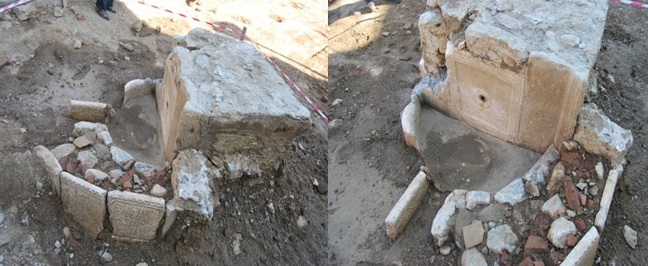
The statue discovered in front of the National Theater of Kosovo in 2011
The demolition of religious objects best shows the low civilization and culture of foreign invaders in our lands. This phenomenon of foreign invaders is described by Radovan Zogovic in his collection “Songs of Ali Binakut” (“Pjesme Ali Binaka”), who ends the fifth song by saying:
“Hey, the grass is growing on our roads!
Our wide roads are washed away
Potatoes grow in the graves.”
After World War II, in 1945, the demolition of the old city cemeteries began. Two years after the war, the earth began to be dug up in the cemetery complex and sent by wagon to the Skopje tile factory. In 1947, a plan was drawn up to build the Pristina tile factory in this location. The workers who worked at that time remembered that during the excavation they came across cemeteries.
Excavations also began under the cemetery complex at the present-day “Asim Vokshi” primary school in the city across the stone bridge over the railway on the Prishtina-Podujeva road. The phase of demolition of Albanian cemeteries in Prishtina continued into the seventies, at the time when the new city cemetery was being built. In the seventies of the 20th century, bulldozers rolled over several dozen old graves with epitaphs written in the Ottoman language in the present-day cemetery yard.
There was also a very well-made grave with a heavy metal lid. From these cemeteries, only one family managed to exhume their relatives at that time. Even during the nineties, in the abyss of the excavations of this cemetery, nearly 100 graves of Albanians from the present-day city cemetery complex collapsed.
Old citizens of the city recall the destruction of religious buildings and old cemeteries. According to Shaip Berila, the four neighborhoods of old Pristina also had their own cemeteries. The cemeteries were above the “varosh”, at the chimney of the tile factory, at the Llapi Mosque. These cemeteries were leveled, while the land was given to the Serbs.
No one at that time dared to ask why this was being done, says Berila. Similarly, today’s Pristina city park was a complex of Albanian cemeteries, especially those who had been displaced from the Sandzak of Nish. Flat cemeteries have also been found at the “Fusha e Pajtimit”, near Bunar i Hajrat.
The fate of the old cemeteries of Pristina was experienced by many localities and cities in Kosovo. Localities with non-Slavic material culture were colonized by settlers brought from Serbia, who built residential buildings based on the cultures of the earliest civilizations and civilizations in these lands.
After the occupation of Kosovo, settlers were settled throughout its territory, in the Pristina district, in addition to the city, settlers were also settled in Graçanicë. Bërrnica, Bardhosh, where cemeteries, properties, residential houses and cult objects were appropriated.
In Bërrnica, the early Albanian cemeteries were appropriated, which, according to the local population, belonged to Albanians, tombstones were taken, partially forged and with them the Serbs created the myth of the nine Yugoslavs. These stones are also published in the book by Dragan Cukić and Milan Ivanović published by the Cultural Monuments Institute of the city of Pristina in 1996.
The authors’ description is very doubtful, therefore this issue remains to be studied by eminent experts in this field. The indigenous Albanian population of the surrounding villages has preserved the data that the raja of Kolovica and Bërrnica, who had lived in these villages even during the Ottoman rule, are Albanians of the Krasniqe tribe and fraternal with the Albanians of the villages of Makoc and Llukar.
From all that was said above, we learn that: Serbs planted potatoes (kompira) on Albanian cemeteries, built factories on Albanian cemeteries and walled up water sources with stones from Albanian cemeteries, while ignorant Albanians, in order to appear modern and tolerant towards foreigners, cover up the crimes of the invaders.
Source
https://pashtriku.org/drqazim-namani-historia-e-qytetit-te-prishtines-dhe-trashegimia-kulturore/?

