

by Prof. Goran Jurišić
Original title: SERBIA AND THE SERBIAN SERVANTS (SERBIS) A TROJAN HORSE IN EUROPE SINCE 1396 AD
On September 25, 1396, a fateful battle took place near Nikopol in Bulgaria between Christian Europe, which then constituted the Christian West, on the one hand, and the Islamic Caliphate of the Ottoman Empire and Serbia on the other, which the Ottoman Empire had won thanks to the Serbs, when Despot Stefan Lazarević appeared on the battlefield with his horsemen and won the battle in favor of the Sultan, who rewarded him with the land of Vuk Branković. Serbia was truly a Trojan horse in Europe, since it was a vassal of the Hungarian-Croatian Kingdom, which had switched sides, fighting for the infidels.
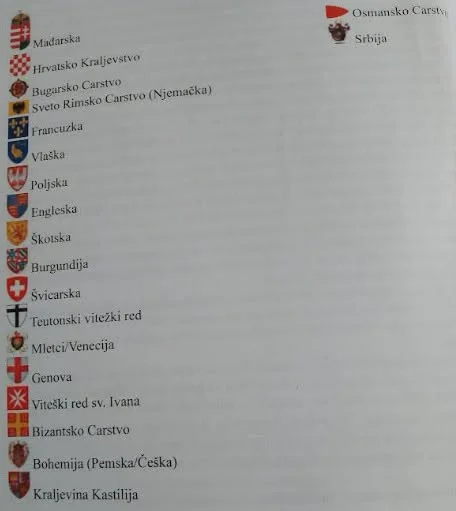
The following European Christian countries fought on the side of the defensive Crusader army led by the Hungarian-Croatian King Sigismund (Žigmund):
Bulgarian Empire and Byzantine Empire, Holy Roman Empire of the German Nation (Germany), Kingdom of France and Kingdom of England, Kingdom of Scotland and Burgundy and Switzerland, Republic of Venice (Venice) and Genoa, Knights of Saint John and Teutonic Knights, Bohemia (Czech Republic) and Wallachia, Kingdom of Poland and Kingdom of Castile (Spain), and Kingdom of Croatia and Kingdom of Hungary (Hungary).
Two years earlier, in 1395 AD, Pope Boniface IX had called on Christians to go on a crusade against the Ottomans and Turks, responding to a call for help from the Wallachian duke Mircea the Old, and the Byzantines. Even the English and French had called off the Hundred Years’ War in order to defend Europe.
First, the Bulgarians and Vlachs defeated the Turks and their Serbian vassals at Rovina on May 17, 1395. Sultan Bayezid and Despot Stefan Lazarević fled across the Danube. While the Hungarian-Croatian vassals, the Serbs, changed sides and began to fight for the Turks, the Bulgarians, as Turkish vassals, also changed sides and began to fight for Christian Europe. For this reason, the Sultan had the Bulgarian emperor Ivan Šišman executed on June 3, 1396, under the walls of Nikopol. A year before that, the Turks had besieged Constantinople, which was also under siege in 1396.
The Crusade against the Turks was mostly financed by Duke Philip II of wealthy Burgundy.
The motto of European knights was: “If the sky falls, we will hold it down with our spears.”
The Crusader army intended to quickly capture the fortress of Nikopol, and then go to the aid of Byzantium, to break the siege of Constantinople by the Ottoman army. Nikopol withstood the siege for 16 days, when the army of Sultan Bayezid suddenly appeared, numbering 100 thousand attackers, and the Crusader army 60 thousand European defenders.
On the right wing of the crusader army stood the Croats led by Stjepan Lacković, but in the center next to King Sigismund stood the Croatian army with Nikola Gorjanski, and the troops of Count Herrmann of Celje. Unfortunately, the French knights held the honor of being the first to strike at the Turks, although King Sigismund wanted him to strike first with the Wallachian contingent.
The defeat of the French had a bad effect on the psychology of the other representatives of the European peoples in the crusader army. Despite everything, the crusader army stood on the verge of victory over the Turks with unprecedented efforts when the cavalry of the Serbian despot Stefan Lazarević arrived to help the infidels, which led to a turning point in the battle, and the victory of the Islamic Caliphate, whose aggressor army was so destroyed that the breakthrough through the Hungarian plain towards Vienna and the continuation of the siege of Constantinople was a futile mission. King Sigismund was killed in the battle.
The Serbian Trojan Horse in Europe was the reason that the European nations would not manage to inflict a fatal defeat on the Turks until the lifting of the siege of Vienna in 1683, that is, for about 300 years, after which they would never recover and would end up on the constant defensive, until the collapse of the Ottoman Empire in World War I, when the beast rose once again and committed genocide against Christian Armenians.
Because the Serbs have always been vassals, sometimes double and triple, this people got its name from the Latin word servus, which means servant. For example, The New York Times on December 31, 1912, wrote that the “servant army” had massacred Albanians in Kosovo:
“SERVIAN ARMY LEFT A TRAIL OF BLOOD” Thousands of men, women and children massacred.” The Carnegie International Commission testifies to the mass killing of Albanians in the Balkan Wars by the army of the Kingdom of Serbia, a vassal of the Austro-Hungarian Monarchy, from 1878 to 1903, when Serbia became a vassal of the Russian Empire, after the Black Hand killed the King of Serbia, Aleksandar Obrenović (and his wife) in the Konak, in Belgrade.
120 thousand Albanians were killed in ethnic cleansing and genocide. Under the bridge over the Vardar River in Skopje lay a pile of dead Albanian bodies with their heads cut off. (Report of the International Commission to Inquire into the Causes and Conduct of the Balkan War.) “We committed the premeditated murder of an entire people. We were caught in the act and stopped. Now we will have to suffer the punishment…” (Captain of the Army of the Kingdom of Serbia, Dimitrije Tucović)
Historian Ivan Lovrenović writes about the Battle of Nikopol in 1396 in his essay Lament over Belgrade:
“This battle, although significantly more important for European history than the one on Kosovo Polje [in 1389], was systematically ignored by the Serbs.”
Thus, the fairy tale about the “systematic suffering of Serbs in the defense of Europe” has been refuted. The Serbs have betrayed Europe, and are ready to betray it again! That is why they are rooting for the Russians and the Chinese, against the West.
Indeed, how is it that the Serbs are silent about the Battle of Nikopolje in 1396, even though they won against the Turks, and yet they emphasize the Kosovo myth? Precisely because the Battle of Nikopolje destroys the Kosovo myth. The Battle of Kosovo ended in a draw, because the Serbs avoided defeat after the Croatian knight Hrvoje Vukčić – Hrvatinić arrived on the battlefield, to which the church bells of Notre Dame Cathedral in Paris rang out in honor of the Croats.
by Historian Goran Jurišić from Zagreb
Sources
dtv-Atlas zur Weltgeschichte – Karten und chronoloischer Abriss, Band 1 Von den Anfängen bis zur Französischen Revolution, Deutscher Taschenbuch Verlag, Hermann Kinder / Werner Hilgemann, München 1964, Neuausgabe 1982.
Radoev Ivanov, “CROATIAN ORTHODOX CHURCH was, is and will be”, Zagreb, 2017, ISBN: 978-953-50546-0-6

