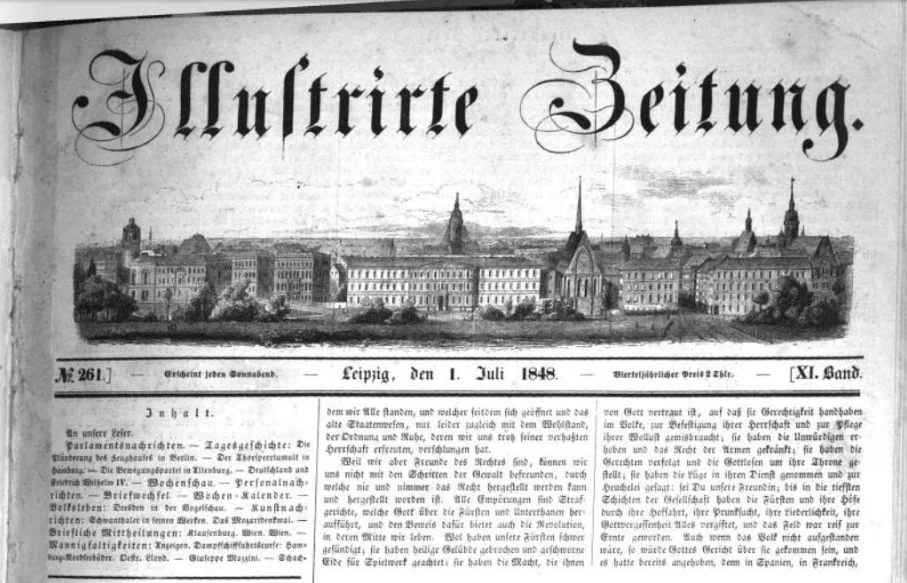

Cited from a newspaper article published in 1848:
“Temesvár, September 8. Several months have already passed since the richly blessed Banat—due to the uprising and the incursion of Serbian hordes—became the scene of distressing, indescribable devastation, looting, and atrocities.
As is well known, the various nationalities inhabiting our fatherland had previously lived in harmony and peaceful relations with one another; the current uprising is therefore all the more shocking given that the legal guarantee of equal rights for all citizens—transcending linguistic differences—had fostered the well-founded expectation that a firmer, more enduring bond would henceforth unite all citizens.
Yet the root of all our misfortune lies neither within the country itself nor with our popular ministry, for neither government decrees nor the plight of fellow citizens could have provoked such an upheaval. Our entire affliction stems solely from the machinations of the Austrian reactionaries, who seek to destroy Hungary’s independence at any cost through the devastating sword of war.
Jelačić, who recently undertook the task in Vienna of leading a war against Hungary—a war intended to continue until the country surrenders control of its finances and assumes a portion of the Austrian national debt—sought first to win over the populace to his cause. He turned to Patriarch Rajačić, who immediately disseminated inflammatory proclamations via covert channels to the Serbian population; they joined forces with the well-trained Military Frontier troops and, together, launched several fierce attacks on flourishing settlements, ruthlessly setting them ablaze.
Near the town of Szenttamás, they have erected fortress-like earthworks, the capture of which will cost thousands of lives. Although the Hungarians have almost invariably repelled these hordes… Yet the loss we are suffering—compounded by the paralysis of all traffic—is incalculable, especially for the Banat, the monarchy’s granary.
Our limited military forces are largely still in Italy, and thousands of our brave troops stand ready for battle to prevent further incursions by the enemy fighting against our Emperor and King; meanwhile, at this very moment, Croatia—already plagued by Serbian robber hordes and a wretched, fanatical populace—is mobilizing a substantial army against us.
Subjugated by Jellačić’s reign of terror, Croatia fights as a tool of the reaction—shockingly deluded—against Hungary and against itself. Since our monarch had voluntarily sanctioned the new laws—including, naturally, the independent Hungarian ministry—amidst boundless jubilation at the last Diet, Hungary had made no preparations for war, relying instead on the sanctity of the royal oath.
Now, however, the very sanctioning of laws that guarantee our independence is suddenly costing us hundreds of millions and causing even the supporters of the new ministry to waver and feel deeply insecure. Thus, the reactionary forces and the Austrian camarilla are firmly resolved to exploit human frailty in an outrageous manner—bringing utter ruin upon us all through Serbian robber hordes (for whom the roasting, impaling, crucifying, and burying alive of our non-Serbian—and especially German—fellow citizens is the order of the day) and crowning their nefarious work with the invasion by the Croats.
Such is the current, lamentable state of flourishing Hungary—a land renowned for its heroic stature, its love of liberty, and the nobility of its spirit; for this reason alone, we may surely count on vigorous support… …must count on Germany—given our situation, which is severely strained by Austria’s arbitrary exercise of power—since Germany’s duty of self-preservation demands that Hungary’s independence be secured, especially as the “Nordic giant” is already showing its face amidst this seemingly minor South Slavic uprising.
Austria, itself blinded, fights in Russia’s interest and seeks to bring about the ruin of Hungary—that vigorous bulwark against absolutism—thereby sealing its own doom. Freedom-loving peoples, hasten hither to extend a brotherly hand of support and salvation in the name of liberty, justice, and human rights offer”.

Source
Illustrirte Zeitung Leipzig, Berlin, Wien, Budapest, New York. Volume 11. 1848. Weber.

