
Cited:
“The Serbian government refuses to provide any explanation for its behavior, which defies the most basic rules not only of international law but also of decency. It would not be surprising if Vienna were to lose patience with such frivolous provocations from a small state. Incidentally, the Serbs treated other Austrian and Italian consuls in the region similarly to the consul in Prizrend.
The following omission from the English Times illustrates how the Serbs’ conduct is viewed by uninvolved parties is shown by the following omission from the English Times:
“Serbia is extinguishing the glory of its successes with its foolish and defiant attitude towards Austria-Hungary. All of Europe was ready to welcome the rebirth of the old Kingdom of Serbia, but the Serbs themselves seem to be doing their best to mock the good opinion they have just regained for themselves.
Nothing can justify the Serbian government’s refusal to allow Austria contact with its consul. It cannot be surprising that such a violation of international law has prompted Austria to send Serbia a note which can be interpreted almost as an ultimatum.
Should Serbia persist in its position, it alone will have to blame itself if it is accused of wishing to recklessly throw Austria into confusion, and the Serbian government can be assured that Europe is determined to to avoid such confusion.”

“Little sympathy for the Serbian conduct of the war can be found in the Serbian warfare in Albania.
To report on the great atrocities committed by the Serbs against the native Albanian population. The Albanians are by no means “Turkish oppressors” and “infidels,” but Christians, devout Catholics. All the more abhorrent are those massacres among the defenseless, women, and children, which are in no way inferior to the much-discussed Armenian massacres.”

Source
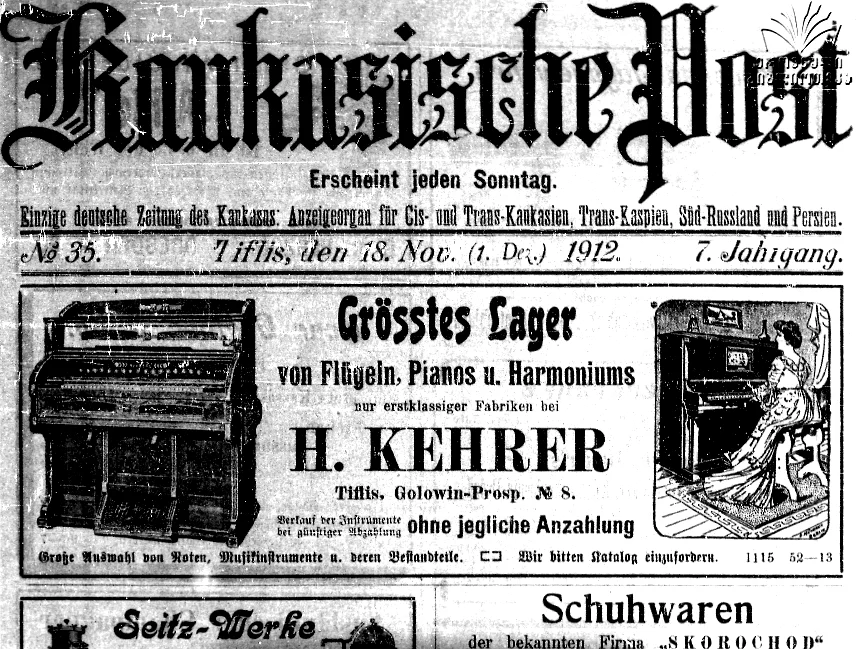
Kaukasischer Beitrag. Erscheint jeden Sonntag. Einzige deutsche Zeitung des Karkasas: Anzeigeorgan für Cis- und Trans-Kankasien, Trans-Kaspien, Süd-Russland und Persien. Nr. 35. 18. Nov. (1. Dez.) 1912.

