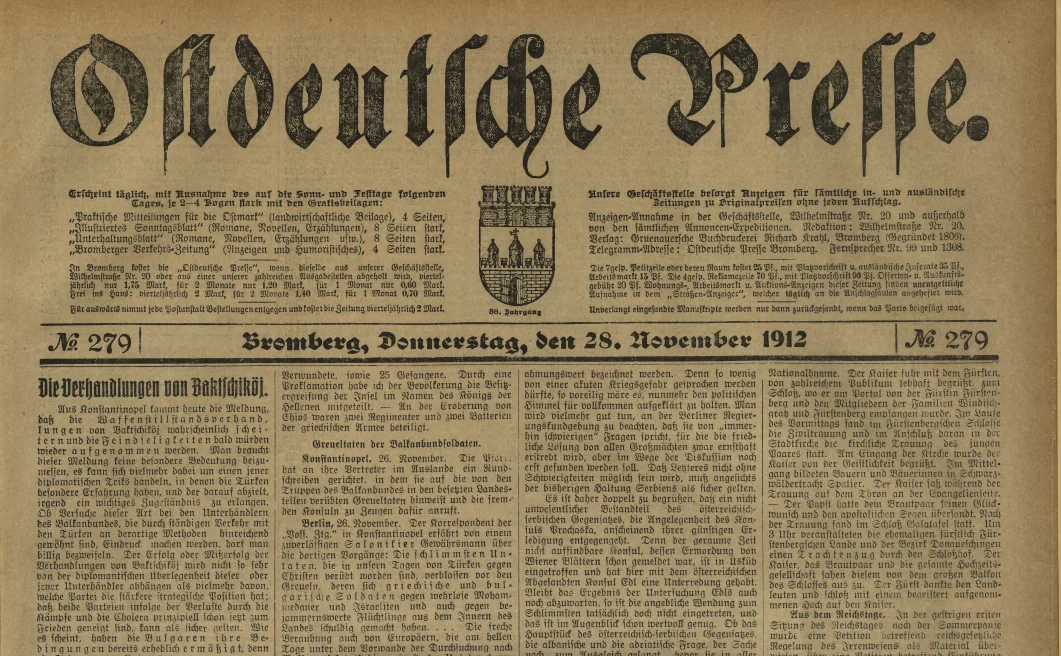

Cited from a newspaper article from 1912:
“Atrocities committed by the Balkan League troops.
Constantinople, November 26. The Porte has sent a letter to its representatives abroad, pointing out the atrocities committed by the troops of the Balkan League in the occupied territories and calling upon the foreign consuls to witness them.
Berlin, November 26. The correspondent of the Voff The newspaper “Ztg.” in Constantinople learns from a reliable salonnier about the events there: The worst atrocities committed by Turks against Christians in our time pale in comparison to the horrors perpetrated by Greek and Bulgarian soldiers against defenseless Muslims and Israelites, as well as against pitiable refugees from the interior of the country.
The brazen robbery of even Europeans, carried out in broad daylight under the pretext of searching for weapons, is the least of the misdeeds committed by the Greek soldiers. They take everything of value from people, watches and money, and when the haul is small, they mistreat their victims in the most shameful manner.
It is also noted that the unruly gang, which roams the army, breaks into the crowds in broad daylight and robs people of anything that is not nailed down. Just a modest entry in the register of their misdeeds. Worse still is the fact that the Greek authorities let things go as they are.
They also remained completely inactive when, on the occasion of the explosion of the powder tower, Greek soldiers slaughtered hundreds of Turks with utter glee. What the Greek troops are doing with a certain mastery in Caloniki is being carried out internally by Bulgarian gangs and soldiers. There, according to quite reliable sources, including some from the Greek Catholic community, all Muslims are being slaughtered, following the example set by the Serbs in Albania.
The war correspondent of the Messaggero reports, as does Voss. Zta.” is reported from Rome, terrible Albanian Albanians in Vilajet Kosiowo. As a result of Albanian resistance, the villages of Ferisiowitich [Ferizaj), Negodin [Negotin], Lipian [Lipjan] and Babus [Babushë] and others were completely destroyed, and the inhabitants were mostly slaughtered.
On the occasion of the explosion of the Bulver Tower, Greek soldiers slaughtered hundreds of Turks with barbaric glee. What the Greek troops in Thessaloniki are doing with a certain mastery is being carried out internally by Bulgarian bands and soldiers. There, according to entirely reliable sources, some of whom are of Greek Catholic descent, all Muslims are being slaughtered, following the example set by the Serbs in Albania.
The war correspondent of the “Messaggero” reports, as the “Vossische Zeitung” from Kom, terrible Greek Albanian massacres in Vilajet Kosiowo. As a result of Albanian resistance, the villages of Ferissovich, Negodin, Lipian, Babus, and others were completely destroyed, and the inhabitants were mostly killed.
A Catholic archpriest recounted that fierce fighting raged for three days around Ferissovich [Ferizaj). After the capture, the Serbian commander ordered the refugees to return home and surrender their weapons. Once this had been done, three to four hundred people were slaughtered. Only about half a dozen Muslim families remained in all of Ferissovich.”

Source
Ostdeutsche Presse. J. 36, No. 279 (28 listopada 1912). (Bromberg, Thursday, November 28, 1912, Often German Press.)

