
Summary
Slavery was an established part of medieval Serbian society long before its abolition in the nineteenth century. During the reign of Emperor Stefan Dušan in the fourteenth century, Serbian law explicitly recognized and regulated enslaved and unfree people. Dušan’s Code, issued in 1349 and expanded in 1354, contains provisions concerning the otroci, a highly dependent social group whose status could resemble slavery and, in some cases, could be hereditary.
Serbian medieval legal sources also use terms such as čeljadin, rab, and čeljad in connection with slaves and unfree people. The term čeljadin is particularly significant because it appears in Serbian charters and documents connected with Dubrovnik and could refer to people who had been captured in warfare and subsequently enslaved.
The existence of slavery in medieval Serbia was part of a wider Byzantine and Balkan legal and economic system in which slaves could be captured, bought, sold, inherited, and recovered. Serbian law was heavily influenced by Byzantine and Roman legal traditions, where slavery was already a recognized institution.
Dušan’s Code also placed restrictions on the treatment and sale of Christians. This demonstrates that slavery and Christian law existed alongside one another: slavery was legally recognized, but certain forms of enslavement and sale were prohibited.
Slavery eventually disappeared as a legally recognized institution in Serbia during the nineteenth century. The 1835 Sretenje Constitution explicitly prohibited slavery, and by the late 1830s it had ceased to exist as a recognized institution in autonomous Serbia.
The historical evidence therefore shows that slavery was not absent from Serbian history. It was already an established institution in medieval Serbia and was sufficiently important to be regulated by Serbian law under Stefan Dušan. The precise status of groups such as the otroci varied, but the surviving legal sources clearly document slavery, hereditary unfreedom, and the enslavement of people captured during warfare.
The Serbian tradition of Slavery and Slave ownership (Otros “otrok” and čeljadin “челꙗдинь”)
Slavery Was Already Present in Medieval Serbia
Slavery was already an established institution in Serbia during the Middle Ages, centuries before its modern abolition. Under Emperor Stefan Dušan in the fourteenth century, Serbian law explicitly recognized and regulated the status of enslaved and unfree people. This is clearly reflected in Dušan’s Code, issued in 1349 and expanded in 1354.
The Otroci: A Legally Dependent Class
The people known as otroci occupied one of the lowest positions in medieval Serbian society. They were dependent upon their masters and, in important circumstances, could be treated as hereditary property. Serbian legal historian Srđan Šarkić has described the otroci as a medieval category of slaves, while also pointing out that their legal position differed in some respects from slaves in the ancient Roman world.
The otroci could possess certain personal rights, but their lack of freedom and dependence upon their owners placed them close to the legal category of slavery. In some cases, their status was hereditary, meaning that children could inherit the unfree condition of their parents.
Čeljadin, Rab, and Other Terms for Slaves
Medieval Serbian legal sources contain several terms associated with slavery and unfree status, including rab, čeljadin, and čeljad. The term čeljadin is particularly significant. It appears in Serbian charters and agreements connected with Dubrovnik. Šarkić explains that, in certain contexts, a čeljadin could refer to a person who had been captured during warfare and subsequently enslaved. This provides evidence that slavery was connected not only with hereditary status but also with warfare and the capture of people.
Dušan’s Code Regulated Slavery
Dušan’s Code is one of the most important pieces of evidence for slavery in medieval Serbia. Rather than ignoring the existence of enslaved people, the Code established rules concerning their position in society. The otroci could belong to nobles and form part of their hereditary estates. Their status could therefore be passed from one generation to another. This shows that slavery was not simply an isolated practice. It was incorporated into the legal and economic structure of medieval Serbian society.
Slavery and the Serbian Nobility
Medieval Serbian nobles controlled land, dependent peasants, servants, and enslaved people. Some otroci were connected directly to noble estates and could be inherited together with other forms of property.
This placed enslaved people at the bottom of a highly hierarchical society. Above them stood dependent peasants, commoners, nobles, and the ruling dynasty.
The legal distinction between these groups was important, because medieval Serbian law did not treat every dependent person as a slave. Nevertheless, the existence of people who could be inherited as property demonstrates that slavery formed part of the social order.
Slavery and Warfare
Warfare was another important source of slavery. The medieval Balkans were characterized by frequent warfare between Serbian, Byzantine, Bulgarian, Hungarian, and other political powers. Captives could become enslaved, and the term čeljadin is connected in the sources with this process.
The wider Byzantine world also provides evidence of an established slave trade. Treaties between Byzantium and Rus’ from 911 and 944 contained provisions concerning slaves belonging to Russian merchants. Slaves could be bought, sold, lost, stolen, recovered, and returned to their owners. Medieval Serbia existed within this same Balkan and Byzantine legal and commercial environment. Dušan’s Code continued and developed this tradition while adapting it to the Serbian state.
Christianity Did Not Immediately End Slavery
The existence of slavery in medieval Serbia did not mean that Serbian law placed no restrictions on it. Dušan’s Code, for example, imposed severe punishment on anyone who sold a Christian into another religion. This shows the complicated relationship between Christianity and slavery during the Middle Ages. Christian law could restrict the sale and enslavement of certain people while still recognizing slavery as a legal institution.
Slavery Continued Until the Nineteenth Century
Slavery did not disappear from Serbian history with the end of the medieval period. The institution survived in different forms for centuries, until Serbia moved toward formal abolition during the nineteenth century. The Sretenje Constitution of 1835 explicitly prohibited slavery. By the later 1830s, slavery had ceased to exist as a legally recognized institution in autonomous Serbia, although it continued in territories that remained under Ottoman rule.
Later Forms of Captivity and Forced Labor
The later expansion of the Serbian state brought new forms of military domination, captivity, forced movement, and forced labor. During the nineteenth and early twentieth centuries, populations affected by Serbian military campaigns could experience severe coercion. During the Serbian retreat of 1915, prisoners were transported under extremely harsh conditions, and contemporary accounts describe prisoners being kept in chains.
These experiences should be distinguished from medieval hereditary slavery, however. A prisoner of war or detainee was not automatically a slave in the same legal sense as an otrok who could form part of a hereditary estate.
A Long History of Unfreedom
The history of slavery in Serbia therefore stretches back to the medieval period. During the reign of Stefan Dušan, Serbian law recognized several categories of people who lacked full freedom. The otroci occupied a particularly low social position, while terms such as čeljadin, rab, and čeljad were used in connection with slavery and unfree status.
Dušan’s Code did not create slavery in Serbia. Instead, it regulated an institution that was already part of Serbian society and the wider medieval Balkan world. The surviving legal evidence therefore makes it clear that slavery was a recognized part of medieval Serbian society long before its abolition in the nineteenth century.
20th century
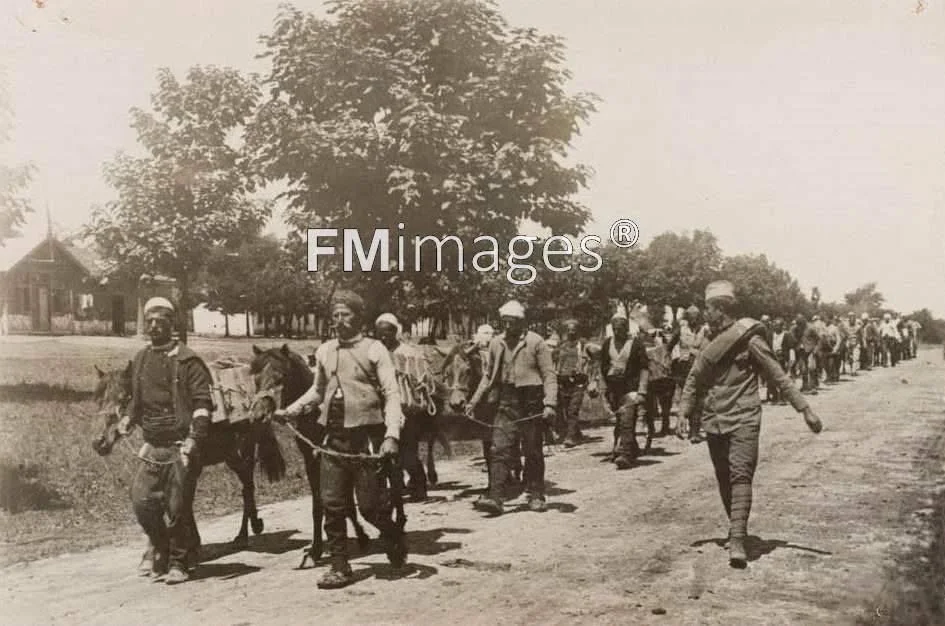
Slavery-like conditions for Albanian captives in 1915 in Skopje

Armenian forced to do labor work in Kalemegdan of Belgrad in 1913.
Conclusion
Slavery was not a modern development in Serbian history. It was already present in medieval Serbia and was sufficiently established to be recognized and regulated by Serbian law.
Under Stefan Dušan, enslaved and highly dependent people occupied a clearly defined position within the social hierarchy. Some could be connected to noble estates and inherit their status from their parents, while others could enter slavery through warfare and captivity.
The terminology and legal provisions preserved in Serbian sources provide direct evidence of these institutions. Whatever differences existed between the otroci and the slaves of the ancient or Atlantic worlds, the historical record demonstrates that forms of slavery and hereditary unfreedom were an established part of medieval Serbian society.
Sources
- Šarkić, Srđan. “The Legal Position of Vlachs and Slaves (Otroci) in Medieval Serbia.” Zbornik radova Pravnog fakulteta u Novom Sadu 44, no. 3 (2010): 37–51.
- Šarkić, Srđan. “Ideas of Stoic Philosophy in Serbian Mediaeval Law.” ISTRAŽIVANJA: Journal of Historical Researches, no. 29 (2018): 39–47.
- Dušan’s Code (1349/1354), especially Articles 21, 44 and 46.
- Petrović, M. Čeljadin in On the Law or Nomocanon of Saint Sava. Belgrade, 1990.
- Šarkić, Srđan. “Divisione Gaiane delle persone nel diritto medievale serbo.” Zbornik radova Pravnog fakulteta u Splitu 43 (2006): 355–360.
- Jovičić, Uroš. “Da li je bilo ropstva u Srbiji?” Nedeljnik.
- A History of Serbian Medieval Law. Brill.
- École française de Rome, study of Byzantine–Rus’ relations and the treaties of 911 and 944.

