
Summary
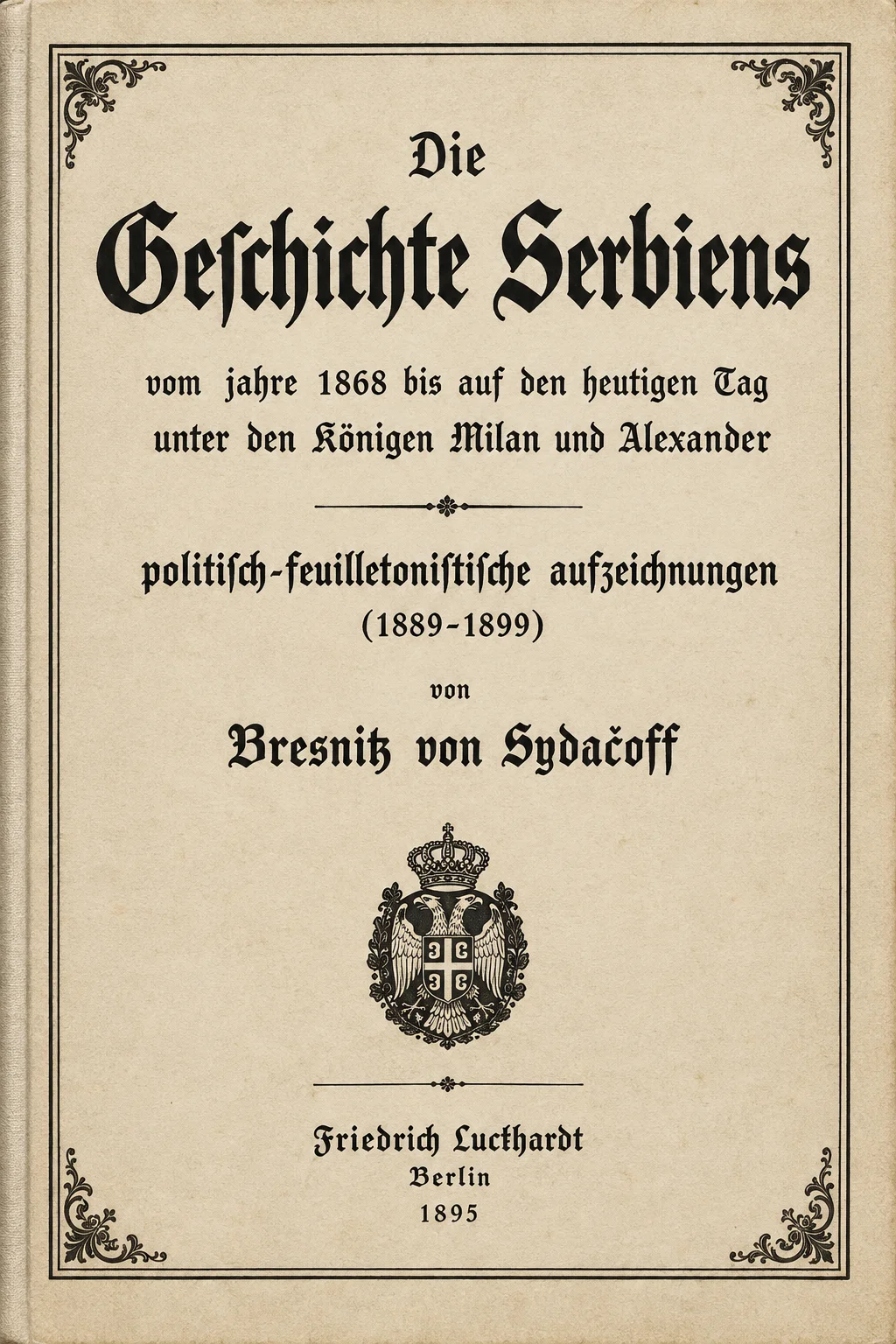
In 1895, the German-language book Die Geschichte Serbiens: vom Jahre 1868 bis auf den heutigen Tag unter den Königen Milan und Alexander, by Bresnitz von Sydačoff, presented a sharply critical portrait of contemporary Serbia. The work was published by Friedrich Luckhardt in Berlin and described itself as a collection of “politisch-feuilletonistische Aufzeichnungen” — political and feuilletonistic observations — concerning Serbia under Kings Milan and Alexander. The book is documented in the bibliographic collections of the University of Pennsylvania, with digitized copies available through HathiTrust.
One of the most striking passages is the author’s description of what he calls the “degeneration” of the Serbian nation. He writes:
“A foolish generation has disregarded this natural law, but the consequence is that the affliction, in the form of decay and degeneration, is befalling the entire nation. In Serbia, things happen daily which …”
The passage continues with an even broader accusation:
“Degeneration is spreading across the entire nation. In Serbia, things happen daily that document the decay of both society and the state…”
What makes the passage particularly revealing is the way the author moves from individual events to a diagnosis of the nation as a whole. Events occurring in Serbian political and social life are not treated as isolated incidents. Instead, Sydačoff interprets them as symptoms of a much larger process.
“Decay” becomes a metaphor for the condition of society, while “degeneration” is presented as something spreading through the Serbian nation. In his formulation, the distinction between political disorder and social decline virtually disappears: the condition of the state becomes evidence of the condition of the people.
The historical setting is equally significant. The book concerns Serbia during the reigns of Milan Obrenović and his son Alexander, a period marked by intense political conflict and by struggles surrounding the Serbian monarchy, political institutions and the country’s direction. Sydačoff himself wrote several works about Serbia and its ruling dynasty.
A biographical entry records him as a journalist who travelled extensively in Russia, the Orient and the Balkans and who had been in Serbia; it also lists Fünf Jahre am Hofe des Königs von Serbien (1895), Die Korruption in Serbien (1896), König Milan und seine Mission in Serbien (1898) and Das Ende der Dynastie Obrenović (1899) among his publications.
Seen in this context, the passage about degeneration can be read as part of a sustained critique rather than as an isolated observation. Sydačoff was interested not merely in describing political events but in interpreting what those events supposedly revealed about the Serbian state and society. The very structure of his writings — including separate works devoted to the royal court, corruption and King Milan — indicates his preoccupation with the relationship between political leadership and the wider condition of the country.
The final appeal in the quoted passage is particularly significant. Sydačoff calls upon the Serbian people to “rouse themselves at the last minute” and to become honest. His argument therefore changes from diagnosis to warning. The nation, in his presentation, has not yet reached an irreversible point of collapse; there remains, at least rhetorically, an opportunity for recovery.
This gives the passage a distinctly moral character. Political problems are translated into questions of personal and collective morality. Corruption is not merely an administrative problem; it becomes evidence of national decay. Political disorder is not simply a matter of institutions; it becomes evidence of degeneration. And the solution is not presented primarily as a particular constitutional reform, but as a moral awakening.
There is consequently a revealing tension in Die Geschichte Serbiens. The title presents the work as a history of Serbia from 1868 “to the present day,” yet the author’s language is often closer to political journalism and social criticism than to detached historical scholarship. His repeated use of concepts such as decay, degeneration, honesty and natural law gives the book the character of a contemporary indictment. The reader is not simply being told what happened; the reader is being encouraged to see the events as symptoms of a national condition.
The book is therefore valuable today not simply because of what it says about Serbia, but because it shows how the actions of Serbia were being interpreted by European observer at the end of the nineteenth century. Its vocabulary captures a period in which nations were frequently discussed as if they possessed a collective moral and biological vitality — capable of flourishing, weakening, decaying or regenerating.
Source
Bresnitz von Sydačoff, Die Geschichte Serbiens: vom Jahre 1868 bis auf den heutigen Tag unter den Königen Milan und Alexander: politisch-feuilletonistische Aufzeichnungen (1889–1899), Friedrich Luckhardt, Berlin, 1895. The work is catalogued as a historical source on Serbia and digitized copies are listed through HathiTrust.

