

Cited:
“The Banat of Mačva and the fortresses of Belgrade, Šabac, and others fell to the Sublime Porte in 1521. The former Serbian realm was divided into various governorships. The customs of the Serbs—especially those of the nobles and despots—remained crude and corrupt; gross and even unnatural acts of cruelty and crime were combined with an outward show of religiosity.
The nation consisted of three classes: the clergy—drawn partly from the Greek and partly from the Latin church, which were opposed to one another, yet superstitiously revered by the people; the nobility consisted of a higher class—the boyars—and a lower class of serfs. There was no middle class, except in the Dalmatian coastal towns. Despite the outward appearance of a monarchy, the system was essentially an oligarchy. Knowledge was found only among the clergy and among Dalmatians and foreigners—particularly Germans—in Serbia”.
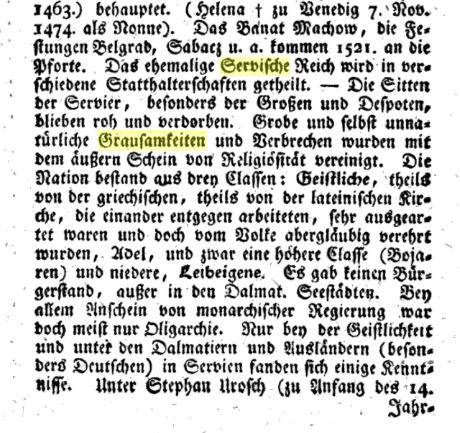
Source
Anleitung zur Kenntniß der allgemeinen Welt- und Voelker-Geschichte für Studirende Bis auf die Entdeckung von Amerika. Vierter Theil. Volume 4. Christian Daniel Beck. 1807.

