
Abstract
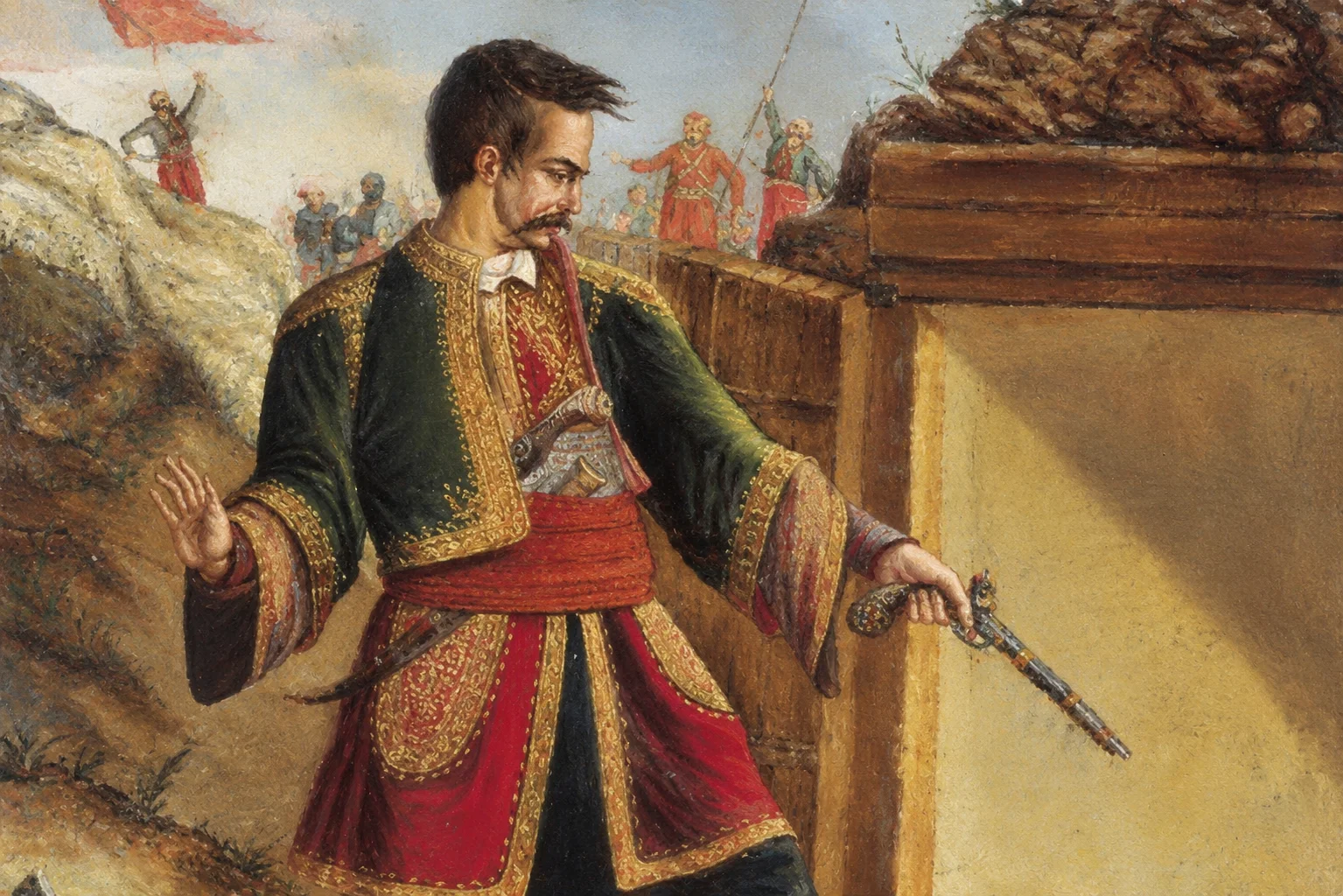
Stevan Sinđelić (Стеван Синђелић) (c. 1770–1809) is remembered as one of the great heroes of the First Serbian Uprising and as the commander who famously detonated the powder magazine at Čegar during the Battle of Nish in 1809. Serbian historical tradition has consequently incorporated him firmly into the national pantheon. Yet the ethnic and demographic history of the region in which Sinđelić was born and raised was considerably more complex than later national narratives might suggest. This raises a provocative historical question: could Stevan Sinđelić have descended from an Albanian Orthodox family that had become culturally and linguistically assimilated into the Serbian population of the Smederevo Sanjak?
The hypothesis cannot presently be established as fact. There is no known documentary evidence that conclusively identifies Sinđelić himself as Albanian. Nevertheless, the question merits examination because Albanians were historically present in numerous settlements throughout the wider Smederevo and Belgrade regions, while Orthodox Albanians constituted a real component of the broader Balkan population. The possibility is further complicated by the uncertain history of Sinđelić’s surname and a speculative phonetic comparison with Albanian forms such as Sinxheli or Singjeli. Such linguistic resemblance is insufficient by itself to demonstrate ancestry, but it provides a potentially testable avenue for further genealogical research.
The purpose of this article is therefore not to replace one national interpretation with another, but to reopen a question that has largely been excluded from conventional accounts: whether the man remembered as one of the foremost Serbian heroes of 1809 could have possessed an Albanian Orthodox ancestral background.
The Serbian hero of Čegar
Stevan Sinđelić occupies an exceptional position in the historical memory of the Serbian First Uprising. In 1809, during the struggle against Ottoman rule, he commanded Serbian insurgent forces at Čegar Hill near Nish. When his position was overwhelmed by Ottoman forces, Sinđelić reportedly fired upon the powder magazine, causing a massive explosion that killed him, his remaining soldiers and many of the Ottoman troops who had entered the defensive position. His death subsequently became one of the most famous episodes of the Serbian revolutionary tradition.
Sinđelić was born around 1770 in the village of Vojska in the wider Ćuprija area (a “nahija” known to have had an Albanian population). Sinđelić later lived in Grabovac. The conventional Serbian account explains his surname as a matronymic derived from his mother’s name, Sinđelija, following the death of his father, Radovan Rakić. This explanation is important because it provides a plausible Serbian linguistic history for the surname. It does not, however, independently establish the deeper ethnic ancestry of the family.
The territory in which Sinđelić lived was not a modern Serbian nation-state. It formed part of the Ottoman Sanjak of Smederevo, commonly known in European sources as the Pashalik of Belgrade. The population of this region was shaped by centuries of migration, settlement, conversion, intermarriage, linguistic assimilation and political change. Muslims, Orthodox Christians, Catholics, Albanians, Slavs, Vlachs, Turks, Bosniaks and other groups interacted within the same geographical space.
The Albanians of Smederevo and the Belgrade Pashalik
One of the most important premises of the hypothesis is the documented presence of Albanians in the wider region. Albanian historiographical literature shows that Albanian settlement historically extended much farther north and east than the territories with which Albanians are most commonly associated today. Among the towns and settlements mentioned in this literature are Belgrade, Smederevo, Kladovo, Jagodina, Ćuprija, Kruševac, Aleksinac, Paraćin, Negotin and other centres of the Sanjak of Smederevo.
Radoshi Trbjeshan
Radoshi Trbjeshan, in his discussion of the First Serbian Uprising, is cited as stating that the overwhelming majority of Albanian inhabitants had moved from cities and towns including Karanova, Kruševci, Paraćin, Rožanj, Smederevo, Kladovo, Belgrade, Šabac and Aleksinac, as well as from numerous smaller settlements. The statement is significant because it places Albanians within the geographical environment from which the First Serbian Uprising emerged rather than restricting Albanian historical presence to Kosovo and the southern Balkans.
Tihomir Đorđević
Tihomir Đorđević is likewise cited in Albanian historical literature in connection with the population of the cities and towns of the Pashalik of Belgrade. According to the interpretation presented there, Ottoman sources frequently referred to the Muslim inhabitants of these urban centres as “Turks.” Such terminology is problematic when used as a modern ethnic category because Ottoman administrative language did not necessarily distinguish between Turks, Albanians, Bosniaks and other Muslim populations in the manner of modern national censuses.
Radmila Tričković
Radmila Tričković is cited as describing Albanian insurgents in 1785 as active around Kruševac, Pustareka, Toplica, Kadilić, Leskovac, Nish and Belgrade, with roads leading towards Nish, Belgrade, Pirot, Vranje, Novi Pazar and Prishtina affected by their activities. The same source material identifies a number of towns in which Albanians were present, including Belgrade, Smederevo, Kladovo, Jagodina, Ada Kaleh, Karanovac, Poreč, Ćuprija, Rudnik, Kruševac, Aleksinac, Užice, Šabac, Paraćin and Negotin. Most significantly for the present argument, it states that in certain places, including Smederevo, Kladovo and Ćuprija, Albanians were more numerous than Serbs.¹
This establishes an important historical proposition: Albanian settlement in the wider region was not a modern invention and cannot simply be excluded from the demographic history of the Smederevo Sanjak.
S. Brestovci
S. Brestovci’s discussion of Albanian traces likewise refers to Albanian residents in a number of centres, including Kruševac, Aleksinac, Karanovac, Belgrade, Vidin, Kladovo and Smederevo.² The cited material therefore presents Smederevo and the surrounding territory as part of a broader zone in which Albanian communities had historically existed.
If these references are correct, then the geographical premise behind an Albanian ancestry hypothesis for a family from the region is entirely plausible. The question becomes one of genealogy rather than geography.
Smederevo and the evidence of the Ottoman urban landscape
One work concerning the Islamic heritage of the Illyrian-Albanian lands states that Smederevo once possessed twenty-four mosques, none of which survived, while similarly substantial numbers of mosques had existed in cities such as Osijek, Herceg Novi, Kruševac and Mitrovica.³
The disappearance of Ottoman institutions illustrates the extent to which the demographic and cultural landscape was subsequently transformed. The history of Smederevo therefore cannot simply be reconstructed from its later nineteenth-century Serbian identity. Communities could disappear through migration, expulsion, conversion, assimilation or demographic replacement, leaving comparatively little trace in later national historiography.
This is particularly relevant to the possibility of Albanian Orthodox ancestry. An Orthodox Albanian family that gradually adopted Serbian as its everyday language could eventually become indistinguishable from its Serbian-speaking neighbours. Within one or two generations, the family’s ethnic origin might disappear from ordinary documentation. This possibility should not be confused with proof that this happened to Sinđelić. It merely establishes a historically plausible mechanism by which an Albanian family could have become incorporated into the Serbian population.
The question of Orthodox Albanians
The historical Albanian population was never religiously uniform. Albanians were and remain divided among several religious traditions, including Islam, Roman Catholicism and Eastern Orthodoxy. Orthodox Albanian communities were particularly important in southern Albania, Epirus and neighbouring regions, while Albanian-speaking Orthodox Christians could also be found elsewhere in the Balkans. Consequently, an Albanian ancestor of Sinđelić would not necessarily have been Muslim.
This distinction is crucial. If an Albanian Orthodox family entered a predominantly Serbian Orthodox environment, religious affiliation alone would not necessarily have distinguished it from its Serbian neighbours. Both communities could attend Orthodox churches, use Christian names and participate in the same religious institutions while speaking different languages or retaining different family traditions. Over time, linguistic assimilation could erase the distinction entirely.
The resulting process might therefore have looked something like this: an Albanian-speaking Orthodox family becomes established in the Smederevo region; subsequent generations adopt the local South Slavic language; intermarriage increases; Albanian ceases to be spoken; and by the beginning of the nineteenth century the descendants are regarded locally as Serbian.
Such processes were not unique to Albanians. The Balkans contained numerous populations whose linguistic and ethnic identities changed over generations. This is why the later Serbian identity of Sinđelić cannot, by itself, answer the genealogical question.
Could “Sinđelić” be elated to “Sinxheli” or “Singjeli”?
The conventional Serbian explanation connects Sinđelić with his mother, Sinđelija. This is a coherent explanation and should remain the starting point for any serious discussion of the name. The surname is therefore not evidence of Albanian ancestry in itself. Nevertheless, a comparative linguistic question can be raised. Could Sinđelić conceivably be related to an Albanian form such as Sinxheli or Singjeli?
The resemblance is striking enough to justify investigation, but not strong enough to constitute proof. Albanian orthography contains the letters “x” and “gj,” representing sounds that can produce forms superficially comparable with the Serbian “đ” sound. Names such as Singjeli are also attested among Albanians. The possibility therefore exists that a family name could have undergone phonological or orthographic adaptation when moving between Albanian and South Slavic linguistic environments. The Sinxheli/Singjeli proposal should therefore be regarded as a research hypothesis rather than an etymological conclusion.
Sinđelić and the wider problem of revolutionary identity
The First Serbian Uprising is normally presented as a Serbian national revolution against Ottoman rule. That description is appropriate for the political movement that subsequently emerged, but the social world from which the uprising developed was more heterogeneous.
The revolutionary territories contained populations of different origins and identities. People could participate in the Serbian uprising for political, religious, economic, local or personal reasons without necessarily possessing what a modern historian would define as an exclusively Serbian ethnic genealogy.
This distinction becomes especially interesting when considering the traditions surrounding Karađorđe Petrović. Both Serbian and French sources have argued that Karađorđe himself had Kelmendi ancestry, connecting his family to the Albanian Catholic Kelmendi tribe.
From Albanian ancestor to Serbian national hero
The most interesting possibility is consequently not that Sinđelić was secretly “really Albanian” in the modern national sense. That formulation would itself impose a nineteenth- and twentieth-century conception of nationality upon an eighteenth-century individual.
The more historically meaningful possibility is that Sinđelić could have belonged to a family whose ancestry was mixed, partially Albanian, Orthodox and subsequently Serbian-speaking. His descendants could then have become fully integrated into the Serbian population while retaining no conscious memory of an earlier Albanian identity.
Such a process would explain why later Serbian sources could remember Sinđelić as completely Serbian without necessarily contradicting the existence of a much older Albanian ancestor. Ethnic identity in the Balkans was not always transmitted in a simple biological or genealogical line. Language, religion, marriage, residence, political allegiance and local community could all reshape identity.
The nineteenth century intensified national categorization. What had previously been a local or religious identity could increasingly become defined in explicitly national terms. A family that was culturally Serbian by the time of the First Serbian Uprising could therefore possess ancestors who had been identified differently one or two generations earlier.
Smederevo before Serbian consolidation
According to a historical textbook, Serbia obtained control over Užice, Soko, Belgrade, Šabac, Smederevo and Kladovo in April 1867.⁴ By this point the political landscape had changed profoundly from the one in which Sinđelić had lived and fought.
The later Serbian state naturally constructed a national historical narrative around the First Serbian Uprising and its heroes. Sinđelić became one of its central symbols. But the fact that he became a Serbian national hero does not retrospectively turn the entire population of his birthplace into an ethnically homogeneous Serbian population.
Nor does the Serbian political character of his uprising prove that every participant or ancestor of every participant had exclusively Serbian ancestry. This is precisely where genealogical history and national mythology must be separated.
Conclusion
Stevan Sinđelić is remembered as a Serbian revolutionary hero, and his role in the First Serbian Uprising is beyond serious dispute. The more difficult question concerns the ancestry of the man behind the national symbol.
The historical evidence establishes that Albanians were present in the wider Smederevo and Belgrade regions and that Albanian communities existed in a number of towns and settlements associated with the territory of the First Serbian Uprising. Historical references specifically identify Smederevo and Ćuprija among places where Albanians lived. The region was therefore ethnically and culturally more complicated than a retrospective picture of an exclusively Serbian population would suggest.
This creates the geographical possibility for Albanian ancestry in families from the region. The existence of Orthodox Albanians creates a further possibility: an Albanian family could have been Christian Orthodox and could therefore have become incorporated into the Serbian Orthodox population without a religious boundary preventing assimilation.
The name Sinđelić presents an intriguing but inconclusive linguistic question. The established explanation connects the surname to Sinđelija, Sinđelić’s mother. At the same time, the possible resemblance to Albanian forms such as Sinxheli or Singjeli deserves comparative investigation. At present, however, this resemblance is speculative and cannot be used as proof of Albanian ancestry.
Notes
- Radmila Tričković, cited in Albanian historiographical literature concerning the Albanian population of the Smederevo region, including the discussion of Albanian settlements in the Pashalik of Belgrade. See also the discussion reproduced in Balkan Academia, “Stevan Sinđelić and the Albanians of Smederevë,” April 22, 2025.
- S. Brestovci, Gjurmime albanologjike, cited in relation to Albanian traces and Albanian settlements in Smederevo and neighbouring centres.
- See discussion of the Ottoman Islamic architectural heritage of Smederevo in Islami në trojet iliro-shqiptare gjatë shekujve, cited in Balkan Academia, “Stevan Sinđelić and the Albanians of Smederevë.”
- Historija, class 8 textbook, 1953, cited for the transfer of Užice, Soko, Belgrade, Šabac, Smederevo and Kladovo to Serbia in April 1867.
- Mittheilungen der Kaiserlich-Königlichen Geographischen Gesellschaft, discussion of the historical names and etymology of Semendria/Smederevo.
Bibliography
Brestovci, S. Gjurmime albanologjike. Prishtina: cited edition and relevant discussion of Albanian traces in Serbia.
Đorđević, Tihomir. Works on the population and urban settlements of the Pashalik of Belgrade.
Tričković, Radmila. Works concerning the demographic and political history of the Ottoman territories surrounding Belgrade, Niš and central Serbia.
Historija. Belgrade, 1953. Class 8 historical textbook.
Islami në trojet iliro-shqiptare gjatë shekujve. Relevant discussion of Ottoman Islamic architectural heritage in Smederevo and other Balkan towns.
Mittheilungen der Kaiserlich-Königlichen Geographischen Gesellschaft. Historical discussion of Semendria, Smederevo and the origin of the city’s name.

