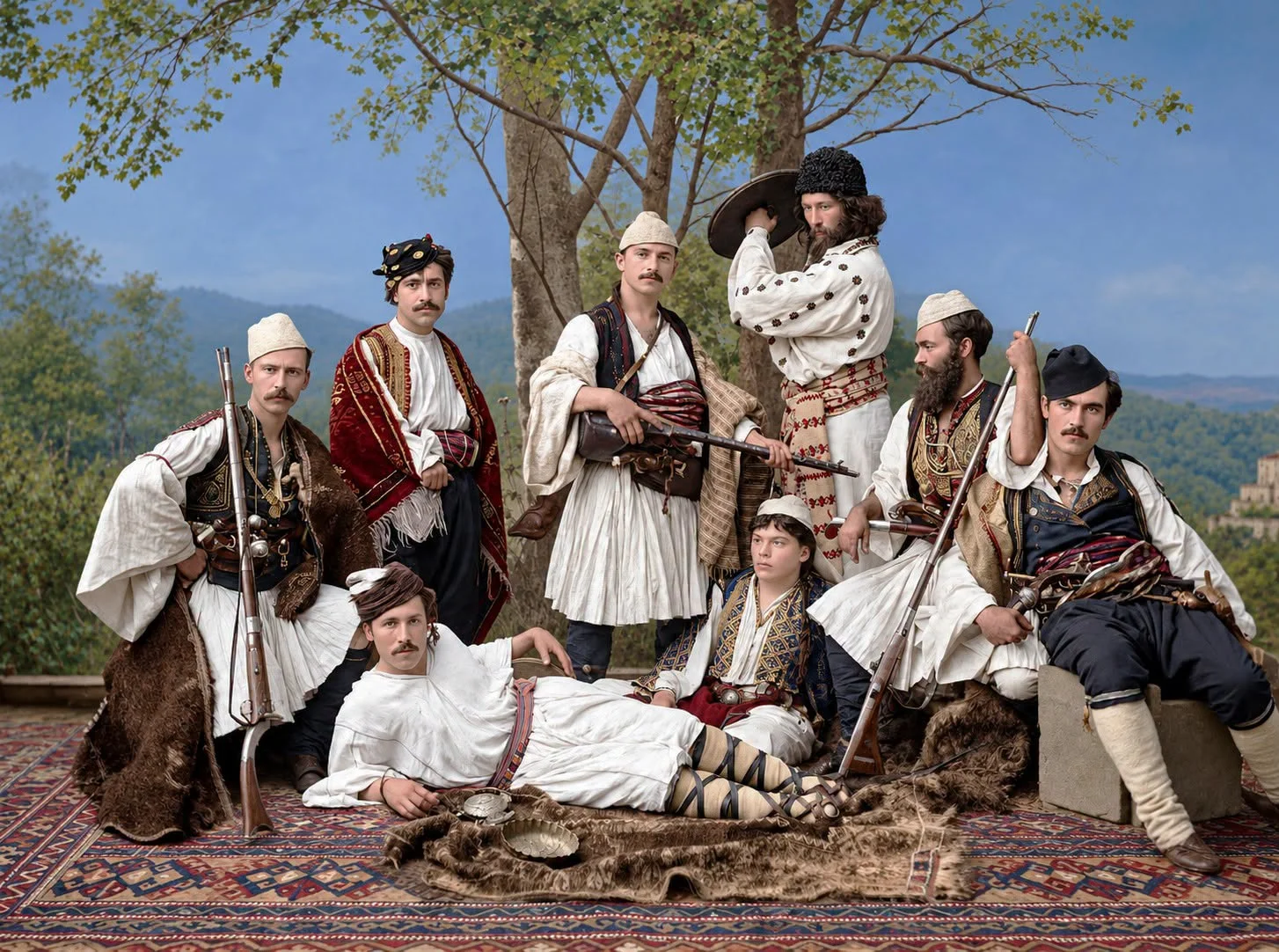

Image from Fustanella page on Facebook.
In some Serbian irredentist, extremist circles, there is a lie circulating that Albanians came to the Balkans via the Ottoman invasion. This is a flagrant lie. Another lie being perpetuated is that Albanians had no alphabet before 1912. This too is a lie.
Truth:
The claim is false on both counts. Albanians (as a people speaking a distinct Indo-European language) were present in the western Balkans long before the Ottoman (Osman) Empire, and Albanian had written forms centuries before the early 20th century standardization of its modern Latin alphabet.
Albanians did not “come to the Balkans with the Ottoman Empire”
Scholarly consensus holds that Albanians have a western Paleo-Balkan origin, with continuous presence in the region. The leading view links them to the ancient Illyrians (or a closely related Paleo-Balkan population such as a Thracian/Daco-Moesian branch in minority theories). Key points:
The ethnonym Albanoi appears in the 2nd century AD in Ptolemy, referring to an Illyrian tribe in what is now central Albania (around Albanopolis).
Albanian is an independent Indo-European branch (sometimes called Albanoid) with its formative core in the Balkans after early Indo-European migrations. It shows early contacts with Doric Greek and other local languages. Place-name continuity (e.g., Scodra – Shkodër, Dyrrhachium – Durrës) and genetic/ancient DNA evidence support long-term regional continuity from the Bronze/Iron Ages, with ancestors largely in place by around 800 CE.
Medieval references to Albanians as an ethnic group appear by the 11th century. They were already in the western Balkans (fighting, living under local principalities, interacting with Byzantines, Serbs, etc.) when the Ottomans began expanding into the region in the late 14th century. The Ottomans entered Albanian areas around 1385–1430s and completed major conquests after Skanderbeg’s resistance (mid-15th century, with key holds falling 1478–1501). Many Albanians resisted, fled (including to Italy, forming the Arbëreshë communities), or later converted and rose within the Ottoman system—they were not newcomers who arrived with the Ottomans.
The reverse migration pattern is better attested: Albanians moved into Anatolia/Turkey during and after the Ottoman period (as soldiers, administrators, settlers, or later refugees), not the other way around as a mass population transfer into the Balkans.
Claims of a late Ottoman-era arrival are a fringe or nationalist talking point, not supported by linguistic, archaeological, historical, or genetic evidence. Albanians are among the older continuous populations of the western Balkans; Slavic migrations (6th–7th centuries) and later Ottoman rule layered on top of pre-existing groups.
The Albanian alphabet was not invented in the early 20th century
The modern standardized 36-letter Latin-based alphabet was agreed at the Congress of Manastir (Bitola) in November 1908. That was a unification of competing systems amid the Albanian National Awakening, not the invention of writing.
Albanian was written much earlier, using adapted Latin, Greek, Arabic, and original scripts:
A 1332 reference notes that Albanians, despite having a language different from Latin, used Latin letters in their books.
The oldest undisputed Albanian text is the 1462 baptismal formula by Archbishop Pal Engjëlli: “Unte paghesont premenit Atit et birit et spertit senit.”
Other early records include Arnold von Harff’s word list (1496–97), the Meshari (Missal) of Gjon Buzuku (1555—the first known book in Albanian), works by Lekë Matrënga (1592), and later authors.
Original Albanian scripts existed, including the Elbasan alphabet (mid-18th century, used for a Gospel manuscript), the Berat alphabet, and the Todhri alphabet.
Writing was fragmented by region, religion (Catholic areas favored Latin; Orthodox used Greek; Muslim areas sometimes Arabic), and lack of a single standard under Ottoman rule. The 1908 congress resolved this for national purposes. Many languages (including some with far older spoken histories) standardized orthographies relatively late; that does not mean the people or language appeared then.
In short: both parts of the claim reverse the historical record. Albanians were a pre-Ottoman Balkan population with deep local roots, and their language had a written tradition long before 1908.

