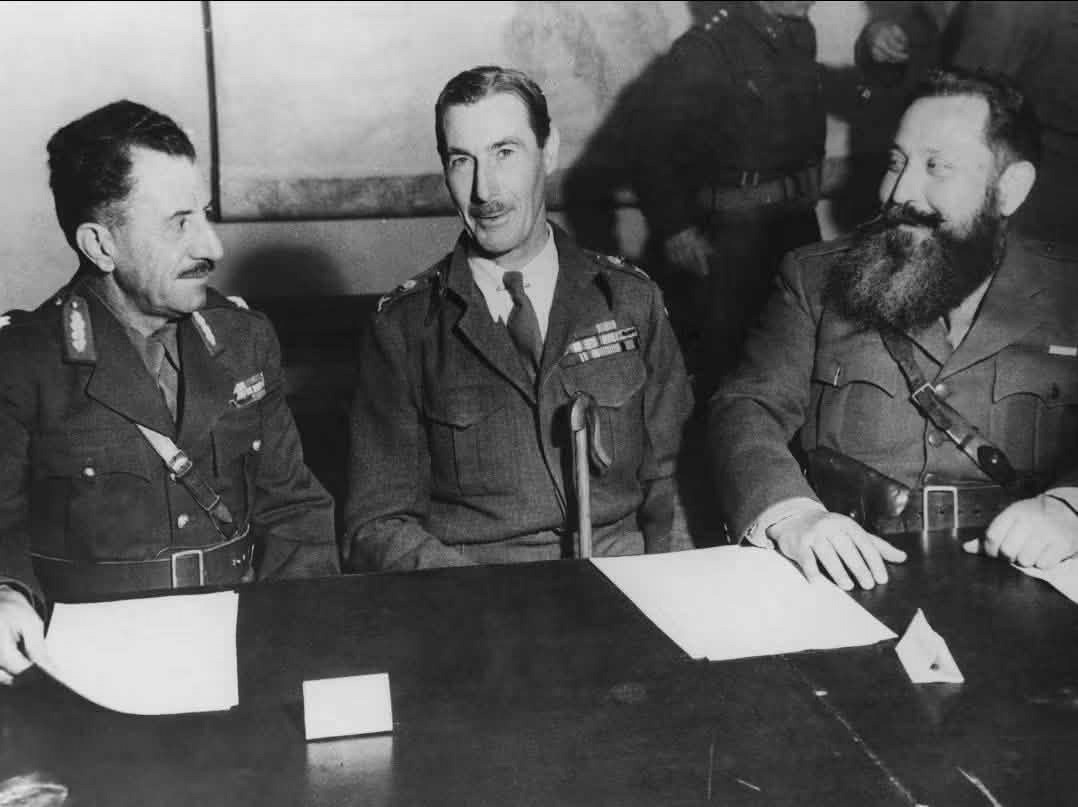

Translated from German to English. Edited by Petrit Latifi. Discovery by Artur Vrekaj. Document titled “10.1524_mgzs.1989.45.1.111.pdf”. Authored originally by Heinz Richter. Geman title: “General Lanz, Napoleon Zervas und die britischen Verbindungsoffiziere”. 2026.
Abstract
This article examines the complex and contested forms of Greek-German cooperation that developed during the German occupation of Greece in the Second World War. Focusing on the relationship between the German military authorities, Napoleon Zervas and the National Republican Greek League (EDES), and British liaison officers, it reassesses the conventional interpretation of the Greek resistance solely as a conflict between the Axis occupation forces and the resistance movements.
Particular attention is given to the evidence concerning General Hubert Lanz, the German XXII Mountain Army Corps, and the intelligence and communication channels connecting German officers with Zervas and the British Military Mission. The article draws extensively on German military archival records, post-war trial documents and affidavits, British reports, contemporary intelligence material, and the published works of historians including Heinz Richter, C. M. Woodhouse, Nigel Clive, and S. Sarafis.
The evidence indicates that contacts between German officers and representatives of EDES were not limited to isolated or informal encounters. During 1943–1944, communication developed around military intelligence, local ceasefires, the German withdrawal from Greece, and the strategic position of Zervas in relation to both the Germans and the British. The role of British liaison officers is particularly important, since they operated within a complex environment in which Allied interests, Greek political rivalries, resistance strategy, and German military calculations frequently intersected.
Introduction
The commander-in-chief of the right-wing Greek resistance movement EDES (= Ethnikos Dimokratikos Ellinikos Syndesmos – National Republican Greek League) has often been called the Greek Mihajlovic in the past because of his dubious contacts with the German occupying forces. But unlike his Yugoslav counterpart, Zervas was on the side of the victors in Greece after the war; thus he escaped Mihajlovic’s unfortunate fate, and although his former British comrades-in-arms had their doubts about his contacts with the enemy at the time, they stuck to their line in their memoirs:
Zervas’s contacts with the Germans were either completely non-committal or existed only in the imagination of former German officers. Until 1973, any suggestion that these contacts had been anything more than purely non-committal was met with vehement denials from former EDES members, and former SOE (Special Operations Executive) officers like C. M. Woodhouse dismissed such suggestions as absurd.
In his book *Apple of Discord*, Woodhouse ridiculed the arguments put forward.1 Even in the mid-1950s, when he gave a lecture on the Greek Resistance in his capacity as director of Chatham House at the Institute for Contemporary History in Munich, he clung to this version: When, during the subsequent discussion, General Lanz spoke up and stated that he had concluded a military truce with Zervas in 1944, Woodhouse denied this so categorically that Lanz was left with the impression that he was being accused of lying.2
For the Greek left, on the other hand, there had never been the slightest doubt about the nature of these contacts (they accused Zervas of collaboration), but they had never been able to present irrefutable evidence. In 1973, the author, with the help of German military records, succeeded in demonstrating that the contacts between Lanz and Zervas had been far closer than had previously been believed or admitted; that they had at times come dangerously close to collaboration, if not outright treason.
This likely prompted Woodhouse to abandon his previous stance of denial. In the introduction to the Greek edition of *Apple of Discord*, he admitted for the first time that Zervas’s contacts had by no means been above suspicion. The former deputy commander of EDES, Komninos Pyromaglou, also initially rejected the author’s arguments. However, when confronted with all the details, he found himself unable to deny their accuracy and accused Zervas of treason.
When the Greek translation of “Greece Between Revolution and Counter-Revolution” was finally published in 1979, it caused considerable excitement among former EDES members, particularly since Pyromaglou refused to condemn the theses presented therein as false. In his memoirs, published in 1982, Woodhouse went even further. He accepted that “Zervas had in fact made a secret bargain with the Germans during November [1943], unknown to Pyromaglou or any of his senior officers.”
But Woodhouse immediately qualified this statement by calling Zervas’s arrangement a “kapaki” (a ruse). He then emphasized, “We [the British Liaison Officers, or BLO] knew little of these intrigues.” Zervas never told Barnes [BLO at 111 MG M 1/89 Zervas’ HQ] or myself about his private truce.”8 These carefully chosen words, however, obscure more than they reveal.
They say neither how far this secret agreement with the Germans went, nor do they precisely establish what the BLOs on the ground actually knew. And above all, they are limited to the contacts in the winter of 1943. Woodhouse remained strictly silent about the later contacts, especially those in the summer of 1944, even though they were very well known.9 Here, the former SIS agent and later diplomat Nigel Clive is far more open.
On page 116 of his memoirs,10 he publishes the translation of a situation report from the XXII. (Birth) Army Corps of 7 August 1944, which had fallen into his hands, and commented: “This was the first time I had seen an official German document formally referring to Zervas’ loyal attitude and it both puzzled and disturbed me. My earlier suspicions that there had been some form of collusion at some level were now, as it were, confirmed in writing.”11
When Clive confronted Barnes with the German document, “I [he] sensed a certain embarrassment in Barnes’s reaction to my [his] information. He dismissed the reference to Zervas’s loyal attitude as the kind of rubbish we can [they could] expect from the Germans.” However, Clive’s suspicion was all too justified: Barnes’s embarrassment was not only caused by Zervas’s recent contacts—as Clive assumed—but also because he was well aware of Zervas’s earlier contacts with General Lanz, which had begun as early as October 1943.
General Hubert Lanz was an unusual figure. Clive’s description of Lanz’s career and character is almost accurate. Indeed, Lanz possessed a quality rarely seen in German generals: a sound conscience and the courage to act according to its ethical imperatives. Whenever he received an order that would have violated his conscience, he was prepared to refuse it or find a way around it.
Thus, during his deployment in Russia, he avoided enforcing Hitler’s Commissar Order by insisting that captured Soviet commissars should not be shot unless they had participated in combat. On February 1, 1943, the day after General Paulus’s surrender at Stalingrad, he became commander of the so-called Army Detachment Lanz, tasked with closing the gap on the Eastern Front between Kursk and Stalino.
On January 26, 1943, during one of his night sessions at his headquarters, the Wolf’s Lair, Hitler had ordered him to hold Kharkov at all costs. Lanz was personally responsible for ensuring that this order was carried out. The next day, Lanz flew to Kharkiv in a snowstorm. Upon arrival, he discovered that he had only one Panzer regiment (Großdeutschland) under Colonel von Strachwitz at his disposal as a reserve.
The Waffen-SS units under his command were fighting desperately against the Russian onslaught. During the initial briefing, von Strachwitz informed Lanz and his chief of staff, Major General Dr. Hans Speidel, about the crimes committed by the SS behind the front lines. They quickly agreed that Hitler was a criminal who demanded the senseless self-sacrifice of entire armies in hopeless military situations. He therefore had to be eliminated.
Strachwitz’s soldiers were to attempt to arrest Hitler during his upcoming visit to Poltava and, if his bodyguards resisted, kill him. Unfortunately for the conspirators, Poltava fell to the Russians, and Hitler instead visited Zaporozhets, where he was beyond their grasp.12 The Russian offensive westward was so successful in the following days that Lanz’s army group was in danger of being encircled and destroyed.
Faced with this situation, Lanz ordered a retreat from the Kharkov area, thereby saving the divisions under his command. Hitler was furious and relieved Lanz of his command on February 21, 1943. For a time, Lanz was out of favor. Court-martial and concentration camps loomed. Eventually, Hitler calmed down and demoted Lanz to commander of the XXII (Mountain) Army Corps.
Although Lanz lost all contact with the military and civilian conspirators against Hitler from then on, he adhered to his nonconformist line. Thus, in connection with the Italian surrender in Athens, he managed to avoid bloodshed by once again circumventing a strict order from the Führer. And when, in the autumn of 1943, the SS wanted to deport the Jews in Epirus, he forbade any interference in his corps area.
Eichmann’s emissaries therefore had to wait until his and his staff’s absence in Hungary between March and April 1944 to capture the Epirote Jews. The same tendency to avoid unnecessary bloodshed can also be observed in his approach to the partisan problem. Finally, Lanz’s military abilities are evidenced by two facts: he was one of only two staff officers awarded the Knight’s Cross for exceptional service after the conclusion of the French campaign, and he was the designated commander of Operation Felix (the conquest of Gibraltar), for which he visited Algeciras together with Admiral Canaris.
Lanz arrived in Ioannina at the beginning of September 1943. A few days later, he convened a meeting of 30 local dignitaries. He explained to them that he had come on orders, intended to act peacefully, was of course aware of the existence of Zervas’s partisans, but wanted no violent clashes. To avoid losses on both sides, he placed particular hope in the good offices of Bishop Spiridon of Ioannina.14 Lanz considered the partisan war unmilitary, since the innocent civilian population suffered the most.
For this reason, he attempted to reach a kind of military truce with the leader of the national partisans, Napoleon Zervas.15 However, no evidence has been found that Lanz also considered the fight against the left-wing partisans unmilitary. Lanz was not a Nazi, but a conservative anti-communist.
He knew that Zervas was also anti-communist and apparently considered him an honest conservative soldier with whom he could negotiate officer to officer. He never understood that Zervas was an unprincipled opportunist, a misjudgment that Lanz would later pay dearly for. During the Nuremberg Trials, Lanz stated in this context:
“An alliance with the Communists was, in my opinion, out of the question, even judging it now in retrospect. You [Lanz’s defense attorneys] are right when you say that I should have allied myself with the stronger enemy. That is, purely realistically speaking, perhaps correct from a military perspective; but that was out of the question. I would like to explain the following:
From the very first day, I always saw my task in Greece solely as preventing an Allied landing in Greece. That was my actual task. The partisan warfare that ensued, which I considered an unpleasant and, from a military point of view, extremely undesirable task, was forced upon us; it was there when I arrived […] This attitude was also decisive in my decision to reach the agreement with Zervas, because Zervas ultimately represented the national or conservative element of order, if I may put it that way, against Communism.”
Furthermore, as a general, I felt more obligated to the old soldier […] than to Communism. That was simply the nature of things. But the crucial point was that we harbored no animosity towards the Greeks or against Greece, and that I supported Zervas in the interest of Greece against Communism.”16 At the end of September 1943, Lanz instructed his enemy officer (Ic), Gebhard von Lenthe, to make contact with Zervas.17 At the same time, he informed his superior command, Army Group E in Thessaloniki, of his intention to reach an agreement with Zervas and requested approval.
Some time later, the reply came from the High Command of the Armed Forces (OKW): negotiations with Zervas would only be permitted on the condition that he capitulate and hand over his partisans’ weapons to the corps.18 At the same time, Lanz was reprimanded by Army Group E for interfering in politics.19 Lanz was very angry about this decision, but even at the risk of being held accountable, he decided to continue his course.
This initial contact, which yielded no significant result, is described elsewhere.20 The second round of negotiations began in mid-December, when, in the civil war between EDES and ELAS (= Ethnikos Laikos Apeleftherotikos Stratos — National People’s Liberation Army), the former had lost the Tsoumerka and been driven back behind the Arachthos River, where they were preparing their counterattack.
Apparently to avoid an additional attack by the Germans in the rear, Zervas now took the initiative and contacted the Germans. On December 18, 1943, the 104th Jäger Division reported to the XXII Army Corps of Engineers that… (Birth) Army Corps: “An officer personally commissioned by Zervas has just seriously offered cooperation and requested German terms by December 19. He stated that Zervas has currently dispatched the same representatives to several cities.
The officer makes an absolutely credible impression.”21 A further contact is evident from the radio message book of the British Military Mission (BMM) at Zervas’ headquarters. On December 17, the aforementioned BLO, Tom Barnes, reported to his superior office in Cairo: “From Barnes […] Interviewed Christodoulos [Zervas’ liaison] Dec. 16th. He stated. Quote. HUNS interrogated him ref. military mission and EDES forces.
They are anxious to obtain cessation of hostilities. HUNS and EDES both are fighting COMMUNISM. HUNS offered help against ELAS.” He was returned to Yannina in order to proceed with Zervas and arrange a secret meeting between Zervas and a senior officer of Huns in Mufti […] Zervas will not parley with Huns in any form […] I feel convinced Zervas is playing a clean game with us and that the rumors are a product of German propaganda fostered by EAM [= Ethniko Apeleftherotiko — National Liberation Front].22
A few days later, there was another contact. The 104th Jäger Division sent an EDES officer to Zervas; the officer returned on December 30 and reported that Zervas would not attack and wanted to prevent acts of sabotage if the Germans did not attack. He wanted to meet with German officers on January 18, 1944. Strict secrecy was necessary. The subject of the meeting on January 18 was to be cooperation in the fight against communism.23
Whether BLO Barnes was informed about this contact cannot be reconstructed from the available sources, but on January 2, 1944, he reported to his superiors in Cairo: “Believe Zervas playing a clean game, but the situation is often very confusing. I feel certain HUNS are doing propaganda for both sides.”24 The XXII (Mountain) Army Corps reported this incident to Army Group E25 on January 4, 1944.
The Army Group’s Ic approved the contact on January 5 but warned that if Zervas failed to appear again, the corps should reject any further proposed meetings. Zervas should be treated with the utmost caution, as he was completely dependent on England.26 In the first half of January, Zervas’ forces launched a counter-offensive against ELAS 114 in the Tsoumerka area.
This offensive was initially so successful that Zervas informed the 104th Jäger Division that he felt strong enough to decide the civil war himself.27 However, on January 26, the ELAS counter-attack was so powerful that Zervas was driven back to the Arachthos River. When the British headquarters in Cairo failed to send ammunition despite urgent appeals from Barnes, Zervas was forced to retreat behind the river, still pursued by ELAS.28
The situation of the EDES became extremely critical. Had ELAS maintained its pressure on the EDES, it could have destroyed it.29 Zervas was evidently aware of this danger. Having lost his high-mountain position and been confined to the lower mountains along the German-controlled road from Ioannina to Arta, his partisan force could only survive with German approval.
The existence of EDES depended on the goodwill of the XXII (Mountain) Army Corps. Meanwhile, Zervas, considering ELAS the greater enemy, began a third round of negotiations with the Germans. On January 31, a Zervas officer named Sarandis reported to the Ic of the 104th Jäger Division, identifying himself with a letter signed by Zervas. Sarandis had previously been a captain in the Greek General Staff and Nomarch (prefect) of Trikkala.
At the beginning of the occupation, he had collaborated with the Italians, and later had contacts with the resistance organization AAA (Tria AlfaAgon, Anarthosis, Anexartisia – Struggle, Reconstruction, Independence). Shortly afterwards, he unsuccessfully attempted to join the EAM, and finally, he joined Zervas.30 Sarandis then conveyed the following offer from Zervas:
“1. Zervas’ offer: a. no hostilities as before. b. cooperation in the fight against the EAM with ongoing briefings from a liaison officer regarding his intentions and the location of his and enemy forces. c. temporary secrecy from the Allies to avoid losing their supply lines. 2. If the proposal is accepted, Zervas intends to attack EAM factions across the Arachthos River in the Agnanda-Pramanta area […] from the west bank on February 3rd and requests support from his own attack southwards from the Metsovon Road towards […] Pramanta.”31 The 104th Jäger Division and the XXII (Mountain) Army Corps agreed, and therefore, on February 3rd, a coordinated attack on the ELAS was launched.32
The EDES attack, however, had to be called off soon after a ceasefire was concluded at the initiative of the British. The German attack, on the other hand, made it clear to ELAS that as long as German troops were present in Epirus, the destruction of EDES was impossible.33 Lanz was absolutely right when he stated in Nuremberg: “I believe I am not exaggerating when I assert that General Zervas, during my presence in Epirus at that time, owed his existence and the existence of his organization to the fact that I stood loyally by him with my troops.
For if that had not been the case, he would probably have been devoured by the Communists.”34 Zervas’s offer was submitted to Army Group E’s XXII (Mountain) Corps for a decision. On February 2, this corps contacted Hitler’s special envoy for the Southeast, Neubacher. Neubacher decided that negotiations with Zervas should continue until a final decision was reached; approval for a geographically limited agreement was possible.
The Army Group forwarded this order to the XXII (Mountain) Army Corps on February 4th, but advised against concluding a final treaty. The sources provide no indication at which level the final decision was ultimately made, but on February 9th, the Army Group informed the Corps that while Zervas had lost political and military significance due to his recent setbacks and was therefore no longer a viable partner for agreements with decisive consequences for Greece, he was still of considerable importance to the Corps as a local partisan leader.
His presence and the quality of his troops prevented further advances by ELAS towards the Ioannina-Arta road.
Therefore, it would be advantageous for the Wehrmacht if Zervas remained in this area, as this would free up its own security forces and allow the Corps to be informed about the movements of the ELAS units. Consequently, joint actions against ELAS would be possible. “Therefore, a treaty between higher authorities and Zervas in the sense of a fundamental political-military agreement appears neither desirable nor necessary.
The only remaining sensible objective, namely to make the Zervas movement in the area of the XXII (Mountain) Army Corps subservient to one’s own intentions, can already be achieved if, on the basis of an assurance of mutual peaceful conduct (gentlemen’s agreement) and due to Zervas’s constant situational awareness, individual actions […] are agreed upon with him on a case-by-case basis, whereby his proposals would always be awaited first.”35
On the basis of this order, the XXII (Mountain) Army Corps concluded the following “gentlemen’s agreement” with Zervas: “1. Tacit ceasefire until further notice. 2. Exchange of some information about EAM, especially before operations by both sides. German support is intended in the event of further pushback of Zervas’s forces.” 3. Strict secrecy, so that Zervas does not lose Allied supplies.”36
From this, the following can be deduced: It is true that no formal written agreement was concluded between the Germans and Zervas, but the gentlemen’s agreement sufficed for both sides. More importantly, however, both sides adhered to this agreement until early summer 1944. Zervas’s liaison officer, Sarandis, acted as contact man. Almost every other day, he informed the Ic of the XXII (Mountain) Army Corps, Captain Gebhard von Lenthe, about the latest developments in the Greek mountains.37
The climax came on March 3, when Sarandis delivered the complete final protocol of the Myrofyllo-Plaka Conference between the EAM/ELAS, the EDES, the EKKA (= Ethniki kai Koinoniki Apeleftherosi – National and Social Liberation), and the Allied Military Mission. — Clive mistakenly cites April 4 as the date and believes that Sarandis only delivered the text of the agreement itself.38
It is difficult to believe that BLO Tom Barnes was unaware of Sarandis’s frequent visits to Zervas’s headquarters, especially since Sarandis was driven in Wehrmacht vehicles almost as far as Dodona, Zervas’s first outpost. From there he rode to Zervas’s headquarters.39 The armistice was observed by both sides, apart from a few minor incidents, until the beginning of June 1944.40
When the Chief of Staff of Army Group E, Major General August Winter, visited Lanz in May 1944, he was highly surprised when they traveled the Ioannina-Arta road without an escort. Lanz explained to him that Zervas had taken over securing the road and that no attacks had occurred for some time. Lanz then showed him some EDES anchors on the rocks above the road.41
Zervas’s complete military passivity from February to May 1944 enabled Lanz to hold Epirus with little more than one division and to fight the 116th ELAS. In light of these facts, Clive had every reason to be suspicious when he read the IC report of August 7, which spoke of Zervas’s loyalty to the Germans. Clive’s published translation of the original version read: “In early June and under pressure from the British, Zervas abandoned his up to now loyal attitude.”42
Woodhouse quite obviously had the same Ic report when he wrote “Apple of Discord.”43 However, he distorted its content by rendering the German word “loyal” with the English “lawful.” In “Apple of Discord” it says: [The Germans] “could not be expected to know that Zervas’ inactivity against them during the summer [sic] of 1944 was the result of express orders from the British authorities; […]
In referring to Zervas’ lawful [sic] attitude towards the German troops, the intelligence summary already mentioned is attesting not his disloyalty towards his allies, but his obedience to their orders; not the success of the German authorities, but their wishful thinking.”44 While Clive was alarmed at the time, Woodhouse, even while he was writing “Apple of Discord” (1947), tried to downplay the importance of the German document even further through a very convoluted argument, continuing in “Apple of Discord”:
“The charge under examination is not that there was an explicit agreement between Zervas and the Germans (which would imply a double-cross on his part), but that the Germans tacitly turned a blind eye to operations on the west coast. Of explicit agreement there has been no evidence, nor has it been suggested. Of tacit acquiscence, it can only be concluded that it is possible, that it must await further evidence from German archives, that it does not incriminate Zervas, and that it convicts the Germans of an expensive mistake. 45
In other words, the alleged cooperation of the Germans with Zervas was a figment of the imagination of the German military on the ground. But back to 1944. Constant attacks by ELAS in the spring of 1944 had provoked German countermeasures: at the end of May, the 1st Mountain Division was transferred south again and placed under the command of the XXII (Mountain) Army Corps.
At the beginning of June, Operation Gemsbock began against ELAS and its Albanian counterpart (Tseta) in southern Albania, northwestern Macedonia, and northern Epirus, roughly along the Greek-Albanian border. The operation lasted from June 6 to 14 and resulted in heavy partisan losses.46 The objective of the operation—securing the communication lines between Ioannina and Koritza—was achieved after heavy fighting.
Immediately after the operation’s conclusion, the 1st Mountain Division was transferred to northwest Macedonia to continue its clearing operations against the ELAS in the Koritza-Ioannina-Trikkala triangle. The codename for this operation was Golden Eagle. By July 3, the 1st Mountain Division and additional units of the XXII (Mountain) Army Corps had reached their assembly areas.
On July 4, Operation Golden Eagle began. Over the next ten days, fierce fighting encircled the ELAS in the Pentalofon area, but despite heavy losses, it managed to escape imminent annihilation by breaking out.47 Operation Golden Eagle was a failure. Several reasons precluded the 1st Mountain Division from continuing its operations against ELAS: On July 5, EDES forces attacked German convoys on the Ioannina-Arta and Ioannina-Igoumenitsa roads, thereby breaking the ceasefire that had been in place until then.
At the same time, Tito’s pressure on Montenegro intensified, and from July 12 onward, ELAS forces in Epirus also began to launch attacks. On July 12, the Commander-in-Chief Southeast, von Weichs, analyzed the situation: The experience of the past months had shown that truly successful anti-partisan warfare was only possible through the full deployment of the few high-quality and fully mobile units.
Without these units, at best, the most important transport links and raw material deposits could be secured, and coordinated attacks repelled, but the further spread and organization of the insurgents could never be prevented. But these units—mainly the 1st Mountain Division and the 4th SS Police Panzer Division—simultaneously constituted the Army Group’s only operational reserves against an Anglo-American landing or Russian breakthroughs.
Zervas’s changed stance could be related to Allied landing intentions in western Greece or southern Albania. Therefore, a thorough destruction of the Zervas bridgehead was very important. Tito’s offensive against Montenegro, however, posed a greater threat. Since both threats could not be fought simultaneously, he proposed, on the condition that an Allied landing in Greece was not imminent and that the German forces in Epirus succeeded in dealing with Zervas, that the 1st Mountain Division be transferred to Montenegro, as Tito represented the greater danger.48
In his next situation assessment of July 17, the Commander-in-Chief Southeast reiterated his arguments: Although the ELAS had also launched an attack in Epirus after July 12, reinforcing the impression of an imminent Allied landing, he still considered the threat in Montenegro to be greater; an Allied bridgehead in western Greece would indeed endanger the German position in Greece, but even a temporary loss of the Belgrade-Thessaloniki supply axis would jeopardize the entire defense of the southeastern region.
Therefore, the 1st Mountain Division should be transferred to Montenegro, and the 4th SS Police Panzer Division, which had been held in reserve in the Thessalian region, should be released for the attack on Zervas and the ELAS, or at least transferred to Ioannina in preparation for a possible Allied landing.”49”:
“On July 18, the High Command of the Wehrmacht, which could discern no intention of landing, agreed to these proposals, and on July 20, Hitler authorized the redeployment of the two divisions. On July 21, the corresponding instructions were issued.50 After this overview of the strategic considerations at the level of Commander-in-Chief Southeast, let us return to the developments in Epirus.
From Clive’s account51 of the developments in June and July 1944, it is evident that both he and Zervas were evidently aware of the preparations for Operation Steinadler against the ELAS and wanted to exploit this favorable opportunity: Operation Steinadler would absorb the forces of the 1st Mountain Division and the other units of the XXII (Mountain) Army Corps for the next few weeks, so that no German intervention would be feared, and after the conclusion of Operation Steinadler, the 1st Mountain Division would probably not be able to immediately carry out another major operation.
At the same time, the German attack on ELAS was to weaken them to such an extent that they could not pose a threat to Zervas. The plan was discussed at a small conference between Zervas, Barnes, and Clive. They agreed “that this was the time for Zervas to assert himself militarily and to exploit every chance of extending his hold on Epirus. It was also the time to begin to prepare the ground for the arrival of British troops.”52
Although Clive does not provide details about Zervas’s plans, subsequent events allow for their reconstruction. Zervas was to extend the territory he controlled to the Adriatic Sea and occupy the port of Parga, so that Allied commando units, possibly even troops from the Middle East, could land there and the Allied supply of ammunition and weapons could be organized more efficiently.
Accordingly, EDES units moved westward, where, on the night of July 5–6, they launched the aforementioned attacks on the convoys in the coastal area of the Arta–Ioannina–Igoumenitsa roads. It is even possible that these attacks These incidents occurred by chance—EDES units moving west encountered the convoys, and a skirmish ensued.53
This hypothesis is supported by the fact that the EDES attacks ended within a day. Furthermore, larger clashes with the Germans were not in Zervas’s interest. On July 17, Parga was occupied by EDES units. The XXII (Mountain) Army Corps calmly interpreted the attacks on the convoys as relief operations by the EDES in support of the ELAS, ordered by British officers.54 Army Group E, however, considered them more dangerous. Far from the scene, it overestimated Zervas’s strength, and abstract considerations transformed the area controlled by the EDES into a genuine bridgehead.
“Having enjoyed EDES neutrality for nearly half a year, the German authorities now overreacted by inflating the danger.”55 Army Group E struck a An annihilation operation against EDES under the codename Zeppelin pre56. The OB Southeast agreed and informed the Wehrmacht High Command accordingly. Lanz, however, considered a return to the status quo ante of the Gentlemen’s Agreement possible.
When his superiors informed him about the Zeppelin plan, he requested a postponement until he had contacted Zervas57. Although Lanz apparently succeeded in making contact with Zervas on one of the following days and signaled his willingness to cooperate in the future, Army Group E continued with planning the attack on Zervas58. But on July 12, ELAS attacked positions of the 104th Jäger Division at Amfilochia near Agrinion in western Greece59.
On July 14, Lanz informed Army Group E that the pressure exerted by ELAS on the 104th Jäger Division made it necessary to transfer the troops intended for Zeppelin there. This, and renewed efforts to make contact with Zervas, showed the The need to relocate the Zeppelin.60 Operation Steinadler ended on July 14. As no decisions had been made regarding further operations, the following days were relatively quiet. On July 20, the Chief of Staff of the Commander-in-Chief Southeast, Major General Winter, personally reported the situation to Hitler, at which time the aforementioned decisions regarding the redeployment of the 4th SS Police Panzer Division were made.
The redeployment of this division to the west took place over the next few days. Simultaneously, the Commander-in-Chief Southeast, in agreement with Army Group E, proposed a coordinated operation from Athens against the ELAS by the XXII (Mountain) Army Corps and the LXVIII Corps, codenamed “Adder.” The reason for this operation was the ELAS attacks on Amfissa after July 1.61
Operation Adder envisioned two simultaneous attacks against the ELAS in southern Epirus and western Boeotia by the 4th SS Police Panzer Division and elements of the 104th Jäger Division or units of the LXVIII Corps. In view of the undeniable successes of these two operations, Zervas would surely yield to German demands (clearance of the coastal area and the port of Parga); should he prove inflexible, he would be attacked after the completion of the operations against ELAS.62
Hitler agreed to this plan on July 29, but recommended swift action, as the unfavorable developments in Turkey might necessitate the 4th SS Police Panzer Division being needed elsewhere. The days leading up to the start of Operation Adder saw various developments. The XXII (Mountain) Army Corps maintained contact with Zervas at various levels. The lack of sources prevents their precise reconstruction, but considering later developments, it can be assumed that during this time there was a constant flow of communication between Ioannina and Zervas’s headquarters.
One of these contacts reached Clive, who recalls: “I carried this information to Barnes myself, as I felt sure that Zervas would be receiving his own version of these negotiations from the EDES Committee in Ioannina. Barnes told me he had heard nothing to this effect from Zervas and doubted the authenticity of our reports. Unless I could provide supporting evidence, Barnes said that he would not take this matter up with Zervas, and he especially asked me to make no independent approach to either Zervas or Pyromaglou.64 I agreed, on the condition that we should review the situation again if I received corroborative evidence of German plans to negotiate with EDES.”65
During the last week of July, units of the 1st Mountain Division were moved north as planned. Clive interpreted these movements as the beginning of the German withdrawal from Greece and reported accordingly to Cairo.66 On August 2, Turkey broke off diplomatic relations with Germany. The German position in Southeast Europe began to waver. The withdrawal was looming on the horizon. Clive recalls: “With the continued advance of the Red Army in Eastern Europe and the progress of the Anglo-American invasion of Normandy since June, No one now doubted that we were witnessing the beginning of the end.”67
It can be safely assumed that these impressions were shared by other BLOs and also by Zervas, a fact that triggered a final round of negotiations between the XXII (Mountain) Army Corps and Zervas. In 1980, Lars Baerentzen published excerpts in the journal Scandinavian Studies in Modern Greek of an extremely interesting document from the SOE Cairo dated August 13, 1944, which cast this final round in a completely new light.68
Up to this point, the negotiations had been largely a matter between the local German authorities and the leader of the EDES, Napoleon Zervas. Now, suddenly, higher and highest officials on both sides were participating, giving the final round of negotiations a completely new quality. For this reason, it seems useful to first quote in full the relevant passages of the key document, which Lars Baerentzen kindly provided me with a copy of notes on German Approaches in Greece. Force 133 Directives.
1. On GH Q instructions following the attempt on Hitler’s life on 20 July 44 we asked SOE London for a ruling in the eventuality of contacts with German Commanders willing to negotiate the surrender of their garrisons. London replied on 2 August 44 that it was most desirable to obtain the surrenders of senior German officers and their garrisons, provided no special political provisions were made and that such activities were normal SOE activities embraced by our charter. Information von [sic!] Lanz approach.
2. On 4 Aug 44 Lt. Col. Barnes received a visit from a Greek emissary of von [sic!] Lanz. The emissary has been in von [sic!] Lanz’ employ for confidential missions for a long time and brought the following message: (a) Just before the Wehrmacht attempt to overthrow Hitler the dissident generals had sent instructions to von [sic!] Lanz to arrange a meeting with Lt. Col. Barnes, but during the delay necessary in finding and despatching the emissary it became obvious that the revolt had failed.
(b) Because von [sic!] Lanz had received no further instructions from the dissident group in Germany he was now unable to meet Lt. Col. Barnes »officially«. But he still wished to arrange an »unofficial« meeting in order to prepare the way for the re-occurrence of similar events. Lt. Col. Barnes did not take any action, except to reply that it was improbable that Cairo would agree to the meeting, but that possibly he could also arrange to meet von [sic!]
Lanz “unofficially” 3.
We instructed Lt. Col. Barnes that although the approach could be a genuine effort by von [sic!] Lanz to extricate himself he must proceed with the greatest caution, and not exclude the possibility of a German effort to find out what our future intentions are, or to drive a wedge between ourselves and our Allies, or to discredit us or EDES in the eyes of the Greeks. He was further instructed to avoid direct contact until he had established the bona fides of the emissary and clarified the situation, and to report, meantime, fully and immediately on developments. 4.
On 11 Aug 44 we received a further message from Lt. Col. Barnes stating that he had received a visit from von [sic!] Lanz emissary on 10 Aug 44, von [sic!] Lanz had accepted his proposals and was most willing to have a meeting. Unfortunately he had been called to a conference in Salonika the same day and he suggested the meeting should be held on his return.
Lt. Col. Barnes’ message further asked for the scope and object of the talks so as to be able to act with more authority during discussions. […]
“Although the content of this document, insofar as it concerns Lanz, is more than dubious, Baerentzen, after some initial reservations, accepted it as correct, despite the fact that the document is full of contradictions, improbabilities, and historical errors: 1. Despite Lanz’s willingness to kill Hitler in 1943, he never became a member of the July 20 conspiracy. He didn’t even have contact with any member of the conspiratorial group.
Lanz confirmed this fact in a 1970 interview. Nevertheless, he sympathized with their ideas. 2. The wording in paragraph (a) ‘the dissident generals’ is highly dubious. It was one of the problems of the German resistance that, with few exceptions, the generals were unwilling to take a stand against Hitler. The opposition came from the colonels. 3. The notion that the ‘dissidents’ (Stauffenberg or one of his friends) were busy sending instructions to some non-member of the conspiracy a few days before July 20 to…
” The instruction to arrange a meeting with an SOE lieutenant colonel somewhere in the Greek mountains seems absurd. What purpose could such a meeting have served? The conspirators would hardly have revealed their intention to assassinate Hitler; secrecy was paramount to them. 4. According to the document, Lanz allegedly sent his message to Tom Barnes on August 4. Had Lanz been a member of the conspiracy, he would not have dared to breathe a word about it, let alone confide such a fact to a Greek agent to pass on to Tom Barnes.
The agent could have fallen into the hands of the Gestapo, or rumors about it could have reached their ears. This would have been fatal, as at precisely that time the Gestapo was rounding up members of the German opposition throughout Europe. 5. Lanz would never have agreed to a personal meeting with a British officer. That would have been against all military tradition.
If such contact had to be arranged, it was the task of his enemy officer (von Lenthe). Furthermore, Lanz would have never negotiated with a low-ranking enemy officer. 6. The phrase “the re-occurrence of similar events” (paragraph b) shows that the author of the document had not the slightest clue about the German reality of that time. Another assassination attempt on Hitler’s life by another group of “dissident generals” was impossible. There were none. 7.
The text mentions an “official meeting” once, and twice it speaks of “unofficial meetings.” It goes without saying that the topic of discussion at such “meetings” between officers of two opposing armies could only be surrender. In other words, according to the Barnes report to which the SOE document refers, Lanz is said to have offered the surrender of his corps to the British; a notion that is simply absurd.
These inconsistencies suggest the conclusion that the content of Barnes’ report could not possibly have originated from the German side; it is too naive. But then who was the author? Logic offers only two other possible sources: the Greek contact or Tom Barnes. Based on my interview with the former “emissary” Sarandis, who recounted the most fantastical stories about his personal meetings with Lanz, which Lanz dryly dismissed as hybrid products of Greek imagination, a kind of co-production can be suspected: rumors that Lanz was a member of the German opposition were apparently endemic in Epirus at that time.
After the assassination attempt on Hitler’s life, these rumors were embellished and amplified, and in 1968 the former EDES partisan, Kostas Triantafyllidis, told the following “true” story: a few days before July 20, Lanz sent a message to Zervas asking him to refrain from any action against the German troops, as Hitler would soon be assassinated, and then the war would soon be over.
Although it will no longer be possible to trace the origin of this myth, it is conceivable that it somehow originated in the officers’ mess in Ioannina. Former fellow officers of Lanz recounted that whenever Lanz spoke about Hitler, he did so in an extremely negative manner, using the crudest language. It is further conceivable that his critical remarks reached Greek ears, where they were embellished by products of the Greek imagination—and thus Lanz became a conspirator of the July 20th plot.
It can be safely assumed that these rumors reached Tom Barnes: either directly or via the “emissary.” However this may have happened, the fact remains that Cairo, with certain reservations, believed that Lanz was a member of the conspiracy, and they did not rule out the possibility that he might try to extricate himself.
In other words, Cairo considered it possible that Lanz wanted to free himself from the clutches of the Nazi regime. The analyst in Cairo saw the following possibilities:”
The following alternatives are based on the assumption that our directives for support of EAM/ELAS remain unchanged. Von [sic!] Lanz. 10. We suggest that the time has now come for a decision to be made as to whether we are prepared to consider an offer by von [sic!] Lanz or other German Commanders to come over to us and, act under our orders. Several courses of action are possible:
(a) Immediate surrender followed by wholesale evacuation. Advantages: Propaganda value for the German forces and the Satellite countries — support to Noahs Ark69 . Disadvantages: Increased control of Greek territory by EAM/ELAS — diversion of shipping for evacuation purposes.
(b) Immediate surrender, with German formations holding specified areas in Greece and acting under our orders. Advantages: Propaganda value as in (a) above. No shipping for evacuation. Support of Noahs Ark. Disadvantages. Political repercussions in Greece and abroad. Relative increase in power of EAM/ELAS.
(c) A secret arrangement by which the German Commanders accept to maintain the status quo and act under our orders. Advantages: No change in the internal situation in Greece. Smooth hand over to the Allies at a suitable time. Possibility of indirect control of Greek affairs. Increased facilities for intelligence. Disadvantages. Difficulty in maintaining secrecy. Political repercussions should the arrangement become known. Loss of propaganda value. […] Considerations 12.
From an SOE point of view it should be possible to carry out plans based on the alternative courses suggested in para[graph] 10 […] The alternative suggested by para[graph] 10(c) is the most difficult of execution and could only be carried out by unorthodox SOE methods. 13. It is obvious that if there was no objection to EAM/ELAS obtaining arms and equipment of the surrendering German units other and more simple courses of action could be envisaged.”70”:
“The key information in this passage is contained in the first sentence of paragraph 10. From this, it can be concluded with certainty that Barnes’ original message must have contained an ‘offer’ from Lanz to switch his corps to the Allied side in some way. This incredible story is corroborated by a German source. In a written statement submitted to the Military History Research Office, the former Ia of the XXII (Mountain) Army Corps, Colonel Walter Klingsporn, reports:
“One evening at the beginning of August, during another conversation with a Greek liaison officer at the corps command post, the Greek remarked that, given the overall situation in the Balkans, a withdrawal of German troops would probably become unavoidable in the foreseeable future. Such a development would cause concern for the Greek national command authorities [EDES], as well as for the British side.
There were fears of an influx of communist forces from the east into Greece, which would appear as a vacuum after the withdrawal of the German troops. The advance of the The fact that the Soviet army and the Bulgarian army, which had defected to the Soviet side, were advancing into Macedonia would give particular weight to this fear. Moreover, it was doubtful whether the German forces would even be able to open the way north, since the Red Army was already at the “Iron Gate” on the Danube and advancing on Niš and Belgrade.
He, the Greek major and liaison officer, therefore had the following proposal from Colonel Tom [Barnes]71, the commander of the British liaison command with the Zervas forces, to submit to the German General Command, more precisely on behalf of the “British High Command Middle East” based in Cairo: The German troops located in western Greece should remain in their current areas of operation under the command of their leaders and with all their own weapons in order to—almost verbatim—”put a stop to the advance of the communist forces from Macedonia.”
The conversation with the Greek liaison officer was conducted, as usual, by me as the The 1st General Staff Officer (Ia) of the Corps led the operation. Other participants included the 3rd General Staff Officer (Ic), the aforementioned Captain von Lenthe, a lawyer in civilian life, and the 3rd Adjutant (03), First Lieutenant Erdmann, also a lawyer by profession.72 Apart from some errors concerning the historical background, Colonel Klingsporn’s report corresponds quite well with the content of the SOE document.
The SOE document speaks of a “change of sides”; the German side of “remaining” in Epirus. In an interview with the author, Colonel Klingsporn added the following: After the departure of the Greek liaison officer, Lanz, his Chief of Staff, Lieutenant Colonel Gaitner, and he, Klingsporn, discussed the “offer.” They considered whether they should report it to Army Group [the army group].
Lanz was convinced that the war was lost and doubted whether the withdrawal would succeed. The regular The retreat route via Belgrade was threatened by the Red Army’s advance. The alternative along the Adriatic coast appeared extremely difficult given the almost non-existent roads and the total Allied air superiority from Italy. Lanz feared that a retreat under such conditions could lead to catastrophe.
Should he remain in Epirus to spare his corps annihilation? Although the discussion was limited to the issues of “staying” or “not staying,” and possible consequences were not even mentioned, it was perfectly clear to the three officers that “staying” meant breaking off contact with the German High Command, switching sides, receiving orders from the British or perhaps even Zervas, and ultimately surrendering.
Finally, they agreed to report the “offer” to Army Group C, albeit in a modified form.73 Before we proceed with the account of the subsequent events, it seems useful to summarize the facts known up to this point. On August 4, both the SOE in Cairo and The XXII (Mountain) Army Corps was presented with “offers.”
Each side had the impression that the “offer” before it originated from the other side; that is, the British believed that the initiative had come from the Germans, and vice versa. Klingsporn’s report reveals the precise content of the alleged British offer. Although Tom Barnes’s original message is not available, the wording of the SOE document allows for the reconstruction of the alleged German offer.
Although the two alleged offers appear different at first glance—“remain” versus “pass over”—analysis of the implied consequences of both “offers” shows that they are more or less identical. The mutual impression that the other side was offering negotiations created a rather strange situation. While both sides categorically rejected negotiations—and especially those with the other side’s government—a few days later, the governments were, unbeknownst to them, in contact, and the higher-ups on both sides were discussing the other side’s alleged proposals. Both sides developed unrealistic expectations.
Illusory concepts, which in reality were little more than projections of their own wishful thinking: the British fantasized about the XXII (Mountain) Army Corps switching sides, and the Germans dreamed of an agreement for an undisturbed withdrawal, a kind of changing of the guard. For several days, both sides engaged in such frantic, unrealistic activity that one is tempted to describe the whole affair as a shadow play.
But it didn’t occur to either side at the time that the alleged offer before them could not have originated from the Middle East Headquarters in Cairo, nor from the XXII (Mountain) Army Corps in Ioannina, but most likely stemmed from the initiative of Tom Barnes. But what were his motives? Although the answer to this question must remain hypothetical and speculative, some possible political and personal considerations that may have led to Tom Barnes’ actions should be examined.
From past experience, Tom Barnes knew that EDES had no chance against a general attack by ELAS. Zervas’ forces had thus far only been bolstered by the presence of the The XXII (Mountain) Army Corps survived and would only exist as a power factor as long as German troops remained in Ioannina. Without German protection, ELAS would shatter EDES. One can easily imagine how alarmed Barnes and Zervas were when they heard of the redeployment of the 1st Mountain Division, which had begun in the last week of July; much like Clive, they interpreted this as the beginning of the German withdrawal from Greece.
The end of EDES was looming. Therefore, a way had to be found to persuade the XXII (Mountain) Army Corps to stay. In all likelihood, Barnes was aware of the previous contacts between Zervas and the XXII (Mountain) Army Corps (including the gentlemen’s agreement), and there is no doubt that he was privy to the ongoing negotiations. Furthermore, it can be assumed that he had heard of Lanz’s “dissident stance” and may have concluded that Lanz was a member of the German opposition.
When Cairo Having been instructed that it was highly desirable to bring about the surrender of senior German officers and their troops, he saw a solution for the survival of the EDES and launched an attempt.74 He presented Lanz with his “offer,” which he rightly considered attractive, as the Klingsporn Report shows. He reported to his superiors that Lanz was offering negotiations that could lead to a change of sides.
Very likely, he added the events surrounding July 20th to convince his superiors and elicit a positive response. He knew that his superiors, too, feared a communist takeover after the German withdrawal and would therefore welcome the “Lanz proposal.” Unlike Lanz, they could have made a proposal that might actually achieve the desired result. Finally, one should not entirely rule out personal ambitions on the part of Tom Barnes: if the plan succeeded, he would certainly have been awarded a high military decoration.
Although the whole maneuver was amateurish, it made good progress in the following days. When the SOE Barnes Upon receiving the first report, Cairo instructed him to proceed with the utmost caution and to ascertain more details. On August 10, Barnes apparently received another visit from the “emissary.” On August 11, he reported to the SOE in Cairo that “Lanz had accepted his proposals and was most willing to have a meeting.” If this wording is not a slip of the tongue, it can be interpreted as confirmation of the thesis that the initiative came from Barnes.
At the same time, Barnes asked Cairo for detailed instructions for further negotiations with Lanz. This request prompted Cairo to formulate the aforementioned report and the possible options and to submit both to the Balkan Operations Subcommittee in Cairo on August 13.75 According to Baerentzen, who meticulously reconstructed the decision-making process on the British side, the Balkan Operations Subcommittee met either on August 13 or 14 and discussed what to do with the “Lanz offer” and another (through Neubacher) was to be carried out.
The head of the SOE in Cairo, Brigadier Benfield, emphasized that the SOE agents in Greece had been instructed to treat this contact with the utmost caution and that no British agent had yet been involved (they). The committee decided that no further contacts should be authorized until instructions arrived from London.76 London replied immediately. Although the actual telegram to the SOE in Cairo is not accessible, as SOE files are still classified, Baerentzen found a telegram from the Foreign Office to the Minister Resident in Cairo, Lord Moyne, which roughly corresponds to London’s reply: In view of the steadily declining morale of the German troops”
…we should […] take advantage of any serious approaches from the Germans in Greece to bring about their surrender and handing over all of their arms and equipment. What would suit us best would be that, once British troops are ready to go into Greece, arrangements for surrender of Germans should be made providing for handing over of all German arms and supplies so they should not fall into the hands of EAM and so that there should be no hiatus of which EAM would take the full advantage.
This could no doubt best be done by surrender of troops and equipment at ports which could be reached easily by us.«77 Brigadier Benfield von der SOE in Kairo befahl daraufhin, daß »an agreement should be reached with the German commanders in Greece, providing among other things that Germans should be held responsible for maintaining law and order in Greece until the Allies take over from them formally”.
In other words, the British wanted the Germans to remain in Epirus (Greece) and hold the country against ELAS and EAM until they themselves could take control. Clearly, they wanted to avoid a repeat of the situation at the time of the Italian surrender a year earlier. Back then, the commander of the Pinerolo Division had surrendered to the commander of the British military mission (Woodhouse), but ELAS had managed to disarm the division and seize the stored weapons of another division, thus greatly increasing its fighting strength.
As already noted, the British feared a takeover by EAM/ELAS at the moment of the German withdrawal from Greece. In their view, a peaceful landing in Greece and the subsequent reinstatement of the Greek government-in-exile were impossible. Therefore, the Germans were to maintain a kind of bridgehead against ELAS, into which the British could then move at the appropriate time.
Such a maneuver naturally implied some kind of secret agreement, along the lines described in the “options” section of paragraph 10b or 10c, which was, of course, a risky undertaking. On August 16, Lord Moyne expressed his concerns: “Any arrangement with the Germans aimed at leaving them in control until the actual moment when we are in a position to step in and take over will be of a most delicate nature.
I do not myself see (how) we could avoid such a (thing?) coming to the ears of EAM who would make immense capital out of it and use it to embroil us seriously with the Soviet Government, not to speak of opinion in England.”79 Lord Moyne’s concerns were justified. Such an agreement could never have been kept secret. The moment Lanz broke off contact with his superiors, there would have been a fierce reaction from the German side, which would have ruined the entire plan.
A maneuver like the OSS Operation Sunrise in Italy nine months later was out of the question; The Nazi regime still had everything completely under control. In retrospect, it would be interesting to know how the British would have handled such an operation. Fortunately for them, however, they didn’t have to prove their capabilities, as developments overtook the planning.
But back to the German side. Operation Adder began on August 5th. Because the ELAS units were well-armed and put up fierce resistance, the operation lasted longer than planned. On August 10th, the Commander-in-Chief Southeast reported this to his superiors and expressed serious doubts about Zervas’s loyalty. The only viable solution, he said, was to destroy Zervas’s forces following Operation Adder. Such an attack, however, could trigger a battle for all of Greece.
The forces of the 4th SS Police Panzer Division were insufficient to destroy EDES; they would have to be reinforced by units of the 11th Luftwaffe Field Division from Attica. Should this proposal not be accepted, the current German stance towards Zervas should be maintained, and attempts should be made to achieve German objectives through negotiations.
The Wehrmacht High Command agreed in principle but postponed a decision, as rumors about Bulgaria’s dubious position had reached Hitler. On August 13, these rumors took concrete form: Bulgaria was negotiating with the Allies. Also on August 13, the first mention of negotiations with Tom Barnes appears in a telegram from Army Group E to the Commander-in-Chief Southeast: The Chief of the Allied Mission at Zervas, Colonel Tom Barnes, considered it important to make contact with a higher German command.
Colonel Tom Barnes, who had recently returned from Cairo, had ended the fighting that had broken out in his absence between the EDES and the 104th Jäger Division. Unless other orders were received, the request would be rejected.80 It is evident that Army Group E’s report to the Commander-in-Chief Southeast was based on a report by the XXII. (Mountain) Army Corps, in which the fact of contact with Tom Barnes and his willingness to talk was reported; the compromising details had been omitted.
Another telegram from the Commander-in-Chief Southeast to Neubacher, dated August 14, shows that the former reacted more favorably. Immediately upon receiving the message from Army Group E, the Commander-in-Chief Southeast contacted the High Command of the Wehrmacht by telephone. Hitler himself expressed the view that good relations with Zervas should be maintained.
Army Group E received orders to leave open the possibility of speaking with Tom Barnes.81 Two specialists were to be sent to Ioannina for the purpose of initiating the talks. It was hoped that further details of the topics to be discussed would be known by August 15.82 On August 19, the OB Southeast sent another telegram to Neubacher, informing him of yet another contact with a British officer (Lodwick), which will not be discussed here, and asking whether Colonel Tom was not identical with Colonel Don (Stott), who had also made an offer to negotiate some time earlier.
Finally, von Weichs asked Neubacher to inform the Reich government (Hitler). Evidently, von Weichs did not want to present the entire matter to Hitler himself and was trying to put Neubacher forward. Neubacher’s arguments would be less easily dismissed by Hitler. Before Neubacher could contact Hitler, new developments occurred. Suddenly, on August 20, Zervas informed the XXII (Mountain) Army Corps that, given the changed situation, he was no longer able to remain neutral.
He was forced to launch attacks on the Ioannina-Igoumenitsa road. The Allies had demanded this of him.83 Nevertheless, he intended to remain in secret contact with the Germans.84 What had caused this change of course by Zervas?
According to Clive, on August 6, the head of the Greek Gendarmerie in Ioannina, Colonel Tarsakopoulos, visited Zervas as an unofficial mediator “to discuss further proposals for a truce between EDES and the Germans, designed to enable EDES to take over Ioannina on the German withdrawal and thereby prevent its seizure by EAM/ELAS.”85
Although no further source exists, this partially corresponds to what Lanz reported in 1970: When Lanz rejected the suggestion that Zervas should capitulate, he simultaneously offered to keep Zervas informed about the German withdrawal plans so that Zervas could occupy the evacuated towns before ELAS arrived. Although Lanz mentioned this in connection with a later offer, it should not be ruled out that this offer was made for the first time at this point.
Clive heard of this matter about ten days later, by which time he had already become suspicious. A day or two earlier, his agents in Ioannina had delivered to him the aforementioned situation report from the XXII (Mountain) Army Corps, dated August 7, which repeatedly mentioned Zervas’s loyalty to the Germans. On August 17, Clive informed Cairo of the report’s contents, and on the 18th, he went to Zervas’s headquarters.
When he informed Barnes of the news, Barnes immediately agreed to confront Zervas, yet Clive had the impression that Barnes was somewhat embarrassed.86 Nevertheless, Barnes dismissed the reference in the German document to Zervas’s loyalty, and Clive accepted this. One can easily imagine Barnes’s panic when he was suddenly confronted with this evidence of Zervas’s past cooperation with the Germans, as it could ruin his entire plan. Naturally, he didn’t say a word about the recent contacts with Lanz. 127 Together they went to Zervas’s. Clive recalls:
“The meeting [. . .] had an unexpected outcome. As I was proceeding with my slow and overcarefully prepared introduction to the Tarsakopoulos affair — without, of course, mentioning the German document that referred to Zervas’ up to now loyal attitud’ — Zervas broke the tension with a burst of boyish laughter. He claimed he knew exactly what was cooking in Ioannina.
When his laughter had subsided, he gave us his assurance that his reply to Lanz had been, and would continue to be, the blunt statement that any proposition from the German side could only be answered by GHQ and the Greek government in Cairo.”87”:
“Zervas’s reaction satisfied Clive, all the more so because Zervas promised to attack the Germans, which he did on August 19. At the same time, however, it is obvious that Zervas’s message to the XXII (Mountain) Army Corps, quoted above, was the result of the meeting with Clive.
Meanwhile, Operation Kreuzotter had ended with little success on August 14, as the ELAS units had escaped after heavy fighting. By around August 20, large parts of the 4th SS Police Panzer Division had reached southern Epirus.
When the Commander-in-Chief Southeast learned of Zervas’s message of the 20th, he immediately reported to the OKW (High Command of the Armed Forces) that he intended to attack Zervas. The operation, codenamed “Betrayal,” was to be carried out by the 4th SS Police Panzer Division, elements of the 104th Jäger Division, and two battalions of the 117th Jäger Division from the Peloponnese, as well as some smaller fortress units.
The operation was scheduled to begin on August 27, 88 and the attack was to take place west of the Ioannina-Arta road. There is little doubt that Zervas would not have been able to withstand an attack by such strong forces. However, developments in Romania and Bulgaria saved Zervas: On August 23, King Michael of Romania had Marshal Antonescu arrested and declared war on Germany two days later.
On August 28, a regency council assumed power in Bulgaria, and the Red Army advanced on Giurgi on the Danube. On August 24, Lanz, still believing in the possibility of a peaceful solution, used the developments in Romania as a pretext to request a postponement of Operation Treason from his superiors. The troops of the XXII (Mountain) Army Corps might be needed elsewhere. 89 Army Group E agreed. 90
Meanwhile, a meeting had taken place at Hitler’s headquarters on August 22, in which v. Weichs, Neubacher, Ribbentrop, Himmler, and others participated.91 It is very likely that Neubacher and von Weichs discussed contact with Tom Barnes. However, events in Romania overtook the decisions made. On August 26, the Commander-in-Chief Southeast received orders to prepare the withdrawal of German troops south of the line Corfu–Ioannina–Kalambaka–Olympus, i.e., to begin evacuating the Aegean islands and Greece.92
On the same day, Army Group E informed Lanz that Hitler wanted to be informed immediately about the points discussed with Tom (Barnes).93 Lanz replied the same day that he expected Zervas’s liaison officer the following day (August 27). Also on August 26, Hitler agreed to the final postponement of Operation “Treason.” The 4th SS Police Panzer Division was to be transferred to Skopje.
On August 27, Lanz informed Army Group A1 that, following the withdrawal of the 4th SS Police Panzer Division, Operation “Betrayal” was no longer possible. Contacts with “Zacharias” (= Zervas) and “Theodor” (= Tom) continued.94 Apparently, Zervas’s emissary had not yet returned. According to German sources, the emissary, Captain Asterios Michalakis, returned on August 29. Baerentzen assumes that two meetings took place, on August 27 and 29, because he doubted that it was possible to relay the content of this conversation to Hitler’s headquarters within a few hours.
However, a document reproduced in facsimile by him clearly shows that at least the last telegram from the OB Southeast to Hitler was sent with the highest priority (KRBlitz), and it is difficult to imagine that the two preceding telegrams from Ioannina to Thessaloniki and from there to Belgrade were sent with lower priority, since Hitler had requested immediate information.
Furthermore, one should not forget the two-hour time difference between Greek time and German summer time. The available German sources mention only one meeting, on August 29. This is also confirmed by a British document listing all contacts.95 In any case, on August 29, Army Group E informed the OB Southeast that, on orders from Cairo, Tom had requested to be informed by noon on August 31 about the possible evacuation, otherwise he would have to break off contact.
Zervas added that England felt strong enough to cope with Soviet influence in Greece. Prime Minister Papandreou had ordered him to comply with all British wishes. Therefore, he could no longer conclude any agreements, nor could he hand over his prisoners. The report concluded with the remark that Army Group Barnes intended to initiate negotiations. Tom had been informed that no immediate evacuation was planned.
He was simultaneously told to refrain from any action against the Germans, otherwise EDES would be destroyed, which was not in the British interest. Since the entire matter was of a highly political nature, instructions were requested by August 30.96. The OB Southeast immediately forwarded this report to Hitler’s headquarters with a telegram of the highest priority, adding that Neubacher had also been informed and requesting instructions by August 30.
The information contained in both reports—that Tom Barnes wished to be informed about the German evacuation plans—appears highly dubious. As explained, neither he nor his superiors wanted a German withdrawal, but rather a kind of surrender in accordance with options 10a, 10b, or 10c. However, the German command posts in the Balkans were aiming for an uninterrupted withdrawal.
This leads to the following hypothesis: Barnes again offered negotiations on surrender. The German commanders knew that Hitler would fly into a rage upon receiving such information and forbid any further contact, thus ruining the entire plan. Therefore, they used the term “evacuation” instead of “surrender.” The wording and logic of the reports support this hypothesis.
For if the topic of discussion had been evacuation, why would a date have been mentioned in the message? This only made sense in the context of surrender. Thus, we have a second modification of the original message. Whether Lohr or von Weichs were informed of this is unknown. This conclusion is reinforced by one Abwehr report and two front-line intelligence reports.
The latter contain the German translation of two messages from Asterios Michalakis to Zervas and Tom Barnes, respectively, dated August 30. In these letters, Michalakis reported on his conversations on August 29. As sources, they are of dubious value. In both letters, Michalakis speaks of an alleged personal meeting with Lanz, a claim that is certainly false, since Lanz never met any of Zervas’s emissaries in person.
Such meetings were, as already mentioned, the exclusive privilege of his staff officers, especially von Lenthes and Erdman. Despite these inconsistencies, Michalakis’s letter to Tom Barnes contains a rather interesting passage, which reads: “He [Lanz] will contact the General of the German troops in Greece today regarding the formulation of the surrender terms, which I will then convey to you.
I will also inform you of the time and place of your meeting with General von Lanz.” As for the nature of the discussions, they can proceed as follows, at the suggestion of General von Lanz. General von Lanz will be accompanied by an English-speaking officer of his personal trust, who will act as interpreter during the discussions between you and General von Lanz. General von Lanz requests that you order a ceasefire between the EDES detachments and the Germans, beginning today and continuing for the duration of the discussions.
The German troops have been ordered to avoid any clash with national troops (EDES) during the negotiations. Furthermore, General von Lanz requests that you expect my arrival there by the evening of Friday, September 1st, instead of Thursday, as there is a possibility that the reply he expects will arrive by Thursday noon.<sup>9</sup> * This account is partly corroborated by the Abwehr document, according to which Barnes demanded the surrender of the German troops, guaranteeing them honorable terms.
The German proposals were expected by Thursday, August 31st.” Since these documents were intended for the corps or army group level, the authors could use much more open language and even the term “surrender.” On the other hand, the fact that Michalakis corresponded with Zervas and Barnes suggests that he had remained in Ioannina to await the outstanding reply.
On August 30th, Lanz received permission to initiate negotiations in order to gain time.100 As Baerentzen has shown, Michalakis was informed of the alleged reply by Lanz’s superior either on August 31st or September 1st. He returned to Barnes, who reported the following German message to Cairo:”
“ZA. Scope of talks withdrawal from Greece. B. Suggested meeting Sep 3 at Dodona. C. If meeting successful rep(resentative)s from German govt would be present second or third meeting. D. Withdrawal from Missolonghi to Arta taking place immediate future. E. Requested armistice Igoumenitsa-Ioannina road”:
“Barnes lehnte anscheinend den vorgeschlagenen Waffenstillstand ab und ließ Michalakis wissen, daß er alle Punkte seinen Vorgesetzten mitteilen werde102 . Kairo reagierte am 2. September und instruierte Barnes”:
(A) to tell Lanz that GHQ is only interested in SURRENDER r(epeat) SURRENDER and (B) so as not to slam the door that he (Barnes) will be receiving further instructions in two or three days time from his superiors”.
“Gegenüber dem Forces Headquarters äußerte der Autor dieser Instruktionen Bedenken”: “it is considered that while Lt. Col. Barnes is competent in his appointment as Liaison officer with Zervas in EPIRUS he is not – repeat – not a suitable person to conduct negotiations with the GERMANS of such a delicate nature as terms of surrender.
It is for consideration whether another and more senior officer should be sent in to take charge of these negotiations and your instructions on this point are requested. Instructions are also requested as to what orders should now be given Col. BARNES who is now waiting further guidance.”103”:
“Cairo clearly still considered it possible to persuade Lanz to surrender. However, before new instructions could arrive, another event influenced the course of events. On September 1, Neubacher, who was in Belgrade at the time, informed Ribbentrop about another alleged British contact regarding the Greek collaborationist government and requested permission to investigate the matter on site. On September 2, the OB Southeast, von Weichs, supported Neubacher with a personal message to the Chief of the OKW, Keitel.
He strongly recommended initiating negotiations with Tom Barnes. Envoy Neubacher believed that an initial, informative discussion with a British representative was possible. In view of the overall situation, which made the deployment of troops in the Macedonian, Serbian, and Danube regions urgently necessary, he considered such a discussion useful and welcome.
“Therefore, if the Führer should decide to evacuate, as seems possible to me based on the Führer’s previous expressions of intent, I am considering presenting the above-mentioned matter to the Führer and obtaining authorization for Envoy Neubacher to ascertain, in addition to the current mandate, English views and possibilities for a step-by-step evacuation agreement.”105
However, before Keitel could present Weichs’ letter to Hitler, the latter had already made a decision. In response to Weichs’s KR-Blitz telegram of August 29 concerning Tom’s offer, Hitler had ordered that the military should take no action. On September 2, this decision, along with Weichs’s letter, was delivered to the Foreign Office (AA), which was requested to provide a prompt telephone statement.106
It is not known whether the meeting planned for September 3 in Dodona took place, but on September 4, Lanz sent the following message to Army Group E: Tom now only wanted to negotiate a surrender. Zervas explained that he had to attack on British orders. The negotiations had been broken off by the corps. Barnes had apparently acted according to his orders.
Although contact with Barnes was broken off, contact with Zervas continued. On September 5, the OB Southeast informed the commanders under his command of Hitler’s decision: it had been decided that the military was not permitted to conduct negotiations with British emissaries. Although the Foreign Minister intended to task Envoy Neubacher with conducting such negotiations, nothing had yet been done.
The only remaining options for Army Group E were thus the existing contacts with the various partisan groups. On the same day, Hitler rejected Neubacher’s request. The telegram from the representative of the Foreign Office at the Führer Headquarters to Ambassador Ritter at Ribbentrop’s headquarters read: “The request of Envoy Neubacher to be allowed to conduct informative talks with English intermediaries in Greece has been submitted to the Führer by the Reich Foreign Minister.
The Führer has rejected the request. Envoy Neubacher has been informed of this from here.”109 Despite these orders, contacts between Barnes, Zervas, and the XXII (Mountain) Army Corps continued. The files of Front Reconnaissance Command 311 show that on September 11, Michalakis presented another offer from Barnes for negotiations regarding surrender, both with and without conditions.
On the same day, Zervas indicated that if Lanz were to lay down his arms, this would have to be done in the presence of the EDES. A surrender to the British would be considered an injustice on the part of the Germans.111 Michalakis even presented the text of an agreement for a highly honorable surrender, containing ten detailed points (officers would be allowed to keep their swords!).
Point 6 proposed that until the actual surrender, the German troops should remain in the cities, keep their weapons, and maintain peace and order.112 Captain Lenthe informed Lanz of this offer. Lanz considered the “offer” grotesque, a product of Zervas’s megalomania. He let Zervas know that he should not harbor any false hopes, but that he remained willing to accommodate him and inform him in good time about the evacuation of certain areas so that he could occupy them before the ELAS arrived.
Zervas, however, would have to repay this accommodation by not interfering with the German withdrawal.113 It is likely that Zervas made a number of proposals for actions against the ELAS in Macedonia on this occasion. He intended to establish a strong EDES force, which would occupy Macedonia upon the German withdrawal.
The collaborating security battalions were to be integrated into the EDES. Official cooperation with the Germans against ELAS was, of course, out of the question. He expected the Germans to provide him with the necessary weapons and to allow EDES units to land on the Chalkidiki peninsula.
These units would then advance north, clear the peninsula of ELAS, and attack the Bulgarian communist gangs up to the border. An incursion into Bulgarian territory was not ruled out. The entire operation would remain unknown to the British. If they were to learn of it later, the action would be declared a revolutionary act.114 Although Lanz Zervas gave a negative reply, the latter remained in contact with the corps. As soon as the Germans evacuated a town, the EDES occupied it.
On September 24, Zervas asked the Germans for permission to march on Athens with all his forces.115 The request was refused. Clive’s various assurances116 that Lanz was still ready to surrender117 are, however, completely unfounded. On October 15, Lanz and the last unit of the XXII (Mountain) Army Corps left Ioannina. He left a completely undamaged city and did not even destroy the large supply depots, although this had been ordered. Zervas’s constant cooperation with Lanz—especially his Gentlemen’s Agreement—spared Epirus much misery, destruction, and reprisals.
But at the same time, it enabled Lanz to fight the ELAS effectively and it fostered the civil war between EDES and ELAS. It is very likely that Lanz was not involved in the German political divisive maneuvers in September and October, which were designed to create as much tension as possible between the Greek political parties so that they would clash after the German withdrawal.118
But even without this, Lanz left behind a time bomb that exploded in December 1944 when ELAS attacked and destroyed EDES. The remnants of EDES were evacuated to Corfu by the British.119 Without the presence of the XXII (Mountain) Army Corps, Zervas obviously had no chance against ELAS. Epilogue: In 1947, during the Civil War, Zervas became Minister of Security and took revenge on ELAS by sending thousands of his former opponents to the infamous concentration camp island of Makronissos or to the firing squads.
His anti-communist obsession did not even stop at the non-communist left, so… For example, his former deputy commander, Komninos Pyromaglou, escaped his persecution by fleeing abroad. However, Zervas’s career as minister soon ran into serious trouble. On March 31, 1947, former OSS officer Kostas Kouvaras testified before the US Senate Foreign Relations Committee that Zervas had collaborated with the Germans.
He substantiated this accusation with the very same Ic report of August 7, 1944,120 which Clive published in abbreviated form, failing to indicate the omissions. This report repeatedly referred to Zervas’s “loyal attitude.”
Kouvaras’s testimony triggered a fierce reaction in the US press, which in turn prompted Zervas to write a personal letter to President Truman demanding rehabilitation and attributing the accusations to the sinister machinations of an international communist conspiracy.121 When details of this leaked to the Greek press, a direct clash ensued between the Americans and Zervas.
On August 27, 1948, his party, the National Party of Greece, accused the “allied factor” (o symmachikos paragontas = the Americans) of interfering in Greece’s internal affairs in an intolerable manner. But the very next day, Zervas made a desperate appeal to the American ambassador in Athens, Lincoln MacVeagh, requesting American approval for his future career as a minister, thereby, in effect, inviting the Americans to engage in the very interference in Greek domestic politics that his party had publicly condemned.122
All this occurred during a US-imposed change of government, with the liberal politician Rendis receiving the Ministry of Security in the new Sofouli government. The American “boss” in Greece, Special Envoy Griswold, had personally ensured Zervas’s removal from office. Meanwhile, the Seventh War Crimes Trial, the so-called Southeast Generals Trial, was taking place in Nuremberg. Among the defendants was General Hubert Lanz, who was accused of the usual war crimes (terrorizing the civilian population, shooting hostages, reprisals, etc.).
The American prosecutor presented selected documents as evidence for these accusations. Since Lanz’s defense attorney, Dr. Fritz Sauter, was denied access to the complete files, such as war diaries, orders, and the like, he had to base his defense on the personal recollections of Lanz and his staff officers. Dr. Sauter therefore developed the following defense strategy: He wanted to prove that Lanz had only fought the communists, who were once again public enemy number one in 1947.
He claimed that Lanz had done nothing against the “nationalists,” the EDES von Zervas, but had actually helped them. With the help of a few documents and sworn statements from Lanz’s former staff officers, Sauter attempted to prove the existence of the gentlemen’s agreement. When the need for evidence was greatest, unexpected help suddenly appeared in the form of an emissary from Zervas, Kostas Triantafyllidis. He appeared in Dr. Sauter’s office and made the following proposal:
If Lanz refrained from mentioning his cooperation with Zervas in the trial, Zervas would ensure that neither documents nor eyewitnesses would be presented by the official Greek side; nothing was to be feared from the former ELAS side, as its members were either fighting in the civil war or imprisoned in Greek government prisons or concentration camps. Such a course of action would, of course, have significantly weakened the American prosecution.
Dr. Sauter, however, rejected the offer, as he considered his “anti-communist strategy” more convincing. Triantafyllidis then contacted the American prosecutor and offered to testify for the prosecution. When Dr. When Sauter mentioned Zervas’s emissaries, such as Sarandis, Michalakis, and others, during the trial, Triantafyllidis denounced them as traitors and denied any collaboration between EDES and the Germans. Instead, he testified about Lanz’s war crimes since his arrival in Epirus.
It is noteworthy, however, that both Triantafyllidis himself and his wife, who had also been a member of EDES, told me that he had only appeared in the mountains in August 1944. Lanz was sentenced to 20 years in prison and was, of course, deeply disappointed by Zervas’s dishonorable conduct, whom he had considered an officer and comrade. When, a few years later, the USA pursued the rearmament of West Germany, it was deemed psychologically expedient to pardon and release convicted German officers.
General Lanz was among those granted amnesty. Nevertheless, these former officers still had to undergo the denazification process, Lanz in 1951. In the changed climate and without Zervas’s “help,” he got off relatively easily. But Lanz never forgot Zervas’s behavior until the end of his life; one can easily imagine his bitterness when Colonel Woodhouse publicly snubbed him during a discussion at the Institute for Contemporary History in 1958.
Since then, it has become known that the Americans were already quite well aware of Zervas’s close contacts at the time of the Nuremberg Trials. All the relevant files were in their possession, but they had been stamped “confidential.” When the German files were returned to West Germany, it was discovered that all passages relating to Zervas’s collaboration had been altered by obscuring all names with self-adhesive plastic tape.
A file designated “Zervas Collection File,” containing a particularly large number of compromising details, was only returned to the Federal Archives/Military Archives much later. Postscript: After completing this treatise, the author received a letter from C. M. Woodhouse, who had somehow been given the opportunity to read the manuscript. His comments focus on two points: the gentlemen’s agreement and the role of Tom Barnes. The arguments relating to the first topic are little more than repetitions of his earlier statements attempting to downplay the significance of the gentlemen’s agreement. The comments on Barnes’s role, however, are more interesting: “10”
Ever since I first heard the stories about Zervas’ contacts with the Germans, one question has puzzled me: if these contacts amounted to outright collaboration, how could this have remained unnoticed by the British Liaison Officers with EDES. One would expect that they [there?] must have been telltale signs, such as a failure to meet GHQ’s operational requirements. This would have been abhorrent not only to the BLO’s but to all Zervas’ officers. 11. Richter’s hypothesis in answer to this puzzle is that Barnes was himself in collusion with Zervas’ collaboration; and that on one occasion Barnes himself took an unauthorized and recklessly irresponsible initiative of his own in dealing with Lanz.
Anyone who knew Barnes would agree that this is inconceivable, but I recognize that Richter would not be influenced by such subjective judgements. 12. There is, however, more objective evidence. Since Barnes spoke neither Greek nor German, any communication between him and Lanz must have taken place through one or more interpreters. In the first instance, one or other of his two senior Greek interpreters (Alkaios Angelopoulos and Dimitrios Papaioannou) must have taken part.
I have spoken to both, and I have total confidence in them. Papaioannou tells me that he was absent from EDES GH Q during the period when Lanz sought contact with Barnes (between 1 and 15 August 1944). Angelopoulos is in no doubt that he acted as interpreter between Barnes and Michalakis, though he does not remember >the actual meetings<. 13. He does recall, however, “the subsequent commotion into which our H Q was 134 thrown […] , the long coded despatches to and from Cairo, our uncertainty as to how the matter should be handled and our queries for advice and instructions from Cairo.
He further recalls being involved in the coding and decoding of messages exchanged with Cairo and, also, of not being convinced of the sincerety of Lanz’s offer, while at the same time it was obvious that it was certainly something which could not be ignored. He points out that Barnes, who was a good engineer and a brave soldier but a most unimaginative individual who thoroughly disliked engaging in dialectical or political discussions, was at a loss as to how the matter should be handled.
Given the intimate involvement of Angelopoulos in the whole affair, and the fact that all Barnes’ communications with the Germans must have passed through him, it is hard to believe that it would have escaped Angelopoulos’ notice if Barnes deviated in any way from his instructions from Cairo. Angelopoulos’ conclusion is that the insinuation is >ridiculously silly:
“Undoubtedly, C. M. Woodhouse is correct in his conclusion in paragraph 10 when he states that Barnes was aware of Zervas’s contacts with the Germans. That he knew about them is evident from his reaction when Clive confronted him with his evidence.123 Apparently, Barnes identified with Zervas to such an extent that Clive got the impression that he was almost canonizing him.124
In his veneration for Zervas, Barnes even went so far as to disobey orders from his superiors in Cairo, as his behavior in December 1943 showed.125 Woodhouse’s statement about Barnes’s character in paragraph 11, which rejects any collusion with Zervas in his collaboration, is indeed a subjective judgment; it could probably have been applied equally to Don Stott before he had his ‘affair.’
The ‘objective evidence’ in the last two paragraphs of Woodhouse’s letter adds few new elements.” It is informative that Barnes needed an interpreter. But nowhere in my treatise is there any mention of Barnes deviating from his orders at that time. The hypothesis was that he seized the “opportunity.”
However, from the sentences of Angelopoulos, which Woodhouse paraphrases, one gets the impression that he believes the “Lanz offer” originated from the German side, which would implicitly exonerate Barnes. This, however, as explained in the preceding pages, is impossible. Therefore, the “offer” can at most be the intellectual product of Michalakis or possibly Zervas.
This would mean that Tom Barnes, and after him his superiors in Cairo, fell victim to a piece of Greek imagination that provoked the far-reaching consequences described. If this were true, it would indeed shed new light on the quality of the chief British liaison officer at Zervas’s headquarters. Credulity would be the least of the accusations that could be leveled against him.
Whatever the case may have been, the fact remains that Zervas maintained more than dubious connections to the German occupying forces. If he was spared the fate of Michajlovic, it was because he sided with the victors after the war.
References, footnotes and sources
- C. M. Woodhouse: Apple of Discord. A Survey of Recent Greek Politics in their International Setting. London, 1948.
- Interview with General Lanz, 1970.
- H. Richter: Greece Between Revolution and Counter-Revolution, 1936–1946. Frankfurt, 1973.
- C. M. Woodhouse: To milo tis eridos. I Elliniki antistasi kai i politiki ton megalon dynameon. Athens, 1976.
- H. Richter: Dyo epanastaseis kai antepanastaseis stin Ellada 1936–1946. Athens, 1979.
- C. M. Woodhouse: Something Ventured. London, 1982, p. 74 f.
- Ibid., p. 74.
- Ibid., p. 75.
- C. M. Woodhouse: Apple of Discord (see note 1), p. 79. Woodhouse refers here to the same secret report as Nigel Clive. See note 10.
- Clive: A Greek Experience 1943–1948. Salisbury, 1985.
- Ibid., p. 117; the following also refers to ibid.
- P. Hoffmann: Resistance, Coup d’État, Assassination. The Struggle of the Opposition Against Hitler. Frankfurt, Berlin, Vienna, 1974, p. 330 f.
- Interview with General Lanz: Lanz’s statements were substantively confirmed by the then Ic of the 1st Mountain Division, Dr. Rothfuchs. Rothfuchs interview, 1986.
- Interview with General Lanz.
- Affidavit of von Lenthe, in: Case 7, Southeast Generals Trial, Document Book II, 3, Lanz, p. 81. The mimeographed records of this trial are held at the Max Planck Institute for International Law in Heidelberg.
- Case 7, Lanz, trial transcript, pp. 64, 77, ibid.
- When Lanz arrived in Epirus, he found a well-functioning intelligence network which had been established by the Ic of the 1st Mountain Division, Colonel Dr. Karlheinz Rothfuchs, in the summer of that year. Interview with Dr. Rothfuchs, 1986.
- Affidavit of von Lenthe (see note 15).
- Interview with General Lanz.
- Richter: Revolution (see note 3), pp. 341–346.
- Federal Archives – Military Archives (BA-MA), RH 24-22/21 and 22, Signal No. 4872 = 104th Jäger Division to XXII Mountain Army Corps, No. 1005/43 gKdos, dated 18 December 1943. From: General Command XXII Mountain Army Corps, Ic appendices to War Diary No. 2, 1 January 1944–30 June 1944.
- Signal Book of the British Military Mission with Zervas, Telegram No. 521/17. A copy of the original is in the author’s possession.
- BA-MA, RH 24-22/21 and 22, 104th Jäger Division, Ic, Br. B. No. 1/44 gKdos to General Staff XXII Mountain Army Corps/Ic, dated 1 January 1944. From: General Command XXII Mountain Army Corps, Ic appendices to War Diary No. 2, 1 January 1944–30 June 1944.
- Signal Book No. 39/2, dated 2 January 1944 (see note 22).
- BA-MA, RH 24-22/21 and 22, General Command XXII Mountain Army Corps, Ic No. 008/44 gKdos to Army Group E, Chief of the General Staff. From: General Command XXII Mountain Army Corps, Ic appendices to War Diary No. 2, 1 January 1944–30 June 1944.
- Oberkommando Army Group E, Ic/A.O. No. 16/44 gKdos to XXII Mountain Army Corps, Ic, dated 5 January 1944, ibid.
- 104th Jäger Division/Ic, Br. B. No. 89/44 gKdos to General Command XXII Mountain Army Corps, dated 25 January 1944, ibid.
- See Richter: Revolution (see note 3), p. 368.
- S. Sarafis: ELAS: Greek Resistance Army. London, 1980, p. 238.
- BA-MA, RH 24-22/21 and 22, Abwehr Detachment 377, Br. B. No. 36/44 gKdos to General Command XXII Mountain Army Corps, dated 3 February 1944. From: General Command XXII Mountain Army Corps, Ic appendices to War Diary No. 2, 1 January 1944–30 June 1944; Woodhouse: Apple of Discord (see note 1), p. 88; Sarafis: ELAS (see note 29), pp. 55, 56, 130, 172, 184.
- BA-MA, RH 24-22/21 and 22, General von Ludwiger, 104th Jäger Division to XXII Mountain Army Corps, on 1 February 1944 = General Command XXII Mountain Army Corps, Ia, Br. B. No. 188/44 gKdos. From: General Command XXII Mountain Army Corps, Ic appendices to War Diary No. 1, 1 January 1944–30 June 1944.
- Sarafis: ELAS (see note 29), p. 239 f.
- Ibid., p. 238 f.
- Case 7 (see note 15), trial transcripts, p. 6483.
- BA-MA, RH 19 XI/82, Oberkommando Army Group E, Ic/AO No. 05/44 to XXII Mountain Army Corps, dated 9 February 1944. From: OKW/Army Group F, Ic/A.O. appendices – classified matters, 10 February 1944–4 November 1944.
- BA-MA, RH 24-22/21 and 22, General Command XXII Mountain Army Corps, Ic No. 431/44 gKdos, dated 3 March 1944. From: General Command XXII Mountain Army Corps, Ic appendices to War Diary No. 2, 1 January 1944–30 June 1944.
- Thus on 9, 12, 14, 16, 17, 18, 23, 25, 27 and 29 February 1944: see Richter: Revolution (see note 3), p. 369, note 48.
- Clive (see note 10), p. 77.
- Affidavit of Friedrich Erdmann, former orderly officer of XXII Mountain Army Corps, Case 7 (see note 15), Document Book I, 2, Lanz, p. 45a. In July 1944 Sarandis was still staying at Zervas’s headquarters. See British Reports on Greece 1943–44, ed. L. Baerentzen. Copenhagen, 1982, p. 137.
- Richter: Revolution (see note 3), p. 481.
- Affidavit Winter, in: Case 7 (see note 15), p. 80 f.
- Woodhouse: Apple of Discord (see note 1), p. 79.
- Clive (see note 10), p. 116.
- Woodhouse: Apple of Discord (see note 1), p. 80.
- Ibid.
- D. M. Condit: Case Study in Guerrilla War. Greece During World War II. Washington, 1961 (= Special Operations Research Office, The American University for the Department of the Army), p. 260; War Diary of the German Armed Forces High Command (Wehrmacht Operations Staff), 1940–1945.
- Compiled by H. Greiner and P. E. Schramm. Published on behalf of the Working Group for Military Research by P. E. Schramm in collaboration with H.-A. Jacobsen, A. Hillgruber and W. Hubatsch. Vol. IV: 1 January 1944–22 May 1945. Frankfurt/Main, 1965 (cited as KTB OKW 1944), p. 672.
- Condit (see note 46), p. 260; KTB OKW 1944 (see note 46), p. 672.
- KTB OKW 1944 (see note 46), p. 674.
- Ibid., p. 675 f.
- Ibid., p. 676.
- Clive (see note 10), p. 105.
- Ibid., p. 106.
- J. L. Hondros: “The German Occupation of Greece, 1941–1944.” Dissertation, Vanderbilt University, 1969, p. 248.
- BA-MA, RH 19 VII/31, telegram from XXII Mountain Army Corps, No. 3094, dated 6 July 1944, to Army Group E. From: OKW/Army Group E – Ia/Ic – “Zervas File,” 24 February 1944–2 October 1944.
- Hondros (see note 53), p. 249.
- BA-MA, RH 19 VII/31, OKW/Army Group E, Ia, No. 6396 secret, dated 8 July 1944. From: OKW/Army Group E – Ia/Ic – “Zervas File,” 24 February 1944–2 October 1944, fol. 40.
- General Command XXII Mountain Army Corps, Ia No. 1768 gKdos, dated 13 July 1944, to Army Group E, ibid.
- Intelligence note, 13 July, and Army Group E, Ia, No. 6601 gKdos, dated 12 July, to XXII Mountain Army Corps, ibid.
- Sarafis: ELAS (see note 29), p. 346.
- BA-MA, RH 19 VII/31, General Command XXII Mountain Army Corps, Ia, No. 1767/44 gKdos, dated 14 July, to Army Group E. From: OKW/Army Group E – Ia/Ic – “Zervas File,” 24 February 1944–2 October 1944.
- Sarafis: ELAS (see note 29), p. 345.
- KTB OKW 1944 (see note 46), p. 677.
- Ibid., pp. 677 f.
- Pyromaglou was the deputy commander of EDES.
- Clive (see note 10), p. 108.
- Ibid.
- Ibid.
- L. Baerentzen: “Anglo-German Negotiations during the German Retreat from Greece in 1944.” In: Scandinavian Studies in Modern Greek, Vol. 4 (1980), pp. 23–62.
- Operation for the pursuit of the withdrawing Germans.
- L. Baerentzen: Negotiations (see note 68), p. 46 f. Emphasis by the author; omissions by the author.
- In the original it said Colonel K. When I asked Klingsporn about this and mentioned the name Tom, he explained that he only remembered that the name of the British liaison officer had been one syllable long and that he had arbitrarily chosen the letter K. in his manuscript. A copy of the statement was given to the author.
- Emphasis by the author.
- Klingsporn interview.
- This hypothesis corresponds quite closely to the background motives of the so-called Don Stott Affair nine months earlier. See H. Fleischer: “The Don Stott Affair: Overtures for an Anglo-German Local Peace in Greece.” In: Greece: From Resistance to Civil War, ed. H. Sarafis. Nottingham, 1980, p. 97.
- Baerentzen: Negotiations (see note 68), p. 47.
- Ibid.
- Ibid., p. 48.
- Ibid.
- Ibid., p. 49.
- OKW/Army Group E, Ic/AO No. 2572/44 gKdos, dated 13 August 1944, to Army Group F, BA-MA, RH 19 VII/31, cited after Baerentzen: Negotiations (see note 68), p. 32.
- In Richter: Revolution (see note 3), p. 487, this order was erroneously attributed to Hitler.
- BA-MA, RH 19 XI/82, Commander-in-Chief Southeast (OKW/Army Group F), Ic/AO No. 6501/44, dated 14 August 1944, to Minister Neubacher via the German Embassy in Athens. From: OKW/Army Group F, Ic/A.O. appendices – classified matters, 10 February 1944–4 November 1944.
- BA-MA, RH 19 VII/31, OKW/Army Group E, Ia, No. 8049/44 gKdos, dated 20 August 1944, to Commander-in-Chief Southeast. From: OKW/Army Group E – Ia/Ic – “Zervas File,” 24 February 1944–2 October 1944.
- Ibid., OKW/Army Group E, Ic/AO No. 2676/44 gKdos, dated 20 August 1944.
- Clive (see note 10), p. 147.
- Ibid., p. 117.
- Ibid., p. 119.
- KTB OKW 1944 (see note 46), p. 680; BA-MA, RH 19 VII/31, Commander-in-Chief Southeast to Army Group E, 20 August. From: OKW/Army Group E – Ia/Ic – “Zervas File,” 24 February 1944–2 October 1944.
- General Command XXII Mountain Army Corps to Army Group E, 24 August 1944, ibid.
- Army Group E, Ia 8204 gKdos, dated 24 August 1944, to XXII Mountain Army Corps, ibid.
- KTB OKW 1944 (see note 46), p. 680.
- Ibid., p. 681.
- Army Group E, Ic/AO No. 2637/44 gKdos, dated 26 August 1944, to XXII Mountain Army Corps, BA-MA, RH 19 VII/31, cited after Baerentzen: Negotiations (see note 68), p. 33.
- BA-MA, RH 19 VII/31, XXII Mountain Army Corps, Ia 2246/44 gKdos to Army Group E, dated 27 August 1944. From: OKW/Army Group E – Ia/Ic – “Zervas File,” 24 February 1944–2 October 1944.
- Telegram from Middle East Headquarters, Cairo, to AFHQ Caserta, dated 3 September 1944. Public Record Office, London, WO 201 1598, cited after Baerentzen: Negotiations (see note 68), p. 51.
- BA-MA, RH 19 XI/82, OKW/Army Group E – Chief of General Staff, Ic/AO, No. 24/44 gKdos/Chiefs to Commander-in-Chief Southeast, Ic, dated 29 August 1944. From: OKW/Army Group F, Ic/A.O. appendices – classified matters, 10 February 1944–4 November 1944.
- BA-MA, RH 19 VII/31, emergency signal from Commander-in-Chief Southeast/Chief of General Staff, No. 1947/44 gKdos/Chiefs, dated 29 August 1944, to Führer Headquarters, cited after the facsimile in Baerentzen: Negotiations (see note 68), p. 57.
- BA-MA, RH 19 VII/31, appendix to Front Intelligence Command 311, Br. B. No. 391/44 gKdos, dated 27 September 1944. From: OKW/Army Group E – Ia/Ic – “Zervas File,” 24 February 1944–2 October 1944.
- BA-MA, RH 19 XI/82, Counterintelligence Command 310, dated 30 August 1944. From: OKW/Army Group F, Ic/A.O. appendices – classified matters, 10 February 1944–4 November 1944.
- Army Group E, No. 2829/44 gKdos, dated 30 August 1944, to XXII Mountain Army Corps, BA-MA, RH 19 VII/35, cited after Baerentzen: Negotiations (see note 68), p. 35.
- Telegram from Middle East to AFHQ, 3 September 1944 (see note 95), p. 35 f.
- Ibid.
- Ibid., p. 41 ff.
- BA-MA, Commander-in-Chief Southeast (Army Group F), Ic/AO No. 56/44 gKdos/Chiefs to OKW/WFSt, for General Jodl, dated 2 September 1944, cited after the facsimile in Baerentzen: Negotiations (see note 68), p. 58 f.
- Ibid., pp. 37 f., 59.
- General Command XXII Mountain Army Corps to Army Group E, dated 4 September 1944. BA-MA, RH 19 VII/35, ibid., p. 53.
- BA-MA, RH 19 XI/82, Commander-in-Chief Southeast (OKW/Army Group F), Ic/AO No. 58/44 gKdos Chiefs, to Army Group E, dated 5 September 1944. From: OKW/Army Group F, Ic/A.O. appendices – classified matters, 10 February 1944–4 November 1944.
- Cited after Baerentzen: Negotiations (see note 68), p. 60.
- BA-MA, RH 19 VII/31, appendix to Front Intelligence Command 311, Br. B. No. 391/44, dated 27 September 1944. From: OKW/Army Group E – Ia/Ic – “Zervas File,” 24 February 1944–2 October 1944.
- Ibid.
- Ibid.
- Interview with General Lanz.
- Ibid. The text of the document is identical to that published by Sarafis: ELAS (see note 29), pp. 394 f.
- BA-MA, RH 19 VII/31, Army Group E, Ic/AO No. 3211, dated 24 September 1944. From: OKW/Army Group E – Ia/Ic – “Zervas File,” 24 February 1944–2 October 1944.
- Clive (see note 10), pp. 121, 131, 137.
- Ibid.
- Richter: Revolution (see note 3), p. 489 ff.
- For the events in Epirus in December 1944, see K. Pyromaglou: “The ‘Dissolution’ of the National Groups of Greek Partisans (EOEA-EDES) in December 1944.” In: Richter: Dyo epanastaseis (see note 5), pp. 595–601.
- K. Kouvaras: O. S. S. me tin Kentriki tou E. A. M. Amerikaniki Mystiki Apostoli Periklis stin Katechomeni Ellada. Athens, 1976, pp. 233–244.
- J. T. Malakases: “Zervas’ Ousting from the Government in 1947 by the Americans because of his Alleged Collaboration with the Germans.” In: Dodoni, Vol. 11 (1982), pp. 365–379.
- Ibid., p. 374.
- Clive (see note 10), p. 117.
- Ibid., p. 48 (“he spoke as Zervas’s mouthpiece”), 85, 110 (“[Clive] had learned not to expect much from him [Barnes], apart from a parade of Zervas’s virtues”), 114 (“Tom Barnes’s attempts to canonise Zervas”), 125.
- Richter: Revolution (see note 3), p. 366 f.

