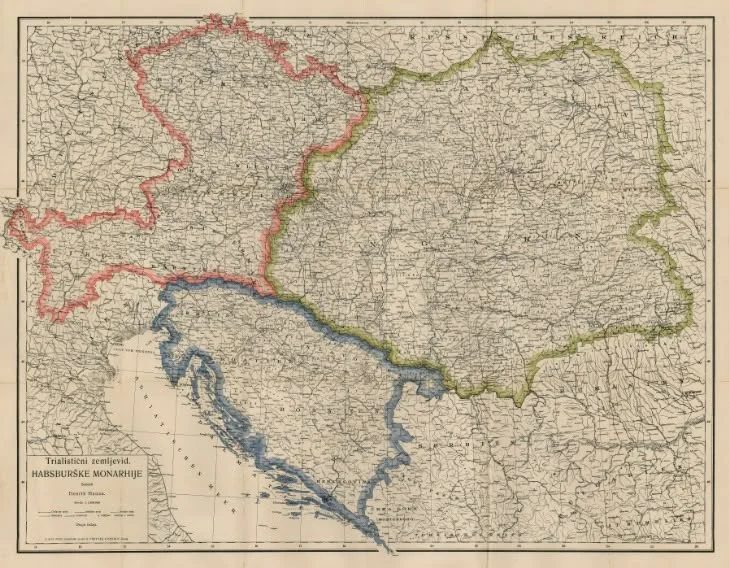

Communists (Titoists) in the Republic of Croatia zealously conceal the historical fact that the “Pravaši” (followers of Starčević) demanded the unification of Croatian lands from Emperor Charles I (IV)—who was also the King of Croatia.
In response, the Emperor sought release from his oath to Hungary and, on October 22, 1918, united the Triune Kingdom of Croatia and Slavonia with Dalmatia and Bosnia and Herzegovina; he authorized General Sarkotić to physically annex Bosnia and Herzegovina to the Croatian state and appointed a Croatian Ban to head the Triune Kingdom of Croatia, granting it state independence—whereupon the Croatian Parliament, on October 29, severed all constitutional and legal ties with Hungary.
Thus, the conditions set forth in 1861 by the “Father of the Homeland,” Ante Starčević, and Eugen Kvaternik—encapsulated in the program of the Party of Rights—were fulfilled.
Unfortunately, under the influence of the insane and criminal Yugoslavist policy of Josip Juraj Strossmayer, the Croatian Parliament on October 29, 1918, cast the Croatian state—the Kingdom of Croatia, stretching from the Sutla to the Drina and from the Mura and Drava to the Adriatic—onto the dustbin of history.
Instead, it proclaimed the State of Slovenes, Croats, and Serbs, even though Serbs did not live in Croatia proper but in Vojvodina—which, alongside Bosnia and Herzegovina, became part of the State of S.H.S.
The coup plotters from the self-styled National Council of Slovenes, Croats, and Serbs—a body that did not represent the Croatian Sabor in Zagreb—staged a coup with the help of liberated Serbian prisoners of war; they dissolved the State of SHS by uniting it with the Kingdoms of Montenegro and Serbia into the Kingdom of Serbs, Croats, and Slovenes—in effect, a Yugoslav and Greater-Serbian “prison of nations.”
The ruling Titoists taught—and still manipulate people into believing—that Croats lacked a state of their own for over 800 years (until the time of Franjo Tuđman) following the loss of independence of the early medieval Kingdom of Croatia in 1101; in reality, however, the Croatian state existed continuously from 1101 to 1918. It was only in 1918 that the Croatian state and the Croatian Sabor ceased to exist, having been cast onto the dustbin of history by Yugoslav revolutionaries—or rather, terrorists.
Written by Historian Goran Jurišić

