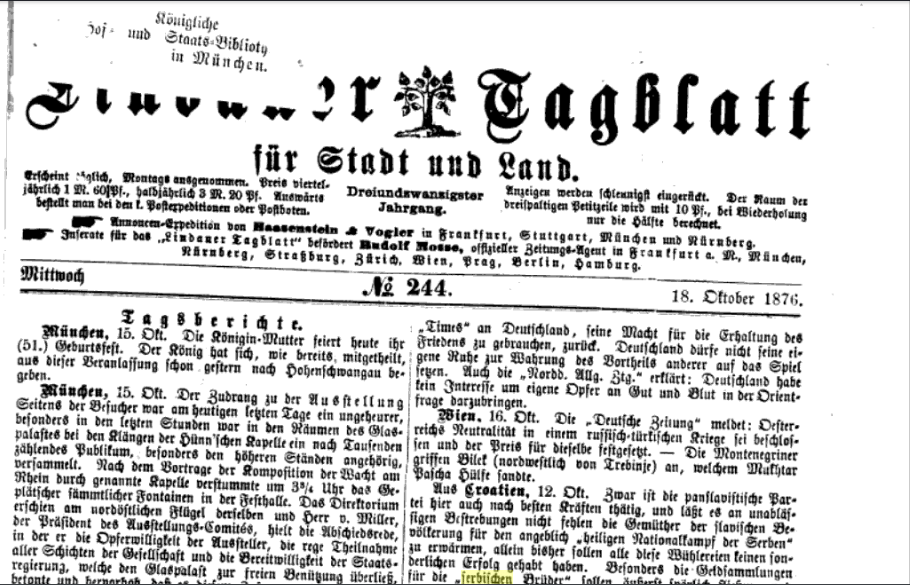

Summary of Serbian wartime conditions and casualties
Contemporary reports from the Serbo-Turkish War of 1876 state that Serbia faced severe difficulties both on and behind the front. One report to The Standard stated that approximately 7,000 wounded Serbian soldiers were being accommodated in inadequate conditions in villages along the Sava and Morava rivers, with serious shortages of doctors, medical staff, bedding, and medical supplies. Reports from Belgrade similarly described the hospitals as lacking basic resources.
At the same time, reports described serious internal disorder in the Serbian countryside. With many police officers conscripted into the army, armed bands reportedly took advantage of the weakened security situation to engage in looting and robbery. Weapons distributed during the war were being used against the rural population, further aggravating the difficulties faced by the Serbian authorities.
The reports also criticized the conduct of Russian volunteers serving with the Serbian forces. According to the Pester Correspondenz, the Serbian government eventually prohibited Russian officers from wearing Serbian uniforms outside Serbia, citing conduct that it claimed was damaging the reputation of the Serbian military. The report describes Russian volunteers returning home in poor condition and without pay, while some reportedly resorted to begging.
Finally, the Presse attempted to estimate Serbian losses from conflicting Serbian and Ottoman official reports. The Turkish reports claimed 8,100 Serbian soldiers had been rendered unfit for combat, while Serbian reports gave a figure of only 350 Serbian soldiers. A separate estimate cited by the newspaper put Serbian losses at approximately 6,880 killed and 34,400 wounded, or 41,280 soldiers rendered unfit for combat in total.
Overall, these reports depict the Serbian war effort as suffering from heavy casualties, inadequate medical infrastructure, shortages of supplies and personnel, deteriorating internal security, and problems involving foreign volunteers.
Cited:
7000 Serbs wounded in the war against the Turks, according to The Standard:
“A report from Belgrade dated July 14 to The Standard states that some 7,000 wounded Serbian soldiers are being housed in a very inadequate manner in villages along the Sava and Morava rivers—lacking doctors, orderlies, bedding, and medical supplies; indeed, stocks of all kinds are lacking.”
Belgrads hospitals lack resources, according to the Journal des Débats:
“Belgrade’s hospitals lack everything. Prince Milan is deeply dejected and hardly speaks anymore; he is constantly surrounded by gendarmes and visits the camp only with a strong escort. He takes no part in military operations. At this moment, it is not even certain whether he is in Deligrad or has returned to Ćuprija, though I have reason to believe the latter.”
Serbian robber bands loot the Serbian countryside, according to a report from the Pall Mall Gazette
“The report further states that looting and robbery are rampant in every part of Serbia. Weapons distributed indiscriminately are being used by marauders against the rural population. Since most police officers have been drafted into the army, it will be extremely difficult to attack and destroy these bands of robbers, who care little for their homeland and seize every opportunity to carry out their raids.”
Russian mercenaries forbidden to wear Serbian uniforms, according to the Pester Correspondenz:
“Regarding the conduct and fate of the Russians in Serbia, the Pester Correspondenz reports from Belgrade (Nov. 19) that, according to a ministerial decree issued on the 17th, no Russian officer in Serbian service is henceforth permitted to wear the Serbian uniform outside Serbian territory.
This measure was prompted by the Russians’ peculiar behavior—conduct they displayed everywhere, showing no regard for men or women and acting without inhibition, whether by day or by night. The government was compelled to issue this order to prevent the honor of the Serbian military from being further compromised or tarnished by the Russians’ actions.
Here, as in Semendria, the Serbian uniforms have been stripped from the Russians returning home in droves, and they have been given old rags to barely cover their bodies. Naturally, there is no question of pay, forcing them to go begging from door to door. I saw with my own eyes a local Serbian merchant handing 20 paras in alms to a Russian officer—that “Muscovite brother.” Some Circassian officers who had arrived with the Russians to take part in the war have offered their services as attendants to wealthy travelers on the ships.”
41,280 wounded and killed Serbian soldiers according to the “Presse”
“An industrious contributor to the Presse has taken the trouble—for which he deserves thanks—to compile a casualty list for both armies based on the contradictory official Serbian and Turkish telegrams. The result is highly revealing. According to Turkish reports, 8,100 Serbs and 243 [Turks] have been rendered unfit for combat so far.
Serbian reports, on the other hand, state that 3,600 Turks and 350 Serbs have been put out of action to date. From these figures, one can draw conclusions regarding the reliability of the news coming from both camps. Even more interesting is a statistic published by the Correspondance Orientale, which we reproduce here in translation.
The correspondence states that since the outbreak of hostilities, eleven official dispatches have reached the Sublime Porte and been made public in Constantinople. These indicate that 134 Turks and Serbs have fallen. Usually, for every fatality, there are six wounded; applying this ratio, the Serbs would have had 34,400 wounded—making a total of 41,280 soldiers rendered unfit for combat.”
Source
Lindauer Tagblatt für Stadt und Land Amtsblatt für den Stadtmagistrat Lindau und das kgl. Amtsgericht Lindau ; amtliches Bekanntmachungsorgan der Gemeinden Aeschach, Bodolz, Hoyren, Nonnenhorn, Oberreitnau; Reutin u. Weissensberg. 1876,7/12 1876. Stoffel u. Wachter.

