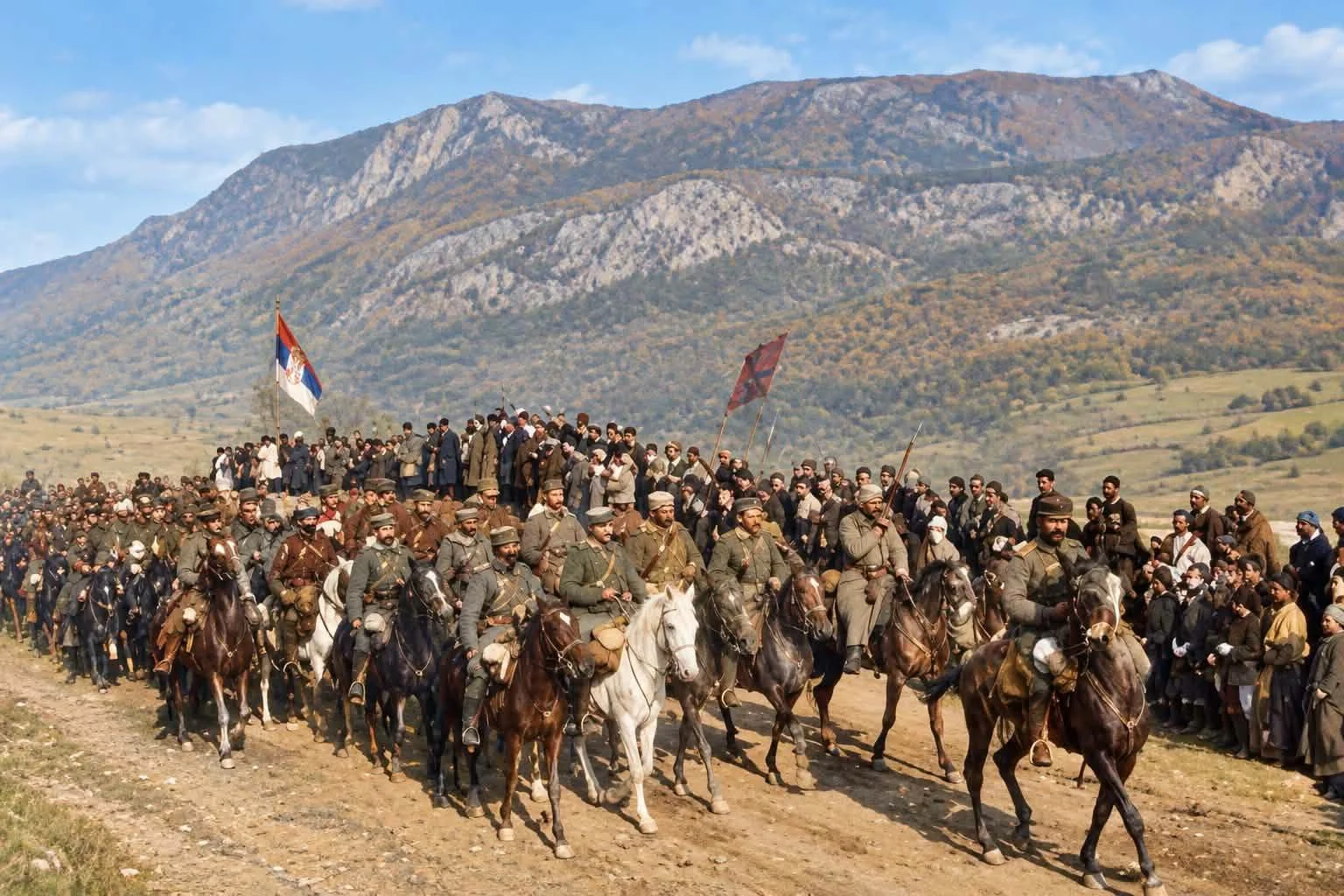

What Prishtina Endured Under Violent Serbian Occupation (1912–1913)
By: Sabedin Sherifi
From Merdare and Prepolac, through Podujeva and Prapashtica, and on to Prishtina, the year 1912 marked one of the most violent periods in the history of Kosovo. Military documents, diplomatic reports, and contemporary accounts record combat, the burning of villages, and the killing of Albanians.
In October 1912, the war reached Kosovo’s eastern border. Fierce clashes took place in the Llap and Gollak regions between Serbian forces and the Albanian forces defending this part of Kosovo.
Serbian army records from October 14 and 15, 1912, document skirmishes in the border zone and casualties on both sides. Reports indicate that Albanian forces had taken up positions in the Llap and Gollak areas and were attempting to halt the Serbian army’s advance.
Following the fighting at Merdare and Prepolac, the Serbian army continued its march toward Podujeva. Contemporary sources document the occupation and burning of Podujeva, after which the offensive pushed onward toward Prishtina. Prapashtica on the road to Pristina
Prapashtica, one of the Albanian settlements east of Pristina, was also located along this military corridor.
Albanian historical sources report that after Serbian forces entered the area, Prapashtica was burned down and Albanian residents were killed.
These same sources also mention the arrest and transfer of a large number of men and boys from the Merdarë and Prapashtica area to Serbia.
A figure of approximately 1,800 arrested and about 1,000 executed in Aleksinac circulates in Albanian literature, yet the original Serbian document confirming this number has not been identified in research conducted to date. For this reason, this figure remains distinct from directly documented data.
Pristina: thousands of Albanians killed
Following the entry of the Serbian army into Pristina, contemporary reports recorded mass killings. One of the most significant accounts is the report by Lazër Mjeda, the Archbishop of Skopje, dated January 24, 1913.
It estimates that around 5,000 Albanians were killed in Pristina.
Mjeda’s report was drafted just a few months after the events took place. He describes the dire situation of the Albanian population following the Serbian occupation and became one of the well-known international witnesses to the violence in Kosovo during the First Balkan War. The foreign press of the time also reported on the killing of Albanians in and around Pristina.
Gollak after the occupation
The violence continued even after the main war front had shifted.
In the Gollak region, incidents were recorded in Shipashnicë, Sfirçë, Tygjec, Hogosht, Gmicë, and Zajçec.
In Shipashnicë, in December 1912, an armed expedition arrested and tortured several residents. Four of them were killed.
In Sfirçë, the burning of a large number of houses was reported.
These events demonstrate that the violence was not confined solely to the front line.
It also affected Albanian villages after the Serbian army had taken control of the territory.
An occupation corridor
The events of 1912 trace a clear line on the map: Merdare → Prepolac → Podujevë → Prapashticë → Pristina. This was one of the main routes of the Serbian army’s advance toward the center of Kosovo.
In this area, documents record border skirmishes, the burning of settlements, and killings. Regarding Pristina, Lazër Mjeda’s report cites a figure of approximately 5,000 Albanians killed.
Following the occupation, documents and testimonies continue to record violence in Gollak and the surrounding villages.
More than a century later, the names of the villages—Merdare, Prepolac, Podujevë, Prapashticë, Prishtinë, Shipashnicë, and Sfirçë—remain testament to a period when the redrawing of borders in the Balkans was accompanied by war, expulsions, arson, and the killing of the Albanian population.
Source
Mediafokus.com

