

Serbia entered the First World War after years of atrocities, massacres and war crimes after invading Albanian territories in the Balkans and after expanding into Kosovo and Albanian lands. During the Balkan Wars, Serbian forces committed serious abuses against Albanian civilians, including killings, looting, destruction of villages, forced conversions, and attacks on Catholic clergy and institutions. These abuses were documented by the Carnegie International Commission and criticized by Serbian socialist Dimitrije Tucović.
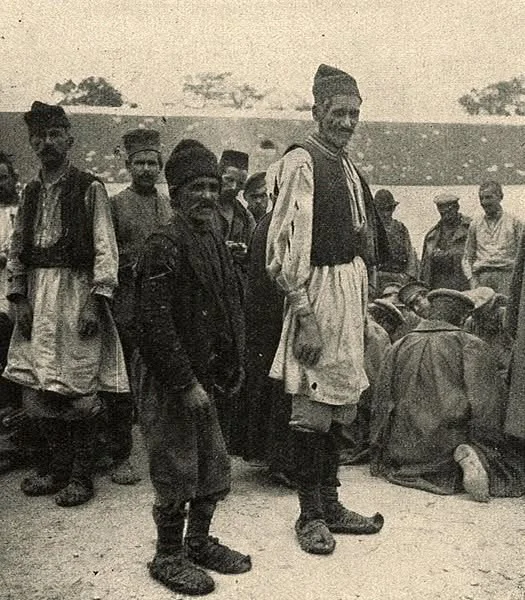
Serbian komitadjis (Chetniks) – known for committing atrocities against Albanians in 1912-1913 – captured by Austro-Hungarian forces in 1914.
In 1914, after the Serbian government declared war on Austro-Hungary by financing the Serbian terrorist Gavrilo Princip who murdered the Austro-Hungarian Archduke in Sarajevo, Austria-Hungary then invaded Serbia across the Drina and Sava. The fighting was extremely bloody. The Serbian army suffered enormous losses and was already severely weakened, and was wiped out in 1915.

Austro-Hungarian troops capture Serbian paramilitaries who would assault the troops and run away.
The decisive defeat came in 1915, when Germany, Austria-Hungary, and Bulgaria attacked Serbia from several directions. The Serbian army was defeated, Serbia was occupied, and the army and government were forced to retreat through Montenegro and Albania under catastrophic conditions. Thousands died from starvation, disease, exposure, and fighting.
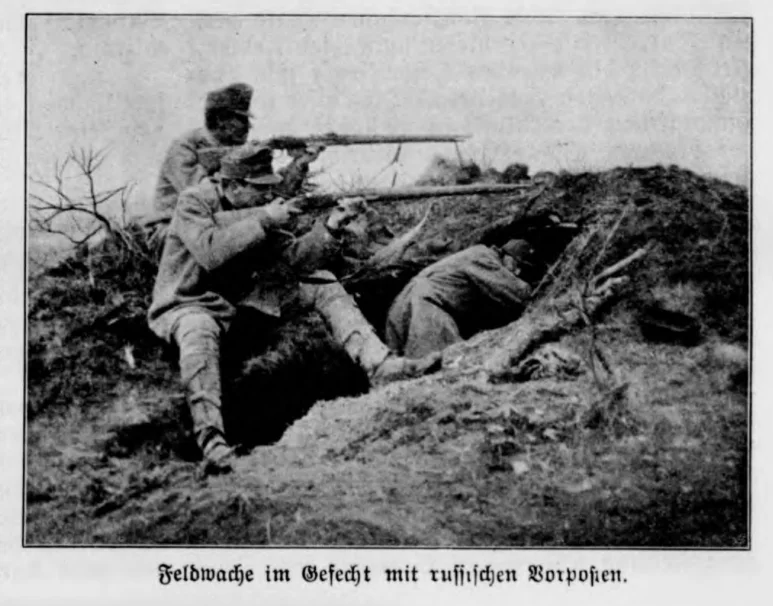
Austro-Hungarian troops fighting Serbian forces, 1914-1915.
During the Serbian retreat, and again when Serbian forces returned in 1918, fighting with Albanian groups and repression of Albanian communities continued. Serbian troops carried out reprisals, killings, destruction, and forced measures against Albanian civilians in areas they sought to control.

Austro-Hungarian troops fighting Serbian forces, 1915.
Serbia was militarily defeated and occupied in 1915, while Serbian forces had themselves committed extensive war crimes and atrocities against Albanian civilians during the preceding and subsequent campaigns. The suffering of Serbia during the First World War does not erase those crimes.

Austro-Hungarian troops fighting Montenegrins in Bjelopolje, 1915.
Sources
- International Commission to Inquire into the Causes and Conduct of the Balkan Wars. Report of the International Commission to Inquire into the Causes and Conduct of the Balkan Wars. Washington, DC: Carnegie Endowment for International Peace, 1914.
- Tucović, Dimitrije. Serbia and Albania: A Contribution to the Critique of the Conquering Policy of the Serbian Bourgeoisie. Belgrade, 1914.
- Mitrović, Andrej. Serbia’s Great War, 1914–1918. West Lafayette, IN: Purdue University Press, 2007.
- Mörsdorf, Sven. “The Prochaska Affair Revisited: Towards a Revaluation of Austria-Hungary’s Balkan Consuls.” Hungarian Historical Review 11, no. 2 (2022): 305–328.
- McCarthy, Daniel J. 1914: Austria-Hungary, the Origins, and the First Year of World War I. Cambridge: Cambridge University Press, 2014.
- Elsie, Robert, ed. The Balkan Wars: Reports of the International Commission to Inquire into the Causes and Conduct of the Balkan Wars.
- Csaplár-Degovics, Krisztián. “Serbia and the ‘Albanian Question’ in 1912–1913: A Re-reading of Published Triple Entente Sources.” Világtörténet 5, no. 3 (2015): 185–218.
- Tessmann Digital Library. Austro-Hungarian newspaper reports concerning the Serbian campaign, Albanian resistance, Prizren, the Prochaska Affair, and the 1915–16 defeat of Serbia.
- French Diplomatic Documents. Documents Diplomatiques Français (1871–1914). Paris: Imprimerie Nationale, 1933.

