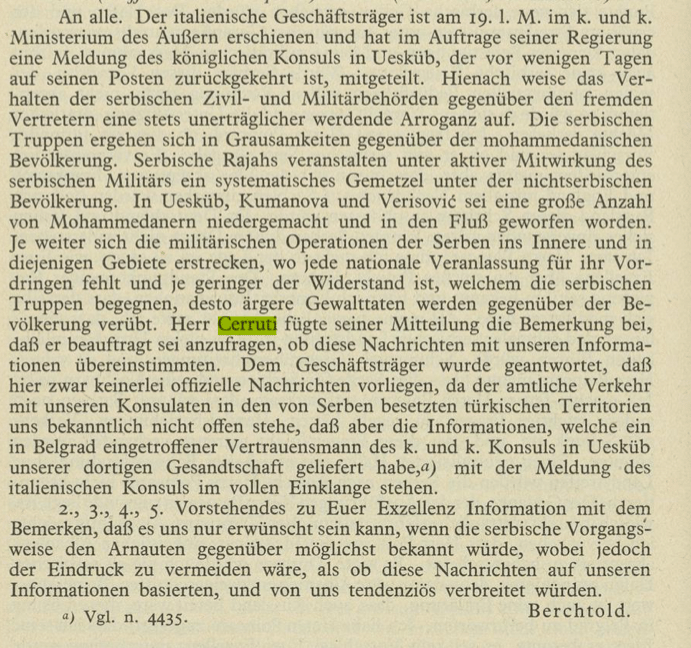

Cited from the “Österreich-Ungarns Außenpolitik von der Bosnischen Krise 1908 bis zum Kriegsausbruch 1914 4. Band (19. Februar_30. November 1912”:
“To all. The Italian Chargé d’Affaires appeared at the Imperial and Royal Ministry of Foreign Affairs on the 19th of this month and, on instructions from his government, conveyed a report from the Royal Consul in Uskub—who had returned to his post only a few days earlier. According to this report, the conduct of the Serbian civil and military authorities toward foreign representatives displays an arrogance that is becoming increasingly intolerable.
Serbian troops are engaging in acts of cruelty against the Muslim population. Serbian *rayahs*, with the active participation of the Serbian military, are carrying out a systematic slaughter of the non-Serbian population. In Uskub, Kumanovo, and Ferizović [Ferizaj], a large number of Muslims were reportedly cut down and thrown into the river.
The further the Serbian military operations extend into the interior and into regions where there is no national justification for their advance—and the less resistance the Serbian troops encounter—the more severe the acts of violence committed against the population become. Mr. Cerruti added the remark that he had been instructed to inquire whether these reports tallied with our own information.
The Chargé d’Affaires was informed that, while no official reports are available here—given that, as is known, official communication with our consulates in the Serb-occupied Turkish territories is not open to us—the information provided to our legation there by a trusted agent of the Austro-Hungarian Consul in Üsküb (who had arrived in Belgrade) fully accords with the report from the Italian Consul.
The foregoing is submitted for Your Excellency’s information, with the remark that it would be highly desirable for the Serbian conduct towards the Albanians to become as widely known as possible; care should be taken, however, to avoid the impression that these reports are based on our own information or are being disseminated by us with a specific agenda. a) Cf. No. 4435. Berchtold.”
Source
No. 4545. Telegrams to Rome No. 19 (1), Berlin No. 21 (2), Paris No. 10 (3), London No. 11 (4), and St. Petersburg No. 15 (5); Budapest, Nov. 21, 1912 (ciphered 6:40 p.m.). Drafted by (S. Nemes; G. Macchio).” (Österreich-Ungarns Außenpolitik von der Bosnischen Krise 1908 bis zum Kriegsausbruch 1914 4. Band (19. Februar_30. November 1912).

