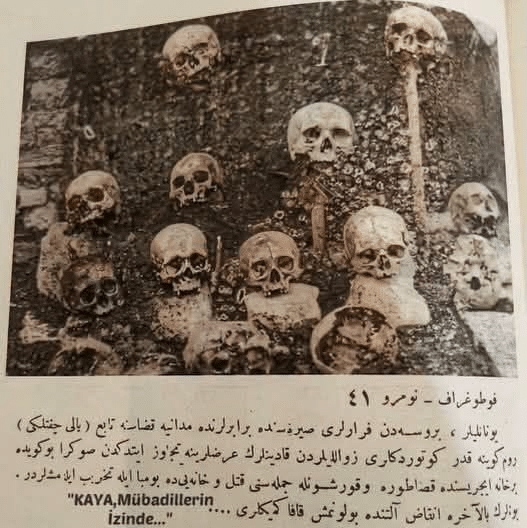

As the Greeks were withdrawing from Bursa, they had dragged the men—along with the women they had raped—to the Greek village of Bali Çiftlik, near Mudanya; there, they massacred everyone inside a house using bayonets and gunfire, before blowing the building up with a bomb. These are the skulls later recovered from the rubble and ruins.
The most difficult years in the history of Bursa were experienced during the Greek occupation. A black cloth was draped over the pulpit of the Turkish Grand National Assembly until Bursa was liberated from the enemy occupation. The insulting of the Greeks to the tomb of Osman Gazi caused the people of Bursa to become even more resentful towards the invaders.
Since the last months of 1920, the Greek troops displayed great brutality with their terror in the central villages of Bursa, the townships of İnegöl, Orhangazi, Gemlik, Mudanya, Karacabey and Mustafakemalpaşa. As a result of this terror, many Muslims were killed or maimed in the aforementioned regions. Villages were looted, burned and destroyed.
Actually, in order to prevent this unavoidable situation, the Istanbul Government applied to the High Commissioners of the Allied Powers with a report containing the events. However, this attempt did not yield any results, and terrorist incidents continued until the end of the occupation.
Bursa was saved after 2 years, 2 months and 2 days of occupation. During the occupation period, the destruction of the Greek troops in and around Bursa was so terrific that it attracted the attention of all Anatolia and even the world.
After the fierce clashes between the Turkish forces and the Greek troops, the Turkish National Forces entered Yenişehir and İnegöl on September 6; Orhangazi and Bursa on September 10; and Orhaneli on September 11, 1922. Simultaneously, on September 11, the Greek troops in Gemlik withdrew towards Mudanya following the coast.
Source
The Atrocities and Genocide Committed in the Province of Bursa by the Greeks Haluk Selvi. https://ttk.gov.tr/wp-content/uploads/2024/05/8-Haluk-Ing.pdf

