
by Artur Vrekaj
In his interview with MEGATV, Rama fails to acknowledge the territory of Chameria as an indigenous Albanian land. A portion of Chameria—specifically Thesprotia—was known as the region of Cestrinia; it was incorporated into Chaonia by the son of Scamander, the Dardanian king of Chaonia. Indeed, this region (modern-day Chameria/Thesprotia) was home to the city—or settlement—of the Sun.
Moving further north, we find Butrint (Buthrotum), the capital of Chaonia under the Dardanian king Scamander. Kumbaro sacrificed this site to the circle of the “Greedy” and hastily sought to Hellenize its history, portraying it as a Hellenic city; yet, the Hellenic figure who founded it as the capital of Chaonia was none other than Scamander the Dardanian.
Further north still lies Onchesmus—modern-day Saranda—which took its name from Aeneas’s father, Dardanus, a first cousin of Scamander.
Phoenice flourished thanks to the port of Onchesmus, but not because of the Jews.
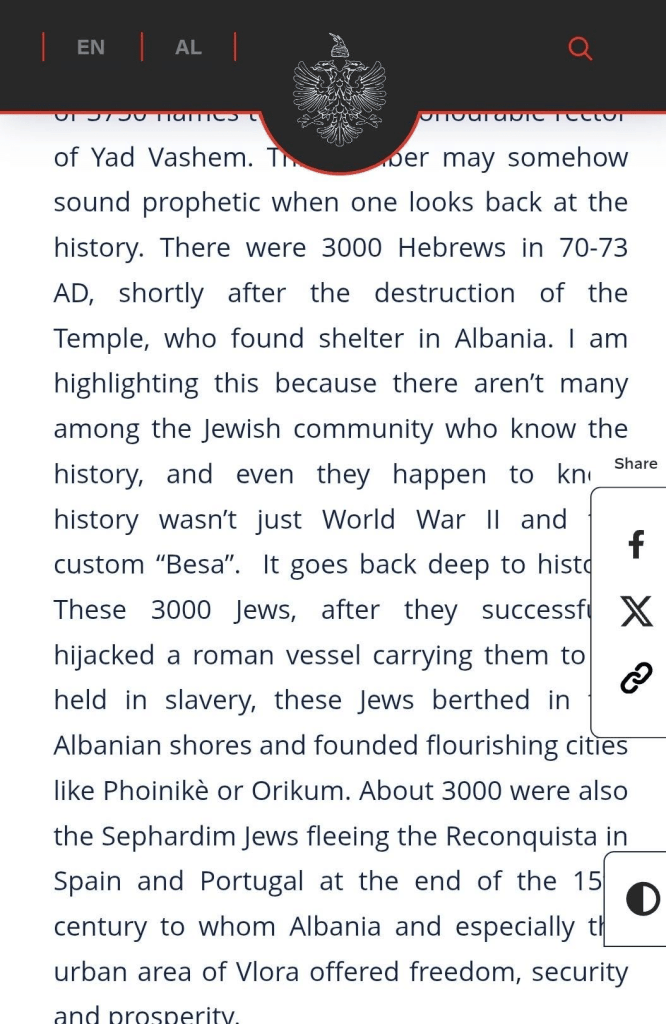
Phoenice is ancient, but it does not appear in the records concerning the first wave of Jews—the Romaniotes—who arrived in Rome during the 70s AD; these were captives from Canaan, Palestine, and Judea who came either due to a storm or by fleeing the Romans on a ship, though there is no precise figure regarding their numbers.
The second edition of the Encyclopaedia Judaica (Volume 20), in the entry titled “Valona,” provides no evidence regarding the size of that first wave of Jews in Illyricum. It specifies only that a ship carrying Jews arrived on the Albanian coast, in Chaonia.
How is it that the Jewish community itself does not know how many Jews were in Illyricum during the 70s AD, yet Rama alone knows?
Where did Rama get the idea that Phoenice was a Jewish settlement? Where did he find the figure of three thousand Jews arriving on a single ship following Rome’s destruction of the Second Temple in Jerusalem?
Rome possessed no ship capable of transporting three thousand Jewish slaves at once in a single vessel.
Even the Roman historian Flavius Josephus makes no mention of three thousand Jews in Illyricum from that first wave. There is no evidence regarding the number of Jews in Illyricum—states Harvey Sarner in the book Rescue in Albania. He cites Flavius Josephus, noting that in ancient times (no specific year is given), there were villages with Jewish populations that bore Jewish names:
Palasë for Palestine (Palestinians?!)—though this is not explicitly stated—and Orikum-Jericho.
Harvey Sarner and The Jerusalem Post highlight that the ruins of a synagogue were discovered in Dardania, an ancient Illyrian port. These ruins date back to the first or second century AD.
Why Dardania?
After all, Chaonia was a Dardanian, Illyrian place name!
When Rama kissed the Wailing Wall, he was contemplating his own future legacy—that of a “Babëzian” Jew. Phoenice (Finiq) was the capital of the Epirote League and has no connection to Jews or any wave of Jewish slaves.
To act as a “Jew-ologist”—as Rama does in Albania today—is a form of “delusional zeal,” standing in stark contrast to the actions of the Albanian people when they saved Jews from the Nazis in the 1930s and 1940s.