

Summary
This report from 1914 describes violence and looting in Salonika (Thessaloniki) after Greek, Serbian and Bulgarian forces captured the city. It accuses soldiers and irregular troops of committing atrocities against men, women and children, including Turks, and criticizes the authorities for failing to maintain order. The population is described as living in fear, with businesses closed and people seeking protection for their money and belongings.
Cited from the “Illustrierte Geschichte des Balkankrieges 1912 – 13 Zweiter Band (Zweiter Band / 1914)”:
“Shortly after the capture of Salonika, reports were made of atrocities which the Greek victors had committed in the conquered city. We have already recorded these first reports, but it is necessary—unfortunately!—to return once more, and this time in greater detail, to these atrocities.
Even at the outbreak of the war, there had been fears that the brutal instincts which would collide here might lead to terrible crimes, and these fears have only been confirmed all too thoroughly.
These Greek, Serbian, and also Bulgarian “crusaders,” who marched in the name of Christianity against the Turkish hereditary enemy—a blasphemy scarcely imaginable in anything more outrageous—behaved like wild animals, indeed worse than animals, and gave free rein to their murderous impulses not only against the enemy, but also in a horrifying manner against defenseless women, children, and old people.
The most serious accusations must in particular be brought against the Greek, Serbian, and Bulgarian irregulars, who matched in bestiality those Turkish hordes that, in the Middle Ages, had sought to drown Europe in blood.
At first, the savage excesses began in Salonika. From a correspondent’s report from the conquered city, which was published in a Berlin newspaper and was written in November, we take the following:
“The old city of Thessalonike has now been occupied by the victorious troops since the 9th of this month. First the Greeks arrived, and two days later the Bulgarians. The fears of the population—that disturbances might break out between the surrender of the city and its occupation by the victors, and that the lives and property of the local inhabitants and foreigners might be endangered by the Turks—have not been fulfilled. Consequently, everyone was satisfied.
“For the time being, people seemed willing to accept the events, began returning to their businesses, and hoped, after the exciting days, for a period of peace and rest. Unfortunately, these expectations have not been fulfilled because of the regrettable excesses committed by soldiers of the occupying army, and it has actually appeared as though the real period of terror is only now beginning.“What has already happened in Salonika under the eyes of the officers of this army is all the more significant because one must take into account the fact that a king, two crown princes, a princess, and several princes are within the walls of Salonika.
“Had there been a firm determination to prevent the excesses, looting by day and night, in the streets, in the shops, and in private houses, nothing would have been easier than to establish a militarily organized guard and immediately shoot every greedy soldier, every member of the gangs that had streamed into Salonika, if caught in the act of looting. The fact that these measures have not been taken at all gives rise to no end of bitter resentment.
“The population has been plunged into fear and terror; businesses had to be closed. Nobody dared to show money or valuables; people brought their belongings and savings to safety, but one searched in vain for protection. Although the Greek authorities had announced that several hundred gendarmes were supposed to be brought here, in reality only 200 Cretan gendarmes arrived yesterday. But that is far too few, since the military must also intervene to protect the citizens from violence and robbery.
“Poor Turkish, disarmed soldiers have had their few coins and their hard-earned bread stolen; they have even been beaten as well. Respectable people, including Austrians, have been stopped in the streets and searched for weapons, while the soldiers were often interested only in taking possession of the watches and money which the people were carrying.
On the other hand, the Greeks, even the soldiers, fire live ammunition day and night, so that bullets rain down on the rooftops. This is called the enforcement of a state of siege, this is called civilization and liberation. Had the Turks been guilty of such actions, they would have been branded as savages and as it is surprising, however, that under the prevailing circumstances the foreign warships did not land crews for the purpose of strict patrol duty. It seems they are still waiting for more serious incidents. The city is economically devastated; it is cut off from all communication.
Added to this are already the harbingers of a famine; there is already a shortage of bread, the bakeries are besieged by the hungry, they can no longer meet the demands. All food prices are rising; anyone who has not made timely provisions for his household must now bear the consequences. It is felt as a relief that the Greeks see themselves compelled to send troops to Gornovitza; the latest battles around Monastir have turned out unfavourably for them.
This at least brings a little breathing space here, although even after their departure the city is still not in a position to provide accommodation for these masses of Greeks and Bulgarians who are camped in and around Salonika.In general, attention is drawn to a very tense relationship between Greeks and Bulgarians, which is said to have no reasonable grounds for the Greeks hurrying to occupy Salonika before the Bulgarians, before they have completed their task regarding Epirus and Monastir.
It is reported that the Bulgarians will not leave Salonika earlier until full clarity has been established about the further fate of Salonika. The Greeks, on the other hand, are already occupying all the offices and public buildings, raising the Greek flag everywhere, including on the old Byzantine churches which the Turks had converted into mosques, and holding one Te Deum after another for the “glorious liberation of the city and of Christendom from the tyrants.” They regard themselves as the conquerors of Salonika, whereas in reality they have only undertaken a military stroll here, with the exception of the battles at Geshdze and Kotschani.”
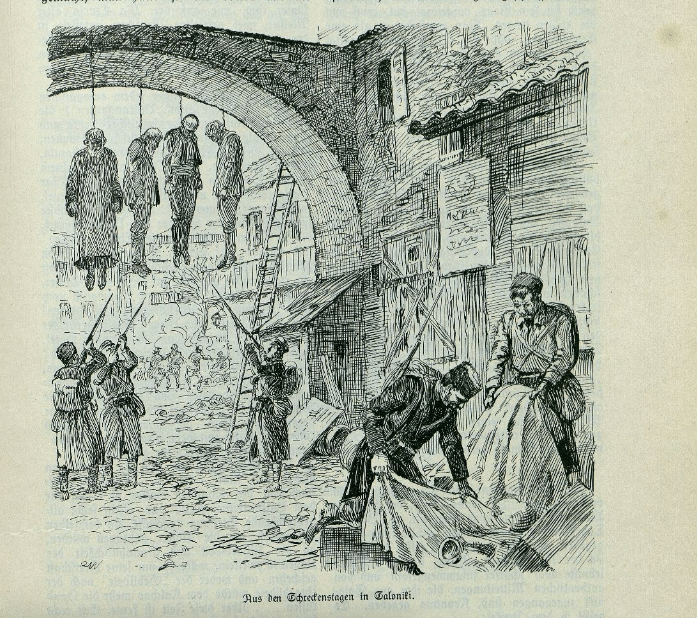
Atrocities in Selanik.

Greek troops marching
Source
Die Greuel des Krieges. Illustrierte Geschichte des Balkankrieges 1912 – 13 Zweiter Band (Zweiter Band / 1914). “[Abb.]: Aus den Schreckenstagen in Saloniki.” Illustrierte Geschichte Des Balkankrieges 1912 – 13 Zweiter Band. A. Hartleben’s Verlag, 1914.

