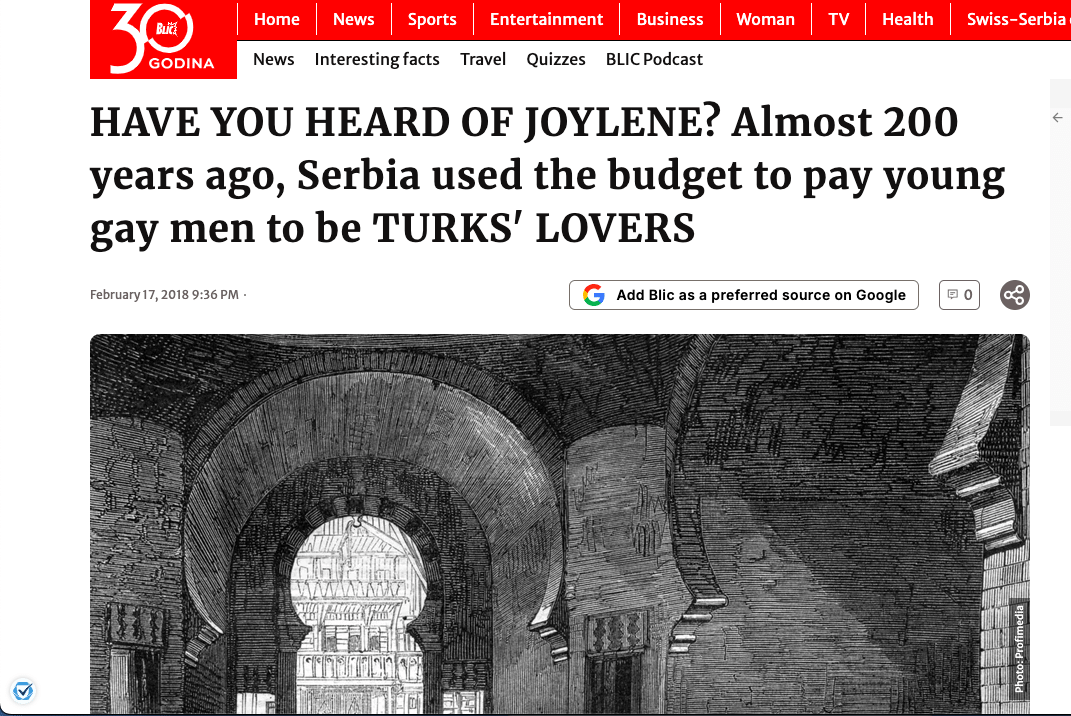

Cited from the BLIC on February 17, 2018 article:
“In the Ottoman Empire, the existence of a male harem was completely legitimate, as was the keeping of a female harem, which was used to the full extent by sultans and other dignitaries. Thus, in Belgrade in the 19th century, there were men’s harems where young men served for the money that was paid to them from the budget of Serbia at the time.
In the spirit of that time, the Vizier of Belgrade also had a male harem, and the young men who served him and his company were called jojleni, which referred to younger gay people. Djoileni were duly paid for their stay in the male harem, and the vizier received money for these expenses from the state, which was then allocated with great difficulty by the people.
This interesting information is presented by Ivan Janković, a lawyer and sociologist, one of the founders of the Fund for Humanitarian Law, in the book “Kata Nesiba i komentari” (Fabrika knjiga).
“Many Turks, especially the more respectable and wealthy, kept as lovers Serbian young men, the so-called adjuvans or jojlens, who served for money. The honorable vizier himself kept them with all his might, and they were taken care of by a special official, who was in the same high rank as, say, a cafe-bash or a harem-cehaj.
The maintenance of this tevabia fell on the budget of Serbia. That budgetary position, which was variously called: ‘children’, To ‘đojlenima’, ‘daire djeci’ or ‘đojle-egbi’, it usually amounted to ten or more thousand groschi”, says Janković in the book.
Đojle means a favorite, someone who is dear, young people for whose maintenance Serbia gave money as part of the tribute, which it gave to the Porte, especially to the Vizier for the maintenance of his retinue. There was nothing similar in Christian societies. It was simply unthinkable for a Christian monarch to have his own harem in general, and especially a male harem. That is a huge difference between Christianity and Islam in this period – said Ivan Janković in an interview with “Radio Free Europe”.
In the part “Kata Nesiba and comments”, he notes that the courtiers should not be confused with the eunuchs, who are also financed by the state “only through other budget items”.
About the young men in Belgrade at the time who earned money by providing sexual services to the Turks, the book also mentions some examples such as the case of a widow from Zemun who sent her slightly dissolute son-in-law to Belgrade in 1829 to learn trade and be under stricter supervision. She soon heard that her son Jovan only hangs out with the Turks, that he stays with them day and night and has a lot of money with him, so she suspects that the Turks “used their lawless custom with him”, and begs the city authorities to return her son to Zemun.
– If you lived in a town, I am now talking about the period until the end of the 1830s, and even longer, in which the main dignitary had homosexual relations with his harem, so to speak publicly, I don’t think the relations were public, but their existence was not hidden, that must change your idea to some extent. Then you, as Christians, rationalized it by saying that it was just another example of the sinfulness and unacceptability of Islam, as a faith and religion, and you could have built strong resistance to such practices – explains Janković for RFE/RL.
The book “Kata Nesiba and Comments” tells about the history of a Belgrade prostitute and her fight for constitutional rights, and as stated, the story is based on authentic archival documents”.
Source

