

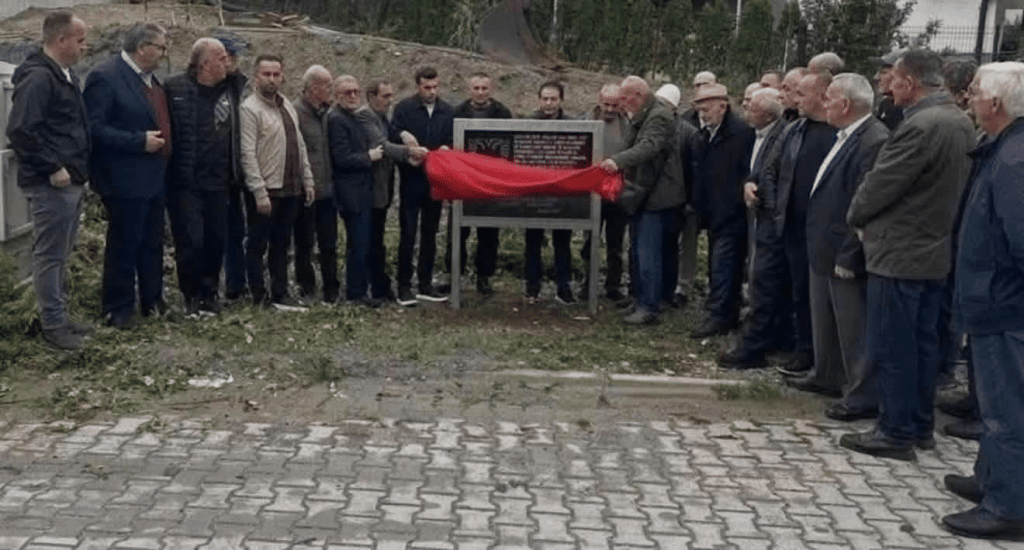
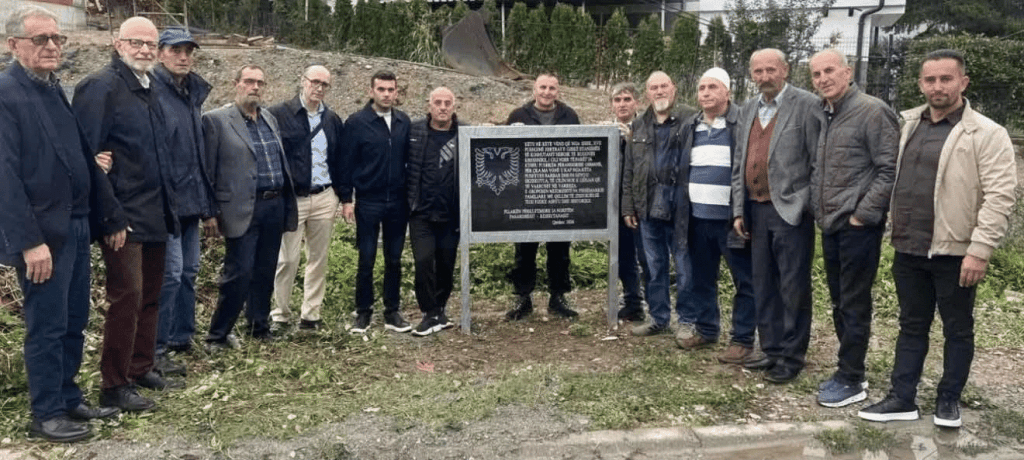
During my stay in Kosovo, I had the pleasure of attending the unveiling of a memorial plaque dedicated to Gjekë Stanisha of Koshutan (Rugova), erected by his descendants—the people of Koshutan.
For us, the descendants of Koshutan families, this plaque holds special significance: it honors our forebears and preserves the bond with our roots. At the same time, it reminds us of our responsibility to pass on the history, resilience, and sacrifices of our ancestors to future generations.
According to the inscription on the plaque and details from the book Rugova kreshnike dhe e kaluara e saj historike (Heroic Rugova and Its Historical Past) by Fazli Sh. Muriqi—alias Bajraktari—Gjekë Stanisha is remembered as one of Rugova’s early figures of resistance against Ottoman rule. Oral accounts passed down through generations tell of his refusal to submit, his capture and summary execution, and the denial of a dignified burial.
Gratitude goes to all those who worked to erect this plaque and to preserve the historical memory of Koshutan, Rugova. Below are some photographs from the unveiling ceremony and excerpts from the aforementioned book.
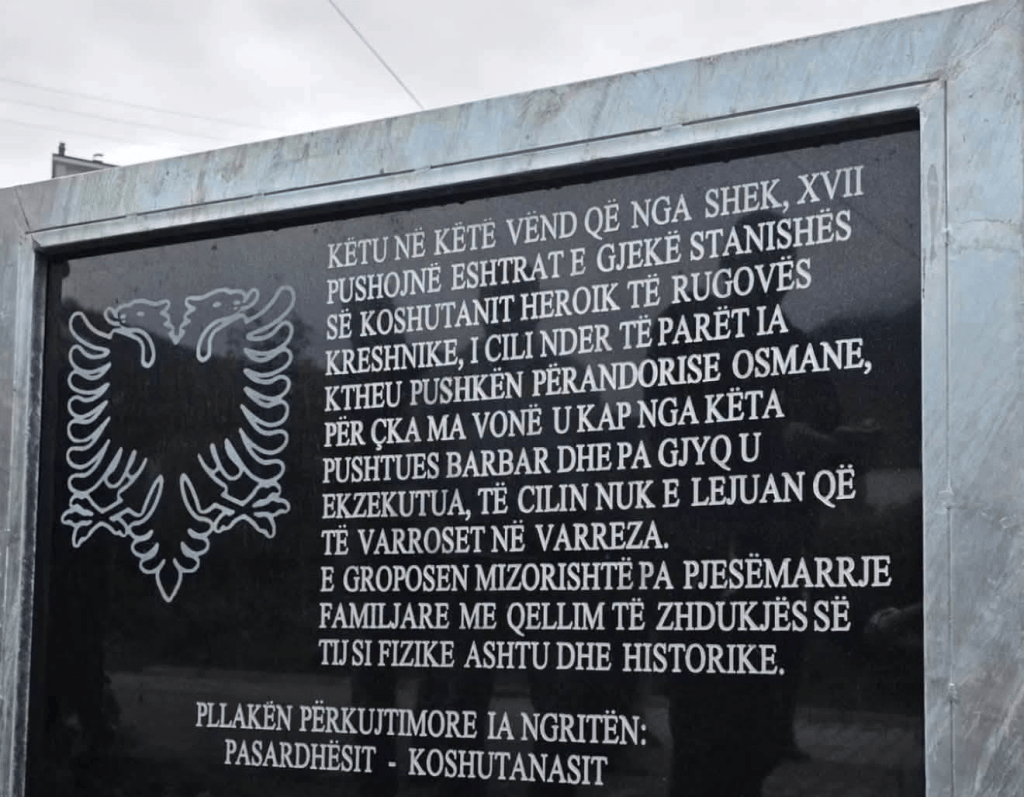
The plaque reads:
“Here, in this place, rest the remains of Gjekë Stanisha of the Koshutanit clan, the heroic man of Rugova, who in the 17th century courageously took up arms against the Ottoman Empire. For this, he was beheaded by these barbaric oppressors and executed without mercy, as they did not allow him to be buried in a cemetery.
He was buried without ceremony, without the participation of his family, with the aim of erasing his physical existence as well as his historical memory.
The commemorative plaque was erected by: The Pasardhësit – Koshutanasit (the descendants of the Koshutani clan).”


Transcribed:
“A Brief Biography of the Best-Known Figures of Rugova’s Past
Since the people of Rugova were active and renowned for their bravery in warfare throughout their history, it is worth presenting them here. The best-known figures mentioned below also bear witness to this. This is only a brief overview of the many wars and battles in which they took part, as well as the numerous sacrifices they made. I believe that much remains unsaid about their deeds, which were so significant.
These biographies are also incomplete because Rugova had many other brave warriors who shed blood and sacrificed themselves. Therefore, I initially sought information from their deeds and from their family members.
Gjekë Stanisha
Gjekë Stanisha of Koshutan was born approximately 300–350 years ago. He was the son of Pren Martini, son of Martin Kola, son of Kolë Gjoni. According to oral accounts, Pren had already been living in Rugova before that time.
Researchers such as Dr. Zymer Neziri, Petrit Imami, Frok Zekiqi, Father Agustin (Zef) Valentini, and Dom Nikë Ukgjini have discussed the repeated settlement of Rugova and the movements of the Kelmendi tribe during the seventeenth and eighteenth centuries. Their studies describe migrations from the highlands north of Shkodër through Pešter and Rugova, and as far as Bosnia and Croatia, following the settlements of their Illyrian ancestors.
On this basis, the author concludes that Gjekë Preni (Stanisha) was among those who returned to the settlements of his ancestors after they had been forcibly displaced from Rugova.
Similar events occurred in 1919 and again in 1999. Nevertheless, the inhabitants of heroic Rugova returned to this ancient region, which, according to the author, had always been inhabited by Albanians.
According to oral accounts, Gjekë Stanisha returned with his brother. Halil Cuka, a history professor from the Muriqi brotherhood who now lives in Haxhaj, states that the inhabitants of this village descend from Marash and his sons: Lekë Marashi, Lulë Marashi, and Currash (Çuk) Marashi. Gjekë’s brother was therefore Marash Preni.
Gjekë Stanisha lived for a time in Boga together with his brother. After a while, they separated, with Gjekë moving to Koshutan while Marashi…”
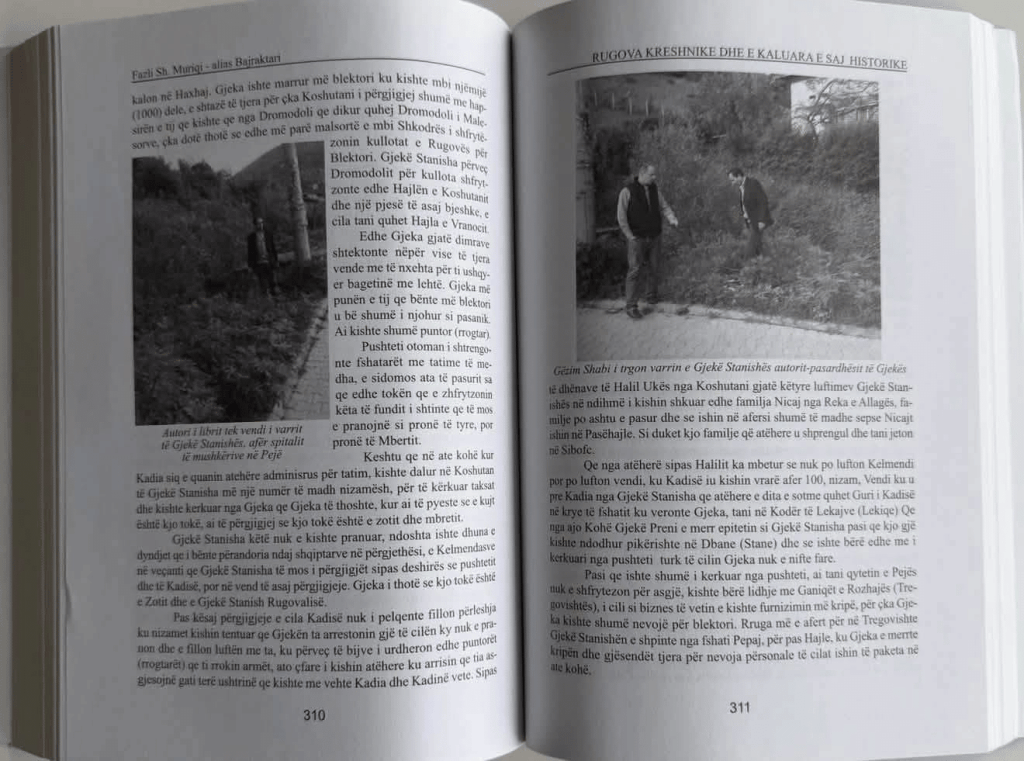
“Fazli Sh. Muriqi-alias Bajraktarı
passes through Haxhaj. Gjeka was busy with the cattle farm where there were over a thousand (1000) sheep, and other animals, for which Koshutani responded very well with the space he had from Dromodol, which was once called Dromodol of the Mountains, which means that even before that he exploited the mountains above Shkodra.
They owned the pastures of Rugova for livestock. Gjekë Stanisha, in addition to Dromodol, also owned Hajla e Koshutani and part of that mountain, which is now called Hajla e Vranoc. Even Gjeka during the winters would travel to other regions to warmer places to feed his cattle more easily. Gjeka, with his work as a cattle herder, became very well known as a rich man. He had many workers (salaried workers).
The Ottoman government oppressed the peasants with heavy taxes, especially the wealthy ones, to the point that they even forced them to accept the land they used not as their property, but as the property of the Emperor.
The author of the book at the grave site of Gjekë Stanisha, near the lung hospital in Peja.
So it was at that time when the Kadia, as they called him at that time, the tax administrator, had gone to Gjeka’s Koshutan Stanisha with a large number of officials to demand taxes and had asked Gjeka to say that when he asked who this land belonged to, he should answer that this land belonged to the lord and the king.
Gjekë Stanisha had not accepted this, perhaps it was the violence and invasions that the empire was inflicting on the Albanians in general, and the Kelmends in particular, that made Gjekë Stanisha not respond according to the will of the government and the Kadija, but instead of that response. Gjeka tells him that this land belongs to God and to Gjekë Stanish Rugovali.
After this answer, which Kadija did not like, the fight began, where the Nizams tried to arrest Gjeka, which he did not accept and began the war with them, where in addition to his sons, he ordered the workers (trogtars) to seize the weapons, the ones they had at the time, where they managed to destroy almost the entire army that Kadija and Kadija had alone. According to
RUGOVA KRESHNIKA AND ITS HISTORICAL PAST
Gëzim Shabi shows Gjekë Stanisha’s grave to Gjekë’s author-descendant
According to Halil Uka from Koshutani, during these battles, Gjekë Stanishë also came to help the Nicaj family from Reka e Allagës, a family also wealthy and very close because the Nicajs were in Pasëhajle. Apparently, this family was then dispersed and now lives in Sibofe.
Since then, according to Halil, it has remained that Kelmendi is not fighting, but the place is fighting, where Kadia had nearly 100 killed, nizam, the place where Kadia was killed by Gjekë Stanisha, which then and today is called Guri i Kadisë at the top of the village where Gjeka used to summer, now in Kodër të Lekajve (Lekiqe). From that time on, Gjekë Preni takes the epithet as Gjekë Stanisha since this happened precisely in Dbane (Stane) and because it was done at the request of the Turkish government, which Gjeka did not know at all.
Since he was much sought after by the government, he now does not use the city of Peja for anything, he had made connections with the Ganiqs of Rozhaja (Tregovishte), who had their own business supplying salt, for which Gjeka had a great need for livestock. The closest road to Tregovishte led Gjeka Stanisha from the village of Pepaj, then Hajle, where Gjeka would get salt and other things for personal needs that were packed at that time.”

“Fazli Sh. Muriqi-alias Bajraktari
According to oral records, after several years of being wanted by the Pasha of Peja and the Ottoman government, Gjeka, with two sons and three workers (rogar), had gone to Tregovishte to retrieve the aforementioned items. During the return, on the way to Haile i Pepajve (now called Hajlë i Keqe), a woman from the Pepajve family of the Despotajve family had met Gjeka Stanisha and had given her a child to cut her hair and make her a godfather. This act was prepared by the Pasha of Peja, through these mercenaries, in which Gjeka Stanisha falls.
After Greka had taken the child’s hair, he had entered and as such, now as Godfather, he had to stay there for a night. The two boys and the workers that Gjeka had with him accompanied him home and he himself stopped at the Godfather’s who ate his head.
The Godfather, namely the Despota family from Pepaj, at the same time informed the Pasha in Peja that Gjeka Stanisha was at a party with this family and if you want to catch him, order him to be here. All of this, according to oral information, was prepared and that now the only action in question was the action to catch Gjeka Stanisha, which they had not managed to do for many years.
After the siege had been carried out during the night, at dawn, the Turkish army knocked on the door of Despota of Pepaj, asking him to open the door for a raid. Since the houses were small at that time and the lower part was used for livestock, they also had an entrance and exit from the inside, so they suggested to Gjeka that he go down from that entrance and exit and since that entrance was not occupied by weapons, he went down where soldiers were waiting for him, and they captured him alive, and immediately escorted him to Peja.
When the Pasha of Peja received the news of the capture of Gjekë Stan-ishë and his bringing to Peja, the Pasha ordered him to be executed immediately without meeting him, because as the Pasha himself had said, when we met him, we should forgive him because such brave men in such cases when they could not be killed, according to ethics and tradition, should be forgiven. (Isa Elez Muriqi tells us information received from his father and others).
So in Peja, Gjekë Stanish Rugovalia is executed by the Ottoman government, at the head of the city, now above the Bedri Pejani Gymnasium, at the old Lung Hospital, where the city cemetery was, which is why it was thought that they would bury him at once. But Gjekë Stanishë is condemned even when he is dead and is not even left in the middle of the cemetery, he is buried on the outskirts of the cemetery, which is what happened. His grave is located at the entrance to the Lung Hospital, where his bones rest to this day.
RUGOVA KRESHNIKA AND ITS HISTORICAL PAST
The author of the book, at the place where Gjekë Stanisha is buried, showing the grave to Gëzim Shabi of the Despota family, whose father had always arranged the grave and had left a will to his descendants to show him the grave site – the reason was that he felt moved, since his ancestors had ambushed Gjekë Stanisha.
Gjekë Stanisha, who is considered to be the first to settle in Koshutan, left behind four sons; Deda, Leka, Luci and Pal. He also left behind a daughter, or sister? Today Koshutani has four brotherhoods; Kurt-Deda-jve. Lekajve, Lucajve and Palajve. In Koshutani also lived the brotherhood of Regjiq-Regjajve. Now the number of inhabitants of Koshutani, descendants of Gjekë Stanisha are numerous and they are scattered everywhere in Peja and other places around and throughout Dukagji and beyond to the Diaspora. The descendants of Gjekë Stanisha, the Koshutans were among the most famous brave men of Rugova, such as; Sali Jaha, Zhujë Selmani, Kadri and Hysen Bajri, Zeka i Sykut, Kajë Shabanja, Mustaf Isufi, Sak Faslia, Rizë Zymeri and many, many others, most of whom were sacrificed for the freedom of these Pel-lazgo-lliro-Dardan lands.
SALI JAHA
Sali Jaha was born in 1803, in Koshutan, Rugova. He is the son of Jahë Haxhië, Haxhi Kurti of the Kurt-Dedaj family. He comes from a family. one of the most famous in Rugova, not only from Sali Jaha but also before. Around the 1760s, in the war against the Montenegrins, Salihi’s two uncles were killed; Shpend and Kadri Kurti. It was the beginning of the 19th century, when Rugova was affected by a serious epidemic, where there was a risk that the entire Rugova would be destroyed.”

