
Discovery Shefqet Cakiqi-Llapashtica
Abstract
André Ravry’s 1939 article, The Albanian Press (1848–1939), traces the development of Albanian journalism from its beginnings among Albanian communities abroad to its establishment within Albania. It examines the role of newspapers and periodicals in promoting national identity, preserving the Albanian language, and advocating political independence during periods of foreign domination. The article highlights key publications, editors, and publishing centres across Europe, the Ottoman Empire, Egypt, and the United States. It also explores the expansion of the Albanian press following the Young Turk Revolution of 1908 and Albania’s declaration of independence in 1912. Finally, it discusses the development of journalism during the interwar period, the introduction of restrictive press legislation, and the suppression of independent newspapers following the Italian invasion in 1939. The article presents the Albanian press as an instrument of cultural preservation and national liberation, while demonstrating how political repression ultimately brought an end to independent Albanian journalism in 1939.
The following article was published in the journal of the University of Press Sciences in Paris, in its third issue (July–September 1939).
THE ALBANIAN PRESS (1848–1939)
By André Ravry
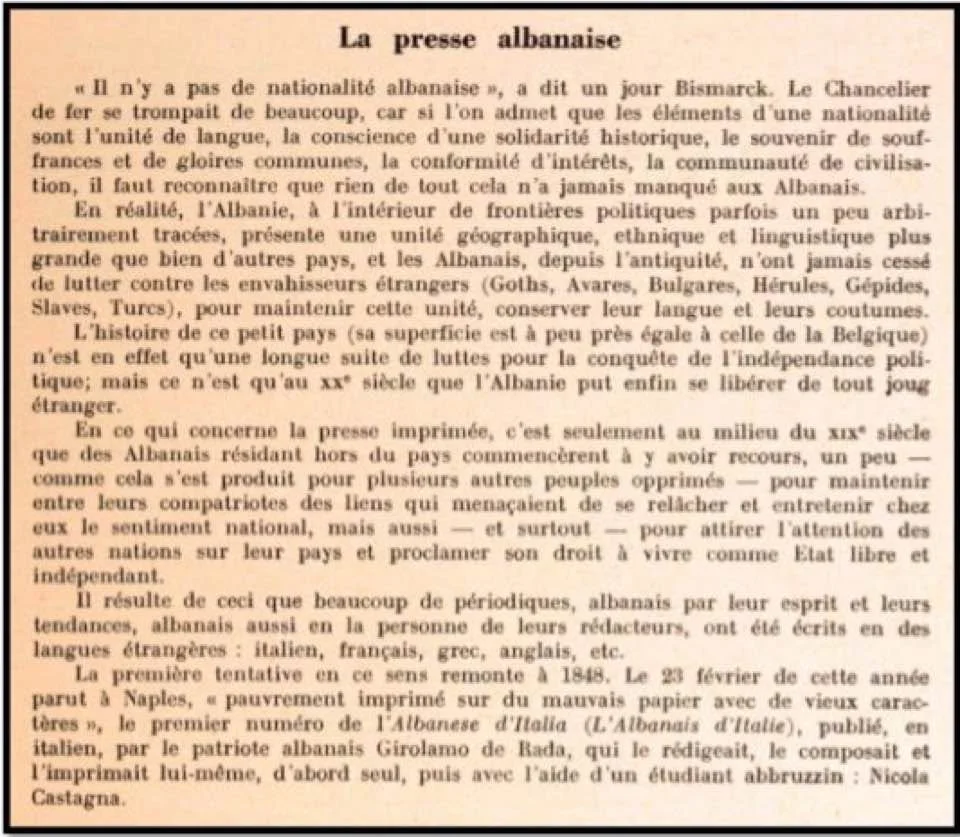
“There is no Albanian nation,” Bismarck once said. The Iron Chancellor was entirely mistaken, because if we assume that the elements of a nationality are a common language, an awareness of historical solidarity, the memory of shared sufferings and glories, compatible interests, and a common civilisation, then we must acknowledge that the Albanians have never lacked any of these elements.
In fact, Albania, within its arbitrarily established political borders, represents a geographical, ethnic, and linguistic unit larger than that of several other countries. Since ancient times, the Albanians have never ceased fighting foreign invaders—the Goths, Avars, Bulgarians, Gepids, Slavs, and Turks—in order to preserve their unity, language, and customs.
The history of this small country, whose area is almost equal to that of Belgium, is indeed a long succession of struggles for political independence. This independence would finally be achieved in the twentieth century, when Albania would at last be freed from foreign domination.
As far as the printed press is concerned, Albanians living abroad began using it only in the middle of the nineteenth century. Like many other oppressed peoples, they used it partly to keep the national sentiment alive among their compatriots, but also—and above all—to draw the attention of other nations and proclaim their right to exist as a free and independent state.
Consequently, many periodicals that were Albanian in spirit and orientation, and whose editors were themselves Albanian, were written in foreign languages: Italian, French, Greek, English, and others.
The first attempt began in 1848. On 23 February of that year, the first issue of Albanese d’Italia appeared in Naples, “printed on poor-quality paper and in old-fashioned type.” Published in Italian, it was the work of the Albanian patriot and editor Jeronim de Rada, who initially did everything himself but was later assisted by Nicola Castagna, a student from Abruzzo.
De Rada believed that Italy would be willing to support his cause, and he immediately began writing in favour of Albania’s independence. However, events soon showed him that, given the situation in Europe, it was still too early to address such an issue. After publishing a few issues, he therefore withdrew to his native region to await better times.
Years passed. Following the Treaties of San Stefano and Berlin, and the partition of Albanian lands, a national defence association was formed, receiving substantial support from Albanian communities in Romania, Italy, Egypt, and the United States. Albanians began to organise themselves. Printed works flourished everywhere. The Bible was translated into Albanian, and newspapers were published in many places.
The first newspaper in the Albanian language, accompanied by a Greek-language version, was published in Athens in 1882 under the title Phônê tês Albanias—The Voice of Albania. Its founder, Anastasio (Anastas) I. Kullurioti, was persecuted by the Greek government because of the Albanian nationalist propaganda he conducted in Athens. He moved his newspaper to Bucharest and, as the persecution continued, sought refuge in Gjirokastër. There, however, the Turkish authorities, acting on the orders of the Greek consul, banned the newspaper and sent him to prison in Corfu. After his release, he returned to Athens and published his newspaper again for a time. Arrested for a second time, he eventually died in prison, most likely having been poisoned.
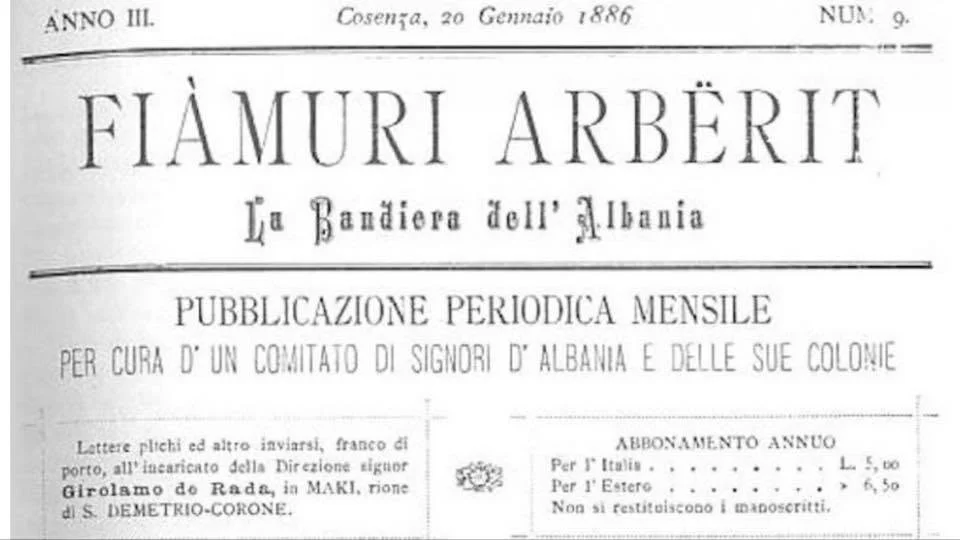
In 1883, “a committee of Albanian noblemen” began publishing a monthly magazine in Italian and Albanian in Corigliano Calabro, Italy. It was called Flamuri i Arbërit (The Flag of Arbër), and its first issue appeared on 20 July. In reality, the magazine was made possible by the personal sacrifices of Jeronim de Rada, who served simultaneously as its director, editor, and administrator.
Austria, Turkey, and Greece, each for different reasons interested in keeping Albania isolated, consequently prohibited its circulation. Deprived of most of its subscribers and potential buyers, De Rada’s publication was also regarded with indifference by the Albanians of Italy, who found it tedious. The last known issue was dated 15 November 1887 and was published in Cosenza.
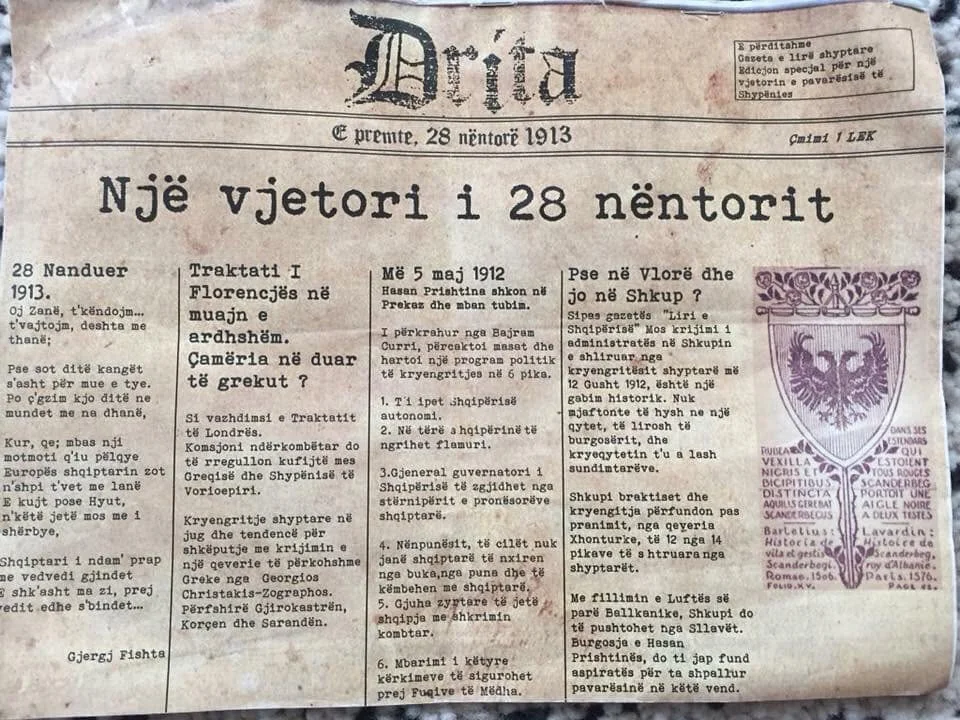
In 1884, the first Albanian scholarly magazine, Drita (The Light), was published in Constantinople by the literary society of the same name. Its director was Pietro Poga, who collaborated with Naim Frashëri and J. Vreto.
On 31 March 1887, Arbri i Ri (The New Arbër), a monthly magazine directed by Franc Stassi Petta and Giuseppe Schiro, was established in Palermo. Published in Albanian and Italian, it failed to survive beyond its third issue, despite the young directors’ confidence and courage.
We have already mentioned that De Rada’s Flamuri i Arbërit ceased publication at the end of 1887. A year later, the patriot Nicola Naço, “who symbolised Albania’s resistance to the brazen domination of the Greeks,” founded Shqiptari (The Albanian) in Bucharest. Written in Albanian and Romanian, it continued the earlier publication’s mission. In 1895, a separate Romanian-language edition appeared under the title Albanesul. The Albanian edition appears to have continued until 1903.
Following the chronology, we arrive at the first periodical published on Albanian soil: the monthly religious magazine Elçija i Zêmers Jesu Krishtit (The Messenger of the Heart of Jesus Christ), founded by the Jesuits of Shkodër in March 1891.
The publication of this periodical within Albanian territory, at a time when Sultan Abdul Hamid had prohibited all works in the Albanian language, can be explained by the fact that Shkodër was a major centre of general culture against which the Turkish authorities had not dared to take action.
In 1895, the first Albanian-language congress was held in Corigliano Calabro under the presidency of Jeronim de Rada. It was decided that a periodical should be established, and the following year Ylli i arbëreshve (The Star of the Arbëresh) was published, with its editorial work entrusted to Archpriest Antonio Argondizza.
In 1897, this newspaper was replaced by Nazione Albanese (The Albanian Nation), a bimonthly Italian-language magazine that continued to exist until the death of its editor, Anselme Lorecchio, on 22 March 1924.
On 25 March 1897, the first issue of Faik Konica’s major magazine Albania was published in Brussels in Albanian and French. It was one of the most important periodicals ever devoted to the Albanian cause. From 1899, and for approximately three years, Konica produced a political supplement entitled Albania e Vogël (Little Albania). In 1902, he moved his newspaper to London, where it continued to appear until 1909.
In the following years, other Albanian periodicals were established in various places, although still predominantly outside their homeland. Some of them were genuinely significant. Between 1897 and 1908, we may mention the following:
In Italy: L’Albania letteraria (1897), a bimonthly newspaper edited by a group of young Italian-Albanians from Corigliano Calabro; La Nouva Albania (1898–1904), a fortnightly publication of the Albanian Political Committee in Naples; Flamuri i Shqipërisë (The Flag of Albania), an Italian-Albanian monthly founded in Naples on 1 January 1904 by Professor Giuseppe Schiro; Gazzetta Albanese (1904); Lajmtari i Shqypenies, published in Rome in 1905 in Italian and Albanian; and Shpnesa e Shqypeniis, whose publication began in Ragusa on 10 September 1905 and continued for two years. It was published in Albanian, Italian, and Croatian.
In Romania: Shqipëria (Albania), published fortnightly from 1897 to 1899 in Albanian, Greek, and Romanian under the auspices of the Albanian group in Bucharest, with the motto “Albania for the Albanians”; L’indépendance albanaise (Albanian Independence), founded in Bucharest in 1898 by Dervish Hima and transferred a year later to Rome under the name Zani i Shqipënisë (The Voice of Albania); Yll’i i Shqipërisë (The Star of Albania), the publication of Albanian patriots in Bucharest from 1898 to 1900, which, despite being written in Albanian, also published articles in French and Greek; and Përlindja Shqipëtare (The Albanian Renaissance), a fortnightly newspaper written entirely in Albanian, except for its leading article, which was in French in the issue published in Bucharest on 15 May 1903.
In Egypt: Bashkimi i Shqiptarëve (The Union of Albanians), a fortnightly publication in Albanian and French, launched in Cairo in September 1900; Besa–Besën, founded in Cairo in October 1900; and Besa, a monthly magazine published in Cairo from 1904 to 1915.
In Bulgaria: Drita, published twice monthly in Sofia from 1901 to 1908.
In Serbia: Albanija, a quarterly newspaper published in Belgrade in Albanian and Serbian in 1905.
In Trieste, then part of Austria-Hungary: Dashamiri, a bimonthly magazine founded on 14 November 1907 and written in the Gheg dialect.
In Switzerland: Albania, a magazine published in Albanian and French in 1905.
In Turkey: Only one periodical could be published, Shqyptari, which belonged to the Bashkimi society of Shkodër. Founded in 1904, it enabled events that had occurred during the preceding year to be compiled for several years.
Albanians in America, for their part, established two newspapers during this period. One appeared in South America: La Questione Albanese, whose first issue was published in Buenos Aires on 1 February 1905. The other appeared in North America: Kombi (The Nation), a bimonthly newspaper founded in Boston on 9 June 1906. On 1 January 1909, it was replaced by Dielli (The Sun).
The Young Turk Revolution of 1908 initially seemed to promise better times for Albanian patriots, who had until then been subjected to severe oppression. Immediately after the Constitution was adopted, Albanian newspapers began appearing within the borders of the Ottoman Empire.
These included:
- Korçë: Korça, first published on 15 December 1908.
- Thessaloniki: Lirija (Freedom), in 1908; Diturija (Knowledge) and Lidhja Orthodhokse (The Orthodox League) in 1909.
- Monastir: Bashkimi i Kombit (The Unity of the Nation), established towards the end of 1909 through the Shoqërî Botonjëse Literare society and published in Albanian and Turkish; Drita, founded in 1909; and Kombi, founded in 1911.
- Elbasan: Tomorri, the publication of the town’s Normal School, founded on 25 March 1910 and printed in Monastir through the Bashkimi i Kombit society.
- Ioannina: Zgjimi i Shqipërisë (The Awakening of Albania), a fortnightly publication of the Bashkimi society, established in 1909.
- Shkodër: Koha (The Time), launched in 1910 and renamed Bashkimi in its second issue.
In Constantinople, Shqiptari appeared in 1909, followed by E Vërteta (The Truth) in 1911.
Outside Turkey, Shqypeja e Shqypënis (The Albanian Eagle) was established in Sofia in 1909, while Rrufega (The Lightning Bolt) and Shkopi (The Stick) appeared in Cairo.
However, the situation soon deteriorated. The newly emerging movement was suppressed, most Albanian newspapers were suspended, and many of their editors were imprisoned. Other newspapers were established abroad, including Liri e Shqipërisë (Freedom of Albania) in Sofia; Trumbeta e Krujës (The Trumpet of Krujë) in St. Louis, United States; Zëri i Popullit (The Voice of the People) in New York; Atdheu (The Fatherland) in Romania; Fjala e të Zotit (The Word of God) in Piana dei Greci, Italy; and La Rivista dei Balcani (The Balkan Review), also published in Italy between 1911 and 1912. At the same time, Dielli in New York became a daily newspaper.
The Young Turks’ attempts to assimilate Albanians into the Ottoman population accelerated events. A general uprising was organised, and in 1912 the Albanians captured Skopje and threatened to take Monastir as well. To halt this movement, which was becoming increasingly serious, and limit the damage, the Turkish government promised to recognise Albanian autonomy under certain conditions. Once again, great hopes emerged, but the Balkan Wars threw everything into question.
Following the defeat of the Turks, Albania was occupied almost entirely by Montenegrin, Serbian, and Greek forces. At the height of the occupation, on 28 November 1912, a small group of Albanian patriots arrived in Vlora aboard an Austrian ship, raised the old flag of Skanderbeg, and proclaimed the country’s independence. An elderly statesman, Ismail Qemal Bey Vlora, assumed leadership of the provisional government.
The timing was opportune, because the expansion of the Balkan states towards the Adriatic worried both Italy and Austria. Both proclaimed the principle of “Albania for the Albanians.”
The diplomatic conference held in London accepted the creation of an independent Albania on 20 December 1912, under the supervision of a European prince chosen by the people. This referred to Prince Wied, who was elected king on 3 December 1913 and landed at the port of Durrës on 7 March 1914.
What happened to the Albanian press during these two years? All the old newspapers had disappeared, with the exception of a few published abroad. However, from the middle of 1913, new publications began appearing to replace them, this time within Albanian territory, which was finally free. These included:
- Konkordia, a weekly political newspaper in Gjirokastër.
- Ushtimi i Krujës, published in Durrës.
- Besa Shqyptare, which reappeared on 18 May 1913 under a new name, Bashkimi, in Shkodër. Some issues also bore the title Zâni i Shkodrës (The Voice of Shkodër).
- Përlindja Shqipëtare, a fortnightly political newspaper in Vlora, founded by D. Berati on 6 August 1913 but closed on 14 March 1914.
- Xgjimi, a monthly magazine from Korçë, launched on 1 October 1913 and discontinued in March 1914. Up to its third issue, it was printed in Bucharest while awaiting the departure of the Greeks from Korçë.
The following should also be added:
- Taraboshi, the first Albanian daily newspaper, founded in Shkodër by T. Tocci on 26 September 1913. It continued until the end of November 1914 and, after a lengthy interruption, resumed publication in 1921.
- Hylli i Dritës (The Star of Light), an important monthly magazine founded in October 1913 at the initiative of the Franciscan superior in Shkodër.
During the reign of Prince Wied, only two newspapers were published in Albania:
- Populli (The People), which appeared in Vlora from 4 April to 19 August 1914 before being transferred to Shkodër when Vlora fell into the hands of insurgents.
- Zana, an illustrated fortnightly literary magazine directed by Mrs Lulo Malësori. It was printed in Bari, Italy, and published in Durrës from June to August 1914.
Then came the Great War, bringing the departure of King Wied and the occupation of Albania by enemy troops. The Albanian question once again came before the world, and other Albanian newspapers appeared outside the country’s borders.
In America, there was a major surge in publishing, with newspapers and magazines such as The Albania (initially in Denver and later in Chicago, 1915); Illyria (Boston, 1916); Perparimi (Watertown, Massachusetts, and later New York, 1916); Yll’ i Mëngjezit (The Morning Star, Boston, 1917); Shqiperia (New York, 1918); and The Adriatic Review (Boston, 1918).
In Lausanne, Switzerland, L’Albanie was founded in 1915 as a “fortnightly publication defending Albanian interests.” In Rome, Kuvendi, an Italian-Albanian political weekly, was launched in July 1918.
In Albania, despite countless difficulties, courageous patriots managed to establish several new periodicals:
- Posta e Shoqnies, a political weekly published for several months in Shkodër, beginning on 5 December 1916.
- Gazeta e Korçës, initially a daily and later published three times a week, established in Korçë on 12 October 1916.
- Zoja Shkoders Drita Shqypnis, a Catholic periodical published in Shkodër from April 1917 to July 1919.
- Kopështi Letrar (The Literary Garden), a magazine that appeared in Elbasan from August 1918 to July 1919.
When the fighting ended, other newspapers appeared to remind the nations negotiating the peace terms and redrawing Europe’s maps that Albania must not be forgotten. These included Agimi (The Dawn), Koha e Re (The New Era), and Populli, published in Shkodër in early 1919; Opinga and Xgjimi i Shqipërisë (The Awakening of Albania), magazines established in Paris that same year; Shqiperia e Re (New Albania) in Bucharest; and La Rassegna italoalbanese in Palermo, among others.
Peace was finally achieved. On 9 November 1921, the Conference of Ambassadors definitively confirmed Albania’s borders, and on 21 January 1925 the country was proclaimed a republic.
Newspapers could now develop under more normal conditions. Even before this moment, however, new publications had sprung up like mushrooms after rain. More than sixty can be counted between 1920 and 1925, although they generally disappeared at the height of their success. Among the most important were:
- Demokratia (Democracy), an influential weekly in Gjirokastër (1925).
- Ushtimi i Vlorës (The Echo of Vlora).
- Zekthi (The Mosquito), the first Albanian satirical newspaper, published in Korçë in 1922.
- Fletorja Zyrtare (The Official Gazette), founded in Tirana in 1922 under the original title Dit e Re (New Day).
On 1 September 1928, the monarchy was restored, and the incumbent president, Ahmet Bey Zogu, ascended the throne under the name Zog I. The new sovereign, who had lived for a long time in Constantinople and Vienna, understood the importance of the press and supported its development as much as he could.
Newspapers had a mission to fulfil in the new kingdom: to establish the authority of the central government among the mountain tribes, for whom blood vengeance, governed by the kanun (customary law), was not yet a thing of the past. Newspapers needed to exert an even greater influence on these communities because they were the only source of intellectual nourishment available to the literate population.
Precisely because of these particular circumstances, the Albanian government believed it was better to have a small number of good newspapers than a large number of mediocre ones. The law of 24 January 1931 stipulated that every publisher had to be at least 25 years old and possess a secondary-school diploma. A deposit of 5,000 gold francs was also required.
The provisions of this law, which contained more than sixty articles, infringed upon freedom of the press. The situation worsened further following two decrees issued on 1 February 1937, which eliminated a substantial number of newspapers. Only the larger newspapers, supported by sound financial foundations, survived. On the eve of the Italian invasion of Albania, every provincial capital had its own newspaper, often a daily.
There were also numerous magazines. Among the most widely read were:
- Minerva, a literary magazine.
- Normalisti, a pedagogical magazine published in Elbasan.
- Vatra e Rinisë (The Youth’s Hearth), a school magazine.
- Zani i Naltë (The High Voice), a Muslim religious magazine.
In a country with a population of 1.2 million, periodical newspapers could not expect to achieve mass circulation. The country had retained certain Oriental characteristics, and published newspapers faced a formidable competitor: the “spoken press,” practised in cafés and marketplaces.
Nevertheless, it can be observed that newspapers quickly reached even the most isolated villages. In recent times, young villagers who had brought their produce to market were often seen buying the week’s newspapers on their way back to their mountain homes.
The Italian invasion of Albania led to the disappearance of all independent newspapers, including Drita, the daily newspaper in Tirana. It was replaced by Fashizmi (Fascism), the “organ of the Albanian Fascist Party,” whose first issue was published on 25 May 1939. The sixth page of this newspaper was in Italian, while the remaining pages were in Albanian. It was the only newspaper still in existence in Albania.
Four other newspapers were published once or twice a week: Littorio Coritca, 7 Prilli (7 April, the date of the invasion), Gazeta e Këmishave të Zeza (The Blackshirts’ Gazette) in Vlora, and Rinia Fashiste (Fascist Youth) in Shkodër. All were organs of the Fascist Party and were published in Italian and Albanian.
by Shefqet Cakiqi-Llapashtica