
by Marios Dimopoulos
When I was studying linguistics, I was preparing to submit my thesis—on the origins of the Greek alphabet and pre-alphabetic scripts—to my professor at the University of Athens, Georgios Magoulas. We were discussing various topics related to prehistory, and he mentioned that when he himself was a linguistics student, he had come across Thomopoulos’s 1,000-page book, Pelasgika.
The work argued that the Pelasgian language was Albanian and that Albanian served as the linguistic substratum for Ancient Greek; he recalled being quite impressed at the time by Thomopoulos’s arguments and the sheer volume of information presented.
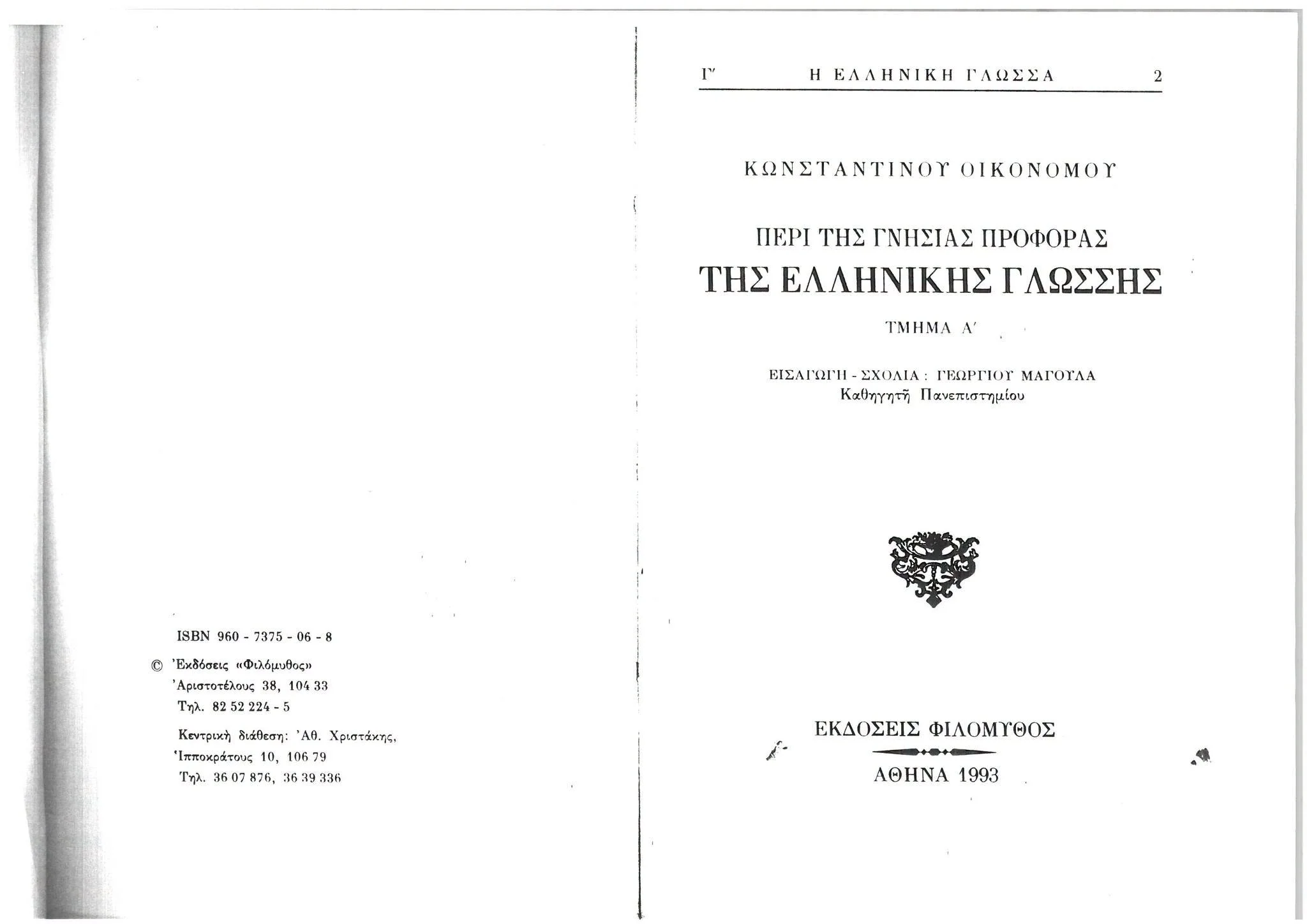
Below, I provide an analysis and commentary by my former professor, Georgios Magoulas, regarding a book by Oikonomos ex Oikonomon titled On the Authentic Pronunciation of the Greek Language (in which Oikonomos attempted to refute the Erasmian theory concerning the pronunciation of Ancient Greek). Specifically, as you can see, it writes the following regarding Thomopoulos:
“Thracopelasgian: In the past, the Pelasgians were considered Indo-Europeans—and, in fact, ancestors of the Albanians (cf. the voluminous book Pelasgika by Iakovos Thomopoulos, Athens 1912).” If Thomopoulos’s book had been a joke or insignificant, it wouldn’t have been mentioned at all.
Therefore, it was a common scholarly consensus at the time that the Albanians were Pelasgians—and this was not claimed by some malevolent, anti-Greek foreigners, but by us Greeks ourselves.
Albanians cannot prove that they are Pelasgians, because they are not Greek and do not know Ancient Greek.
Anyone who does not know Ancient Greek is not an Albanian. I, however, know Ancient Greek just as well as I know Modern Greek; and in the year 2026, I shall prove—with even more evidence than Thomopoulos provided—that Albanians were Pelasgians.


