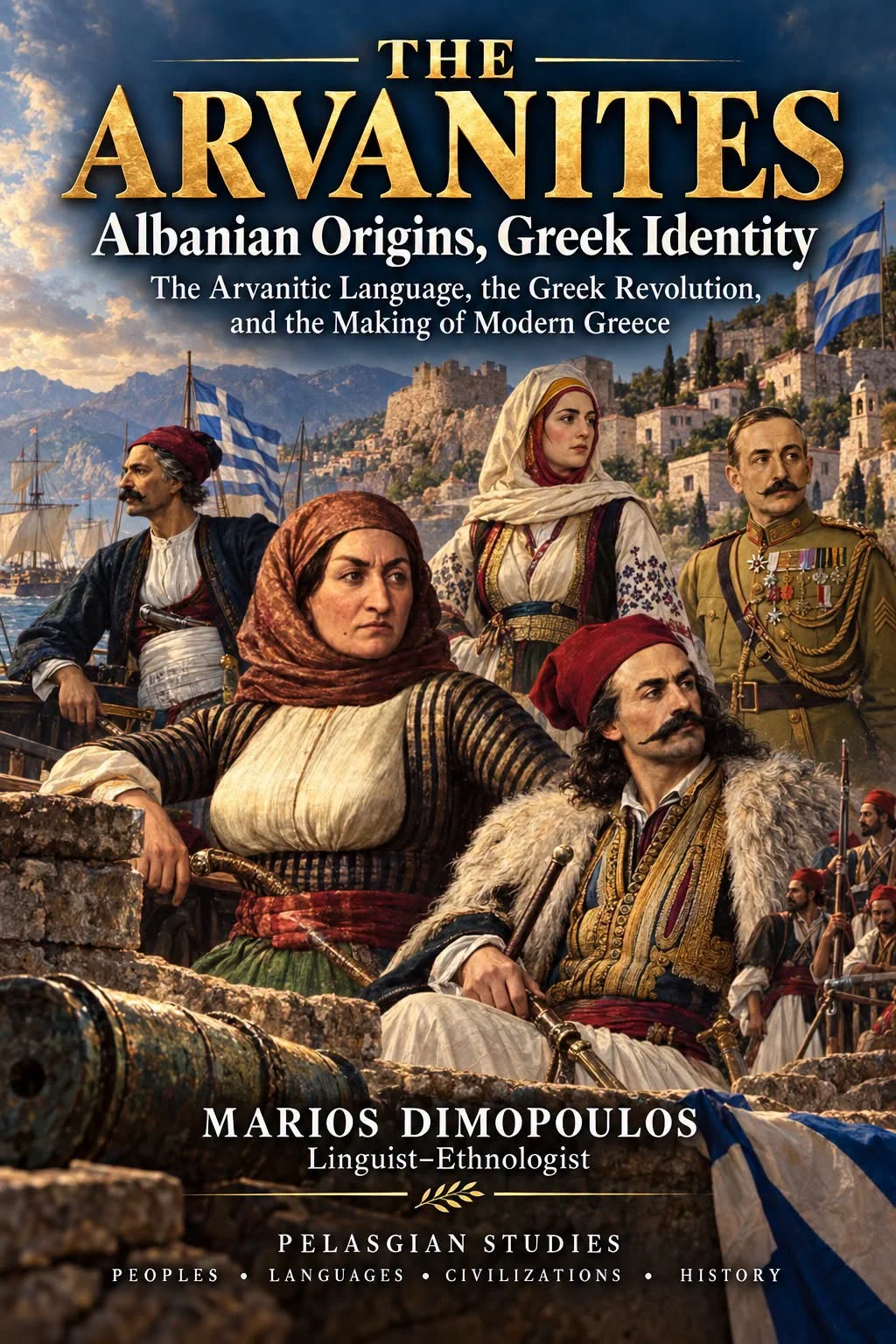

by Marios Dimopoulos.
This book examines the origins, language, and historical identity of the Arvanites of Greece, arguing that their Albanian ancestry and their Greek national identity should not be regarded as contradictory. Drawing on historical sources, linguistic evidence, and nineteenth- and early twentieth-century Greek writings, as well as Arvanite intellectuals and associations, the study reconstructs the medieval migrations of Albanian-speaking populations into Greek lands and traces their gradual integration into Greece’s political, cultural, and national life.
It pays particular attention to the Arvanitic language and its relationship to Albanian. The book challenges modern attempts to separate Arvanitika from Albanian or to describe the Arvanites simply as Greek-speaking or bilingual Epirotes who somehow adopted an unrelated Albanian idiom.
The book examines historical terminology, personal names, place names, songs, family traditions, and linguistic evidence to clarify the relationship between Arvanites, Albanians, and the wider Albanian-speaking world.
At the same time, the study rejects the simplistic idea that Albanian ancestry somehow diminishes the Greek identity of the Arvanites. Instead, it traces how Albanian-speaking communities became an integral part of the Greek nation and played a major role in creating the modern Greek state. The Arvanites are therefore presented neither as “foreigners” within Greece nor as evidence against Greek continuity, but as one of the historical populations through which modern Hellenism itself was formed.
A central section of the book is devoted to the Greek War of Independence. The book examines the contributions of Arvanite and Albanian-speaking populations from Hydra, Spetses, Souli, Attica, Boeotia, the Peloponnese, and other regions through the lives of military leaders, sailors, political figures, and local communities. The study explores how Christian Arvanites fought for the Greek revolutionary cause while other Albanian-speaking groups served the Ottoman state, showing why religious allegiance, political loyalty, linguistic identity and ethnic origin cannot be mechanically treated as identical categories.
The book also revisits the historical terminology surrounding the words Arvanite, Albanian, Arvanitia and Shqipëri. Greek texts from the nineteenth and early twentieth centuries are examined to show how the terminology changed over time and how the word “Arvanite” could be used in much broader ways than in contemporary Greek usage. This semantic history is essential for understanding older sources without imposing modern national categories upon them.
The book pays special attention to the writings and testimonies of prominent figures of Arvanite or Albanian background. The book examines statements attributed to Theodoros Pangalos about his Albanian ancestry and childhood knowledge of Albanian, as well as the writings of Arvanite intellectuals and political figures who openly discussed Albanian ancestry while identifying fully with the Greek state. It also revisits Greek political texts that described Greeks and Albanians as ancient and closely related Balkan peoples and regarded the Albanian element within Greece as an integral component of the modern Greek nation. Pasted markdown
An important body of evidence comes from nineteenth- and early twentieth-century Arvanite organizations and publications. The study examines texts associated with the Arvanitic League of Athens, the Spetsiot Association, Michail Lamprynidis, Panagiotis Koupitoris, and other writers who discussed the Albanian ancestry of Greek Arvanites in terms very different from much of the nationalist discourse that emerged later.
These documents reveal a period in which Albanian ancestry and Greek patriotism could coexist openly without being perceived as mutually exclusive. Pasted markdown Pasted markdown
The study also examines historical attempts to make the Arvanites a bridge between Greece and Albania. Some nineteenth-century writers and associations portrayed Greeks and Albanians as kindred peoples, sometimes through the then-popular Pelasgian theories of common descent, and advocated forms of political, cultural or strategic cooperation.
These historical ideas are reassessed in light of modern scholarship and placed within the author’s broader hypothesis of a deep Greek-Albanian and Pelasgian relationship.
Finally, the book advances a broader interpretative proposal: if Greeks and Albanians preserve elements of a much older Palaeo-Balkan continuum, then the medieval movement of Albanian-speaking Arvanites into southern Greece may be interpreted not simply as the arrival of an alien population, but—within the author’s Pelasgian model—as a return to regions connected with an earlier ancestral Balkan homeland. The author presents this proposition as a research hypothesis rather than an established conclusion and compares it with the conventional historical model of medieval Albanian migration.
The book’s broader purpose is to remove the Arvanites from modern Greek-Albanian cultural conflict. Rather than being used as evidence that divides the two peoples, their history is presented as one of the clearest examples of their centuries-long interaction. Albanian in origin, Greek in national history and central to the creation of modern Greece, the Arvanites can be understood as a historical bridge between Greeks and Albanians rather than as a subject of nationalist competition.

