
Summary
In The Albanians: An Ethnic History from Prehistoric Times to the Present (2009), Edwin E. Jacques explores the ancient roots of Albanian identity through the history of Epirus, the Illyrians, the Pelasgians and the sanctuary of Dodona. Ancient Epirus, encompassing parts of present-day Albania and northwestern Greece, occupies an important place in the Albanian historical narrative because of its geographical, cultural and historical connections to the western Balkans.
Jacques discusses Dodona, an ancient sanctuary associated with Zeus, the sacred oak and the eagle, which was regarded as a divine messenger. He connects these traditions with Homer’s Iliad and examines their possible significance for understanding the eagle’s enduring importance in Albanian identity. The ancient Pelasgians, whom Greek sources associated with Dodona, also feature in theories of Albanian origins, alongside the Illyrians, who inhabited substantial areas of the western Balkans.
The Albanian interpretation emphasises the possibility of deep historical continuity between the ancient populations of the region and the ancestors of modern Albanians. The eagle, later established as the central symbol of the Albanian flag and associated with Skanderbeg, represents national unity, courage and cultural survival. The ancient history of Epirus and the western Balkans provides an important context for understanding Albanian historical identity.
Introduction
The history of the Albanian people can be explored through the ancient traditions, populations and kingdoms of the western Balkans, particularly Illyria and Epirus. In The Albanians: An Ethnic History from Prehistoric Times to the Present, Edwin E. Jacques presents a historical interpretation that connects Albanian origins with the ancient Illyrians and Pelasgians, the traditions surrounding Troy, and the cultural heritage of Epirus.
These connections form part of a broader Albanian historical narrative in which the people, language and identity of Albania are understood as having deep roots in the ancient Balkan world. The book’s description on Google Books explicitly notes that many Albanians trace their ancestry to the Illyrians and Pelasgians and associate their heritage with ancient heroes and Alexander the Great.
Ancient Epirus occupies a central place in this interpretation. Its historical territory extended across areas that today belong to southern Albania and northwestern Greece. It was home to peoples such as the Molossians, Chaonians and Thesprotians and maintained close connections with neighbouring regions of the western Balkans. From an Albanian historical perspective, Epirus cannot be separated from the wider history of Albanian-inhabited territories.
Its ancient kingdoms, religious sanctuaries and political traditions belong to the history of a region whose population and cultural landscape changed over many centuries. The Albanian connection to Epirus is therefore important not only geographically but also in discussions about the historical continuity of populations in the western Balkans.
One of the most significant places in ancient Epirus was Dodona, a renowned sanctuary dedicated primarily to Zeus. The oracle was famous for the sacred oak through which the god was believed to communicate his will. Ancient writers associated Dodona with the Pelasgians, whose identity has long been debated. Within the Albanian theory of ancient origins, this association is particularly significant.
If the Pelasgians represented an early population of the Balkan region connected to the ancestral communities from which Albanians emerged, the traditions surrounding Dodona would form part of the deeper cultural history of the Albanian homeland. This interpretation has a place in Albanian historical thought.
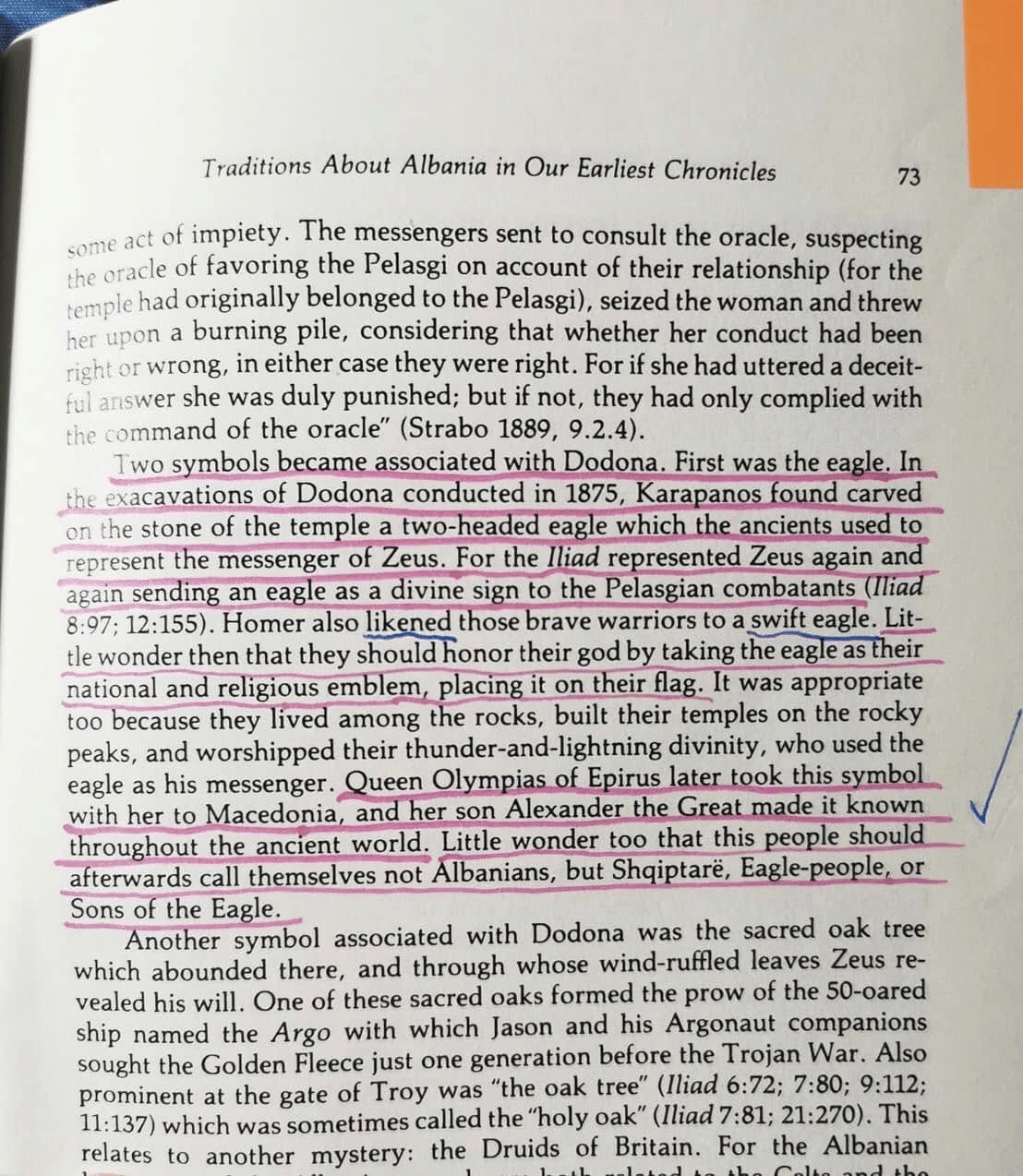
On page 73 of his book, Jacques discusses the eagle associated with Dodona and refers to archaeological excavations conducted by Karapanos in 1875, during which a two-headed eagle was reportedly discovered carved into stone at the sanctuary. Jacques connects the eagle with Zeus and with ancient literary traditions in which the bird appears as a divine messenger.
He cites Homer’s Iliad, including passages 8.97 and 12.155, in which an eagle appears as a sign associated with Zeus and the battlefield. He also draws attention to Homer’s comparison of warriors with a swift eagle, linking the bird with strength, courage and divine authority. Read through an Albanian historical perspective, these traditions provide a compelling cultural parallel with the eagle that later became the national emblem of Albania.
The Albanian double-headed eagle is far more than a decorative image. It represents the historical endurance of the Albanian people, their sense of unity and their determination to preserve their identity through centuries of foreign rule. The eagle is particularly associated with Gjergj Kastrioti, known as Skanderbeg, the fifteenth-century Albanian leader who resisted Ottoman expansion.
His legacy became a defining element of Albanian national consciousness, and the eagle eventually took its place at the centre of the national flag. The ancient eagle traditions described by Jacques can therefore be interpreted as part of the wider symbolic landscape in which Albanians understand their history.
The Pelasgian question is equally important to the Albanian theory of origins. Ancient Greek authors used the name Pelasgian for populations associated with different parts of the ancient pre-Greek and Paleo-Balkan worlds.
In Albanian national historiography, some writers have proposed that the Pelasgians were among the ancestors of the Albanians and that their presence in the ancient Balkans represents an early chapter in Albanian ethnogenesis.
This theory became particularly influential among Albanian intellectuals who sought to establish the antiquity of their people and demonstrate that Albanian identity was rooted in the region long before the arrival of later empires. Jacques’s book belongs to this wider discussion of Albanian origins.
The Illyrians provide another central element of the Albanian historical narrative. Ancient Illyrian communities inhabited substantial areas of the western Balkans, including territories associated with modern Albania. The Albanian language is an independent branch of the Indo-European language family, and its early development has long been studied in connection with the ancient populations of the region.
From the Albanian perspective, the combination of geographical continuity, the survival of the Albanian language and the historical record of the western Balkans supports the importance of investigating an indigenous origin for the Albanian people.
The history of Epirus also connects the region to some of the most prominent figures of antiquity. Olympias, the mother of Alexander the Great, belonged to the Molossian royal family of Epirus. Her marriage to Philip II of Macedon linked the Epirote and Macedonian dynasties, while Alexander’s conquests extended the influence of the ancient Macedonian kingdom across a vast territory.
For Albanians, the history of Epirus is significant because it places the region within the political and cultural developments of the ancient Mediterranean. Jacques discusses Olympias in connection with the broader history and symbolism of the region.
Dodona’s sacred oak adds another dimension to this historical picture. The sanctuary’s religious traditions centred on the belief that Zeus communicated through the sounds and movements of the oak’s leaves. The tree was therefore a sacred link between the natural world and divine authority.
Together, the oak and the eagle represented important elements of the religious life of ancient Epirus. For those exploring Albanian historical traditions, these symbols form part of the ancient cultural environment of a region closely associated with Albanian history.
The Albanian name Shqiptarë and the name Shqipëria are also frequently connected in popular tradition with the eagle. Albania is often described poetically as the land of the eagles, and the eagle has become a powerful expression of Albanian national identity. This association reinforces the symbolic relationship between the modern Albanian people and the eagle traditions discussed by Jacques.
Taken together, Epirus, Dodona, the Pelasgians, the Illyrians and the eagle form an important part of the debate surrounding Albanian origins. The Albanian theory emphasises the ancient roots of the people in the western Balkans and interprets the region’s archaeological, historical and cultural traditions as evidence worth examining when reconstructing the past.
Jacques’s account contributes to this perspective by bringing ancient literary references and regional traditions into a discussion of Albanian identity. The strength of the broader historical argument depends on assessing each connection carefully, distinguishing documented geographical and cultural relationships from hypotheses about direct descent.
The history of Albania should not be reduced to a single ancient people or symbol. It developed through many centuries of political change, cultural interaction and linguistic continuity. Nevertheless, the ancient history of Epirus and the western Balkans remains essential to understanding the historical landscape in which Albanian identity emerged.
Dodona’s oracle, the traditions of the Pelasgians, the presence of Illyrian communities and the enduring power of the eagle all contribute to the story Albanians tell about their origins. Even where direct genealogical connections remain uncertain, these traditions demonstrate the lasting importance of the ancient Balkans in Albanian historical consciousness.
Source
Edwin E. Jacques, The Albanians: An Ethnic History from Prehistoric Times to the Present. McFarland & Company, 2009, p. 73. The book discusses Albanian origins, the Illyrians, the Pelasgians and traditions connecting Albania with the ancient world.
Google Books: https://books.google.com/books/about/The_Albanians.html?id=JNYmAQAAMAAJ
Ancient references mentioned: Homer, Iliad 8.97 and 12.155; Strabo, Geography 9.2.4.

