
Debates about the political situation in Serbia and its role in the region remain one of the most sensitive and discussed topics in the Western Balkans. Since the collapse of Yugoslavia, Serbian society has undergone a long process of transformation, but at the same time it has maintained internal political tensions, centralized power structures, and strong influences from nationalist circles and external actors. In this charged climate, critical voices that openly articulate Serbia’s problems often remain rare – and for this very reason take on special weight.
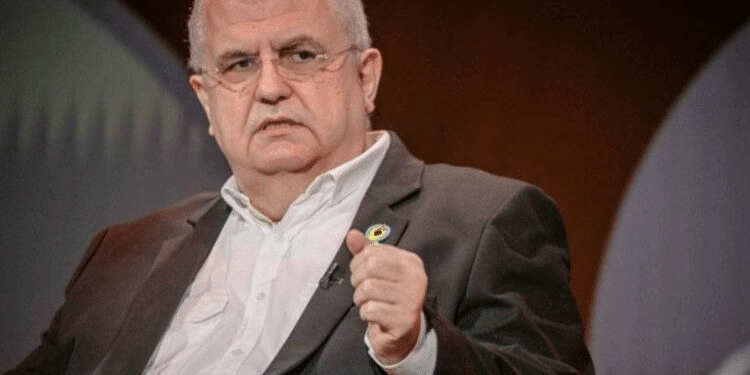
One of these voices is Nenad Çanak, a politician and intellectual from Vojvodina, known for his direct criticism of Serbian nationalism, authoritarianism and the influence of foreign services in Serbia. In the following interview given to the Montenegrin portal “Aktuelno”, Çanak presents a harsh and uncompromising analysis of Serbian political reality, describing Serbia as a state captured by criminal structures, Russian influence and fascist orientations.
SERBIA IS A FASCIST PIG STABLE
Nenad Čanak is a special personality not only in Vojvodina and Serbia. He says things in a clear language and without sparing anyone.
This is an interesting interview that Čanak gave to the Montenegrin portal “Aktuelno” on the current situation in Serbia.
Author: Stanko Radulović
The founder of the League of Social Democrats of Vojvodina (LSV), Nenad Čanak, is one of the most prominent politicians in these areas, who since the arrival of Slobodan Milošević has continuously criticized Serbia’s harmful nationalist policy, which constitutes the main destabilizing factor in the region.
Čanak has shown several times with actions that he is a friend of Montenegro and that he does not see it as an appendage of Serbia, but as a sovereign country and political subject with all its own characteristics.
In an interview with the portal Aktuelno, he spoke about the situation in Serbia, the Serbian Church, the Montenegrin Orthodox Church, the current political climate in Montenegro, regional relations and the situation with Vojvodina.
Aktuelno: In Serbia, students have been protesting for more than a year now, and citizens have joined them, but Aleksandar Vučić refuses to step down. When you look at the events in Serbian society, it seems that Vučić is devastated, but at the same time it seems that everyone in Serbia is working to prevent him from experiencing his political end so soon. How do you feel about all this now, considering that the protests no longer bring the results they had at the beginning?
Čanak: First of all, I would like to correct you: this is not about Serbian society, but about society in Serbia. There is no Serbian Government, but the Government of Serbia, nor a Serbian president, but the president of Serbia, and so on. This is the essence of the matter, through all the confusion and lexical complexity.
The whole scene cannot be described like this, because if something has no name, it cannot be thought of. When you give it the wrong name (Serbian), it will lead you astray and that is the whole deception that is constantly happening here. If you call everything by its right name, you will understand that Serbia as a state still does not have defined external borders, it does not have clear relations with internal politics, let alone foreign policy.
What is unacceptable is that the state has allowed the same political clique to rule at all levels, which is only a transmission of political will, a political oligarchy. We are in a position where the executive is led by a party, and the party is led by criminals.
Milošević used criminals for his own needs, the same was done in the SFRY, but very discreetly; here the criminals have entered a higher stage, they are not tools, they are partners in the exercise of power. Serbia at this moment is a fascist state; I do not speak as an insult, but as a diagnosis, and with great sadness about where my homeland has fallen. mine. You have theocracy, misogyny, xenophobia, insistence on militarism and territorial expansions, inequality of citizens before the law.
Čanak: Yes, the whole story is based on that ugly statement of Nikola Pašić: “Laws are for opponents”. When we look at the situation this way, it is clear that nothing has changed in the last two years, since our last conversation; only the trend has led us to a position where we live in open fascism, in open violence by Russian services, and in total surrender to the West, except for attempts to extract something from EU funds.
Aktuelno: Does the change of some words of the anthem “Bože pravde”, from the part that says “Bože spasi srpskog kralja” (God save the Serbian kingdom) to “Bože spasi srpske zemlje, srpski rod” (God, save the Serbian race (strain)) correspond to this fascist narrative and aspirations?
Čanak: Čanak: That change of the anthem is one of the biggest stupidities I have seen in my life, because in that way the respective anthem has been completely falsified, even though Serbia is a republic. I would understand the preservation of the original text (Serbia has preserved some monarchist symbols in the coat of arms and flag).
Davorin Jenko wrote the anthem on the occasion of the coronation of
Milan Obrenović, that is, the king from the dynasty that in Serbia was successfully extinguished without any living descendants. I understand “Bože pravde” with the king as a historical moment and this is legitimate, however, there are many more beautiful songs for the anthem than this.
This transformation into “Serbian lands” – and Serbian lands are, approximately, everywhere where Serbs live – is not even entirely accurate, because Serbian lands are no longer in Croatia, because they refer only to the territories where Serbs live; but this does not apply to Chicago, where the largest number of Serbs outside Serbia live.
If they care so much about Serbs, why has no one noticed that there are more Serbs in Chicago than in Montenegro, Kosovo and Macedonia combined? When have you ever heard of care for Serbia in Chicago? Never. Chicago cannot be instrumentalized, and the same applies to Vienna.
This clearly shows the territorial and political claims that Serbia, as a fascist state, has. Also, in some parts of Ukraine, for example in Kharkiv, Russian is spoken, because Russification and destruction of books in the Ukrainian language, which was banned, was carried out and children in schools have not learned their native language.
Aktuelno: How do you explain Serbia’s aggressiveness towards Montenegro’s right to its own church?
Čanak: According to Orthodox canons, the church occupies the territory of a state. In the newly formed space of the Kingdom of SHS (Kingdom of Serbs, Croats and Slovenes, later Yugoslavia) there were three autocephalous Orthodox churches and several independent eparchies: the Orthodox Church of the Principality of Serbia, the Orthodox Church of Montenegro and the Autocephalous Metropolis of Karlovci, for the needs of the Orthodox population in the territory of Austria-Hungary.
Since the church is regulated according to the borders of the state, the new state, by unification, united the Orthodox churches and this united church received the tomos with great difficulty in 1922. When in 2006 Montenegro regained its independence, at that moment this church had to be dissolved and the autocephalous Orthodox Church in Montenegro had to be returned.
Aktuelno: How do you comment on the fact that the Serbian Law on Religion states that the church in Serbia was founded in 1836, while it is manipulated by saying that the Serbian Orthodox Church (SPC) was founded by Saint Sava in 1219, who has the status of an enlightener, but who never “enlightened” anyone?
Čanak: Rastko Nemanjić, Saint Sava, did not found any Church, did not establish any educational institution, never taught anyone to read and write any literary works. The Hilandar Monastery already existed, and he and his father simply bought it, and therefore it is crazy to refer to that period for what is happening today. When I talk about the “Serbization” of Montenegro, I mean first of all that offensive political Serbization; I am not talking about ethnic Serbs and I personally know a part of ethnic Serbs for whom Montenegro is their homeland, who feel like constitutional patriots of their country, Montenegro.
For this reason, the procession of the lamps is one of the best examples of the misuse of religious freedom for political purposes, where they attracted bad elements from the entire region to come there and deal with the overthrow of power in Montenegro, but not because of Milos Đukanović, but because of Montenegro’s pro-European and pro-NATO path. Because Montenegro is the last piece of the coast that should not be part of NATO.
Aktuelno: Serbia is also aggressive towards Bosnia, which cannot escape the weight imposed by Vučić and Dodik?
Čanak: Bosnia and Herzegovina can exist only and only as a civic state, while you have made it a pseudo-ethnic tri-national state with entities that are not clear enough, but it is called a republic and a federation. Look, a state that consists of a republic and a federation, and at the same time, when the powers of the international community are used to dismiss Dodik, then all of Serbia starts complaining:
“They dismissed our president of the republic”. He is not the president of the republic, but of the entity. Republika Srpska should have had a changed name, because it was created as a republic by those who were all war criminals, most of whom, except for those who killed themselves, are sentenced to life imprisonment.
And now you leave a criminal project intact, from the name to the institutions, and wonder why it does not work. In a civil war there can be no end to the war without winners and losers. In a war between states there may be, but in a civil war there cannot be, and in Bosnia and Herzegovina there was a civil war with elements of genocide.
Aktuelno: How do you see the status of Vojvodina in all this?
Čanak: For everything that is happening, there is a very simple solution, so simple that it hurts, that is why everyone closes their eyes: an independent Vojvodina. In Vojvodina, the SNS organized a series of rallies against a “Vojvodina separatism”, which in fact does not exist, and then I wrote a text: what would happen if it existed?
Here it is clear that if Vojvodina were an independent state, what would happen: sanctions would immediately be imposed on Russia, the nationalization of NIS (Serbian Oil Industry, a large refinery bought by the Russians) would take place and its return to Vojvodina.
NIS no longer exists; everything is Naftagas Vojvodinas with a few gas stations outside Vojvodina. All the production, the oil fields, all of them are in Vojvodina.
By returning the oil fields to Vojvodina and taking them from Russia, the supply of terrorist organizations to the territory of the Western Balkans is cut off, which is very important. Thus, Serbia will no longer have an inch of border with Croatia and Hungary. The abolition of smuggling cooperation with these countries to avoid sanctions against Russia, because Serbia sells oil through Croatia to avoid sanctions, and Orban, as a pro-Kremlin metastasis in the EU body, has a loyal ally in Serbia.
The weakness of an independent Vojvodina would be the fact that it would be surrounded by nation-states that would try to divide it, so it would have to have international protection as part of a security project to stop Russia from penetrating the West.
Aktuelno: In Montenegro, Đukanović is accused of smuggling cigarettes and oil, even though it is known that Momir Bulatović had arranged everything in Tirana with Berisha and that it was his project?
Čanak: Montenegro has survived this way, has filled the budget, has paid pensions, personal income and everything else, and was under sanctions because of Serbia’s policy. It was not because of his political stance, but because of Serbia’s actions.
Montenegro, at that time, helped the democratic opposition leave Serbia so that it would not disintegrate, provided logistics for the fight against Milošević and contributed a lot to everything.
Montenegro has not deviated from the European path; but it has invested in deviating – since 2016 and the attempted coup, where services from Belgrade acted for the interests of Russia, and now are we going to be fools?
Aktuelno: How do you comment on the fact that no media, not even independent ones, want to write about crime in Crvena Zvezda, which is a center for drug distribution, a center for the construction mafia, a place where pornographic films are made… Non-governmental organizations accuse Dragan Milošević and Zvezdan Terzić of releasing the most serious criminals from the Central Prison for 50,000 to 100,000 euros?
Čanak: “All this is correct, but first of all, there is no media in Serbia – there is a propaganda machine – and they only differ in which of the tycoons, i.e. oligarchs, they work for, but they do not differ in any way in the extent to which they have given up journalism and are exclusively engaged in propaganda. That is why I am banned from the media in Serbia.
I don’t know if you have noticed that when N1 records the student protests, there cannot be a single frame (view) without someone passing by with a Chetnik turban or a cockade; and of course, icons and crosses are mandatory.
The people who are there say that they do not even notice this, but then why is it so important for the media to show it as if it were some leading force? Because it is neither a force nor a leading one. This cannot inspire anyone, nor gather a sufficient number of people, because, after all, the church is a branch of the BIA (secret service), which serves hindered any activity that would be directed against the regime.
When the children marched through Serbia, no Orthodox church opened its doors for them to sleep there, but the children slept in the streets. Catholic churches opened their doors. Now, in order to further mark the territory, the SPC has discovered that 11 churches were missing in Novi Sad, especially in Liman and in the parts where the SNS traditionally loses elections.
“So, this country is a pigsty, a fascist pigsty, where the SPC priests are an organized criminal group that has all the privileges of being financed from the budget, without paying taxes, working with cash without fiscal receipts and at the same time having its own television, radio and media.
At the same time, with RTV Vojvodina, it is managed from Belgrade.”
Aktuelno: Would the independence of Vojvodina bring about a relaxation of relations in the region and the end of the dream of Greater Serbia?
Čanak: The independence of Vojvodina would lead us to a situation where the border with Croatia and Hungary would be pacified, where the program of RTV Vojvodina would be broadcast in the six official languages that exist in Vojvodina. This would be a serious blow to the propaganda in Serbian and Hungarian directed towards Vojvodina. The weakness of an independent Vojvodina, I will repeat, would be the fact that it would be surrounded by nation-states, which would try to dismember it according to the Bosnian model. For this reason, an independent Vojvodina would have to have international protection and it would be part of a security project to stop Russia’s penetration towards the West.
Aktuelno: How could this be solved?
Čanak: Very simple. Slobodan Milošević was not convicted of war crimes just because he died, yes so did Adolf Hitler – which does not mean that they were not war criminals. Why am I making this parallel? Austria joined the Third Reich with the full consent of the people in Austria, who enthusiastically welcomed the unification with Germany.
After World War II, with the annulment of all decisions of the criminal regime that was the Third Reich, the decision to unify Germany and Austria was also annulled. By the same logic, by which the autonomy of Vojvodina was abolished in 1990, all subsequent laws and constitutions should be put out of force.
Vojvodina should have the right to self-determination just like all federal units of the former Yugoslavia. Unlike Kosovo, which was conquered by the sword during the Balkan wars, Vojvodina with its territory and population was annexed to Serbia. It was not liberated – this is a pure lie – nor did it join any Assembly.
The so-called The Assembly of Novi Sad had as much legitimacy as the Assembly of Podgorica had during the annexation of Montenegro to the new state. There were only representatives of Slavic peoples. Slavs at that time made up less than 40 percent of the population, so even if they were legitimate representatives, they would still be less than half, because two-thirds were non-Slavic.
This way of unification, which is now presented as a kind of liberation of Vojvodina, is a farce. We, as the League, even prepared a proposal that they rejected. We wanted to erect monuments to all the Serbian soldiers who fell for the liberation of Vojvodina in the First World War. The amount needed? Zero – because there is none…
When they arrived in Petrovaradin, they stayed there for three days waiting to cross the Danube, while here the citizens of Novi Sad themselves organized patrols that somehow maintained order on the streets. And those so-called liberators were greeted by the mayor of the city with the words:
“Where have you been all this time?”
Only a year later, in the newspaper “Zastava”, the newspaper of the Serbs in Vojvodina, the text was published on the front page:
“Cry, Vojvodina, what has happened to you”, and then the looting and plundering that followed were listed – just like in Montenegro, in the Serbian Republic of Krajina, in Bosnia and Herzegovina. So, everything that Slobodan Milosevic and his criminal regime have done should be declared illegal – just as everything done during Hitler’s time was declared illegal, but also everything done after that time.
Then Belgrade will start shouting that this is the destruction of this or that, while, if you look closely, Belgrade is a metastasized cancer in the land of the Western Balkans, sucking the energy from everything. And for this reason, entire hectares of the most fertile land are being sold to build the “Ling Long” tire factory, which is extraterritorial and where not even ambulances can enter. Who gave you the right to violate your subjectivity in this way by granting such concessions to other countries?
Aktuelno: Can you imagine an Italian, for example, in Switzerland, saying that he does not recognize Switzerland as a state – as is happening in Montenegro – and then being rewarded with the post of Speaker of the Parliament?
Čanak: Yes, I can. There was an Italian who advocated for some terrorist acts and who had lived there for 30 years. In the morning they came, packed him up and sent him to his “country of origin”. In this sense, things are very simple: whoever comes must behave according to the rules he finds there. Human freedom is limited by the right to freedom of others. In this sense, freedom of religion is limited by the right to be free from religion. I am for everyone to practice their own faith, but no religion forces me to behave according to its rules.
Personally, I am baptized as Orthodox, but by deep conviction I am an atheist. Now I am working to have my baptism certificate recognized in the Montenegrin Orthodox Church (CPC), since I was baptized in the Serbian Orthodox Church.
Aktuelno: Does Christianity violate its fundamental human principles with its activities?
Čanak: I would not enter into those theological debates, but I keep the Bible close to me because it, Roman law and Greek philosophy are the three pillars of European civilization. And the Serbian Orthodox Church has lost all traces of legitimacy – it is an organization of interests, violent and arrogant, in the service of an even more violent organization called SDB (UDB), namely BIA, which is in the service of criminals and big capital. This is the situation in Serbia, which, I repeat, is a fascist state – and this will not pass without blood. As you have noticed, suddenly students have started dying and suddenly everything has started going wrong. Whoever thinks that this will stop is seriously mistaken.
Aktuelno: 25 years ago Serbia did not properly condemn the regime of Slobodan Milošević and the politicians of that time; lustration was not carried out and their acquired property was not confiscated. This should not happen again after the fall of Aleksandar Vučić’s regime – do you agree?
Čanak: I was committed to this 25 years ago. Without polishing, that is, without banning political parties, there is no discussion about further developments. Then Djindjić told me: “Leave it Nenad, you cannot build democracy by banning political parties.” But they are not parties – they are groups for carrying out criminal enterprises; therefore, they are not parties, but criminal organizations. The political scene of Serbia is full of condoms pulled over services, but when they spend them, nothing remains of them – that will be the case with these people too – they will not exist when they leave power.
The students did a great thing because they freed people from fear. Now it is shameful to be a “scoundrel” and on the side of the regime – even those who are, hide it and are ashamed. Nobody knows what will happen the day after Vučić falls. If the police, the BIA, are not immediately disbanded, and the files are not opened, the day after tomorrow it will be too late. I have seen it, I have experienced it.
The transitions (political desertions) happen overnight, and 300,000 “qaci” overnight will switch to students and manage to get into the state apparatus. That is why I do not participate in any of this, because I do not want to be on the pillar of shame for everything that will happen the day after tomorrow – because the collapse will come within a year, and then these people will return with bloody knives and slaughter in the streets.
That is why Vučić must go. But there cannot be so much injustice without someone being held accountable. Their property should be confiscated, they should end up in prison for the contracts they have made, because they have declared every agreement from which they have benefited greatly as state secrets. This should allow the people to breathe a little more freely.
Aktuelno: What after this? How many people does it take to take over the state administration?
Čanak: For the basic takeover of the state administration, you need 6,000 people who you should not touch and another 6,000 who you should immediately dismiss, so that in their place you can bring in people who will do the job. Serbia does not have these 6,000 people at the moment – and in this sense, this is the tragedy of the times we live in. Young people are standing in front of the embassies who are leaving; Serbia is emptying. In Novi Sad and Belgrade the population is growing, while in other cities it is falling – we will have an empty place.
Aktuelno: Has your book been published in Montenegro?
Čanak: My novel “Travellers to the Molusca” was published in Montenegro, and my only condition was that it be translated into Montenegrin. I did not ask for any royalties from the publisher, and this is the first book by an author who writes in Serbian to be translated into Montenegrin in the last many decades.
Aktuelno: When “The Crown of the Mountains” was first published in Belgrade in 1851, 400 words had to be translated because it was then unintelligible in Serbia, while we in Montenegro understand it today “untranslated” by a miracle?
Čanak: Yes, they cannot understand it. There is something even funnier to tell you. Personally, for the needs of the party school, I translated Ilija Garašanin’s “Načertanije”, because he wrote in the Serbian of 1844, and that language is completely incomprehensible today.
The issue of language is complex – but even this act of mine to have my novel translated into Montenegrin has a simple reason: the Montenegrin language is not directed against anyone. It is a miniature form of revolt against the disappearance of identity.
And for this reason, despite being so close to Serbian, Croatian and Bosnian, Montenegrin should be one of the official languages of the state – if not the only one. You can’t abolish something just because it resembles something else.
You have Ukrainian and Russian, which have 70 percent of words in common, while Serbian and Russian have 60 percent of words in common.
Source
https://usalbanianmediagroup.com/nenad-canak-serbia-eshte-nje-stalle-me-derra-fashiste/?

