
On December 8, 2020, the High Court in Belgrade, Department for War Crimes, pronounced the first extrajudicial verdict regarding the war crime committed in Bogdanovci during the Homeland War against members of the Albanian national minority. With it, Boško Soldatović, a member of the Military Police Company of the Second Proletarian Guard Mechanized Brigade of the JNA, was found guilty and sentenced to 15 years in prison.
During the siege of Vukovar, its only connection with the rest of Croatia was the so-called corn road towards Vinkovci, which led through the villages of Bogdanovci, Marinaci and Nuštra. Around two hundred defenders participated in the defense of Bogdanovci, including, in addition to the people of Bogdanovci, members of the National Guard Corps, special police, the Ministry of Internal Affairs and the Croatian Army. In total, one hundred and twenty-nine people died, forty defenders and eighty-nine locals.

With the fall of Marinaci and Cerići in October 1991, Bogdanovci, like Vukovar, remained completely surrounded, and along with the Heroic City, became a symbol of resistance to the Greater Serbian aggressor. The few, poorly armed and exhausted defenders and locals heroically defended the village and offered desperate resistance to the much superior enemy. The number of dead and wounded defenders and civilians increased every day, causing the defense line to gradually collapse, and the stock of weapons, especially anti-tank weapons and medical equipment, almost disappeared.
In the early morning hours of November 10, 1991, the JNA, supported by various paramilitary units, launched another violent attack from all directions with planes, tanks and artillery, and it soon became clear that the defense of the village was broken. The remaining defenders with mobile wounded and a part of civilians in several groups set out to try to break through the enemy lines in different directions, during which a large number of them were killed. Unfortunately, almost all civilians who did not break through, some due to their position at the time of the attack, but most due to their health or age, were captured and then killed after the occupation army entered the village.
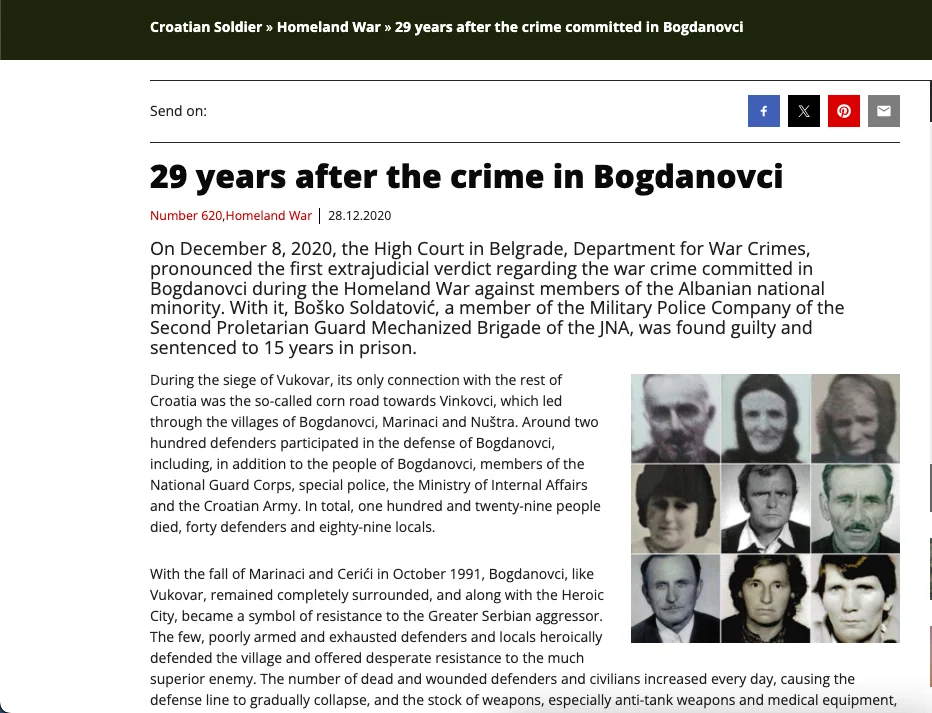
The next day, November 11, 1991, in Bogdanovci, against all humanity and humaneness, one of the greatest war crimes of the Homeland War was committed, about which very little is known in the wider Croatian public. After capturing and abusing ten Albanian villagers, nine of them were shot, and only a woman was spared, having undergone horrific torture, including multiple rapes.

The surviving witness of the event, LB, who was saved by a JNA officer because he knew her deceased husband, said: “Before our eyes, they beat the old men for three hours in such a cruel way with curses and insults, that it was terrible to see them cry like little children.” Five women were senselessly and senselessly killed – Ljulje Barlecaj, Mrike Barlecaj, Manike Lleshaj, Vera Barlecaj and Đulja Barlecaj, and Kristo Lleshaj, Pren Krasnići and Nikola and Zef Paljušaj were also killed.
Boško (Milomira) Soldatović was accused of the aforementioned crime, and the indictment states that: “… On 11/11/1991, in the town of Bogdanovci in the Republic of Croatia (RO), then part of the former Socialist Federal Republic of Yugoslavia (SFRJ), as a member of the Military Police Company of the Second Proletarian Guard Mechanized Brigade (2.pgmbr) of the Yugoslav People’s Army (JNA), violating the rules of international law during the armed conflict that that area existed.
It did not have the character of an international conflict, between the armed forces of the JNA on the one hand and Croatian armed formations that included members of the National Guard Corps (ZNG), the Croatian Defense Forces (HOS) and the Ministry of Internal Affairs (MUP) of the Republic of Croatia on the other hand, towards civilians who do not take part in hostilities in relation to whom one must treat humanely at every opportunity without any unfavorable discrimination based on ethnicity.
By committing murders during the midday hours hours, in the part of Bogdanovaci in coma forces of the JNA established control, on their own, without anyone’s order or approval and without any reason, in the vicinity of the building of the Local Community (MZ), took the lives of 9 (nine) civilians, residents of non-Serb nationality, with gunshots, killing them on the spot, thereby committing the crime of war crimes against the civilian population under Article 142. paragraph 1. Central Committee of the FRY.”
During the investigation, one of the witnesses to the crime stated that: “… they spent the night in one of the houses, and on November 11, 1991, he found himself in the local office in the village, where he found about ten captured elderly civilians and one younger woman who was being taken away and returned.
In the morning hours, he was in front of the local office with a group of civilians when a volunteer from the Military Police Company, Boško Soldatović, known by the nickname ‘Sole’, reloaded his automatic rifle and killed all the civilians with a burst of fire.” The witness also said “… that he turned around and saw the civilians staggering and falling” and emphasized that he “… clearly saw the person who was shooting at them.”
The second witness will state that he did not see the actual act of murder because he turned his back, but that he saw the accused taking the civilians out of the building and that before shooting, he heard him order them to kneel.

During the trial, Boško Soldatović denied committing the described crime and stated that he had no contact with the civilian population in Bogdanovci, and his defense requested an acquittal. After the court hearings, the Higher Court in Belgrade nevertheless found Boško Soldatović guilty on December 8, 2020 and sentenced him to 15 years in prison, instead of the 20 requested by the Serbian prosecution.
Although the verdict for this war crime went almost unnoticed, its importance is manifold. If, after the appeal to which the convicted person is entitled, it is confirmed, not only will the families of the murdered civilians, almost thirty years after the murders of their loved ones, await the conviction of the perpetrators, but this verdict will be one of the rare ones handed down to members of the JNA, which undoubtedly confirms their participation in the war crimes committed.
The Albanian national minority made a significant contribution to the defense of Croatia. 2,800 volunteers and 350 mobilized soldiers participated in the Homeland War. 87 Albanian defenders were killed, 304 were wounded, and 229 were retired as military invalids. Vukovar and the surrounding area were defended by about 200 Albanian volunteers.
According to the 1991 census, before the Homeland War, out of a total of 1,113 inhabitants in Bogdanovci, there were approximately 160 members of the Albanian national minority, Roman Catholics. Nine of them were shot as defenders – two were killed and four more were wounded.
Text: Tanja Belobrajdić
Photo: Tanja Belobrajdić archive, Facebook / Bogdanovci Municipality, screenshot from HRT
Article
https://hrvatski-vojnik.hr/29-godina-nakon-pocinjenog-zlocina-u-bogdanovcima/

