
by Sokol Neçaj
More than a century ago, foreign powers considered giving Albania a name but not sovereignty. Today, the danger does not come from secret treaties, but from a government that seeks to identify itself with the state itself, and from institutions that are losing their ability to restrain it.
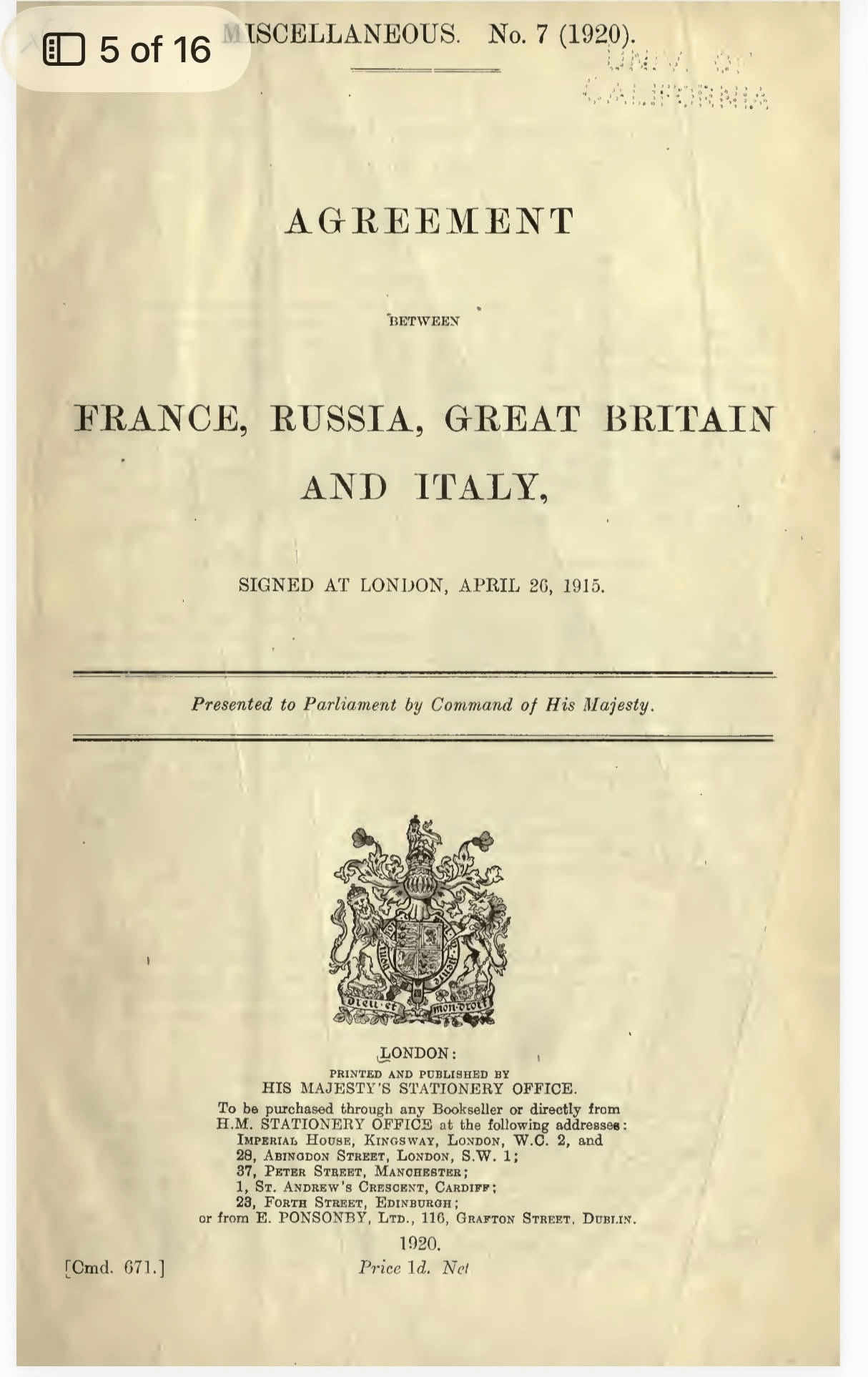
On April 26, 1915, the great European powers signed a secret agreement in London that treated Albania as part of the geopolitical bargaining of the First World War. Under the agreement, Vlora and Sazan would be ceded to Italy, other parts would be left to neighboring countries, while a small Albanian state would remain in the center, existing only formally, neutralized and dependent.
Albania would be allowed to exist on the map, but not as a state capable of deciding its own destiny.
This is the lesson we draw from 1915, because history reminds us of a truth that is often forgotten: a country’s existence on the map does not guarantee the existence of a free, functional, and sovereign state.
A state can retain its borders, flag, embassies, and official ceremonies while gradually losing its ability to protect the public interest. It can appear strong from the outside while being hollowed out from within.
This is the danger that should concern us today.
The state is hollowed out when the law does not apply equally to everyone. When the administration serves the party more than the citizen. When Parliament loses its oversight role over the government. When public wealth is distributed according to proximity to those in power. When the judiciary faces pressure whenever it comes close to powerful interests.
Institutions continue to exist, but they lose the very purpose for which they were created.
The signs of this problem are not merely political perceptions. European Union reports have identified weaknesses in parliamentary oversight of the executive, the politicization of appointments to independent institutions, and attempts at political interference in the judiciary. These are not technical matters. They are indicators of the state’s ability to correct its own mistakes.
One of the most dangerous distortions in Albanian political life is the identification of the state with the government, and the government with its leader. This mentality gives rise to the idea that any criticism of those in power is an attack on the country, and that any investigation into public officials poses a threat to stability.
In reality, the opposite is true.
A democratic state is built so that it does not depend on a single individual. Its strength is measured by its ability to investigate public officials, constrain the government, and ensure the peaceful transfer of power without shaking the foundations of the constitutional order.
When the departure of a leader is presented as a national catastrophe, we are dealing with a dangerous personalization of power.
The primary responsibility falls on the government, because it controls the administration, public resources, and the instruments through which policies are implemented. But the opposition also has a duty to develop an alternative that strengthens institutions rather than simply replacing the beneficiaries of the system. Changing the names does not change the nature of the mechanism.
Albania needs one fundamental thing: the genuine possibility of changing those in power while the law remains unchanged.
The weakening of institutions brings another danger: increased dependence on external influences. States with strong institutions negotiate on the basis of the national interest. Fragile governments often seek support abroad to ensure their own political survival.
Here we return to the lesson of 1915. Back then, others made decisions about Albania without Albania. Today, we should be concerned whenever decisions with long-term consequences are made without transparency, public debate, and parliamentary oversight.
Foreign investment is essential. Strategic partnerships are necessary. But the public interest can be protected only through clear procedures, accountability, and institutional oversight. When personal relationships replace established procedures, the state becomes hostage to agreements that citizens neither know about nor have the power to scrutinize.
A decision that serves the ruler does not necessarily serve Albania.
Equally troubling is the severing of the connection between citizens and the country’s future. Emigration is a right. For many families, it represents a legitimate opportunity for a better life. But when leaving becomes the only alternative to injustice, insecurity, and a lack of prospects, it turns into an expression of distrust in institutions.
The consequences cannot be measured by demographic statistics alone. The loss of professionals, young people, and families weakens the state’s capacity to function and creates a self-destructive cycle: weak institutions drive people away, while their departure weakens those institutions even further.
Nevertheless, alarm must not turn into fatalism.
Albania is not a failed state, nor is it doomed to become one. Its institutions still retain the capacity for self-correction. The results achieved by SPAK, Albania’s Special Structure Against Corruption and Organized Crime, in prosecuting high-level corruption demonstrate that there are centers of institutional resistance within the system that must be protected and strengthened.
The way out does not require saviors. It requires functioning institutions.
It requires those in power to accept constitutional limits. It requires Parliament to exercise genuine oversight. It requires the judiciary to act without fear. It requires the civil service not to be an appendage of the ruling party. It requires political accountability not to be postponed indefinitely under the pretext of ongoing criminal proceedings.
European integration matters precisely when it helps advance these processes. Not as diplomatic window dressing, but as a mechanism that restrains power and protects citizens.
In 1915, Albania risked being left with a name but no sovereignty. A century later, the challenge is different, but just as serious: we must not allow the country to retain only the outward form of a state while losing its substance.
Because the state is not defended only at its borders. It is defended whenever the law restrains the powerful, an institution resists an unlawful order, and a citizen obtains justice without having to seek an intermediary.
Only then will Albania be more than a name on a map. Only then will it remain a state.