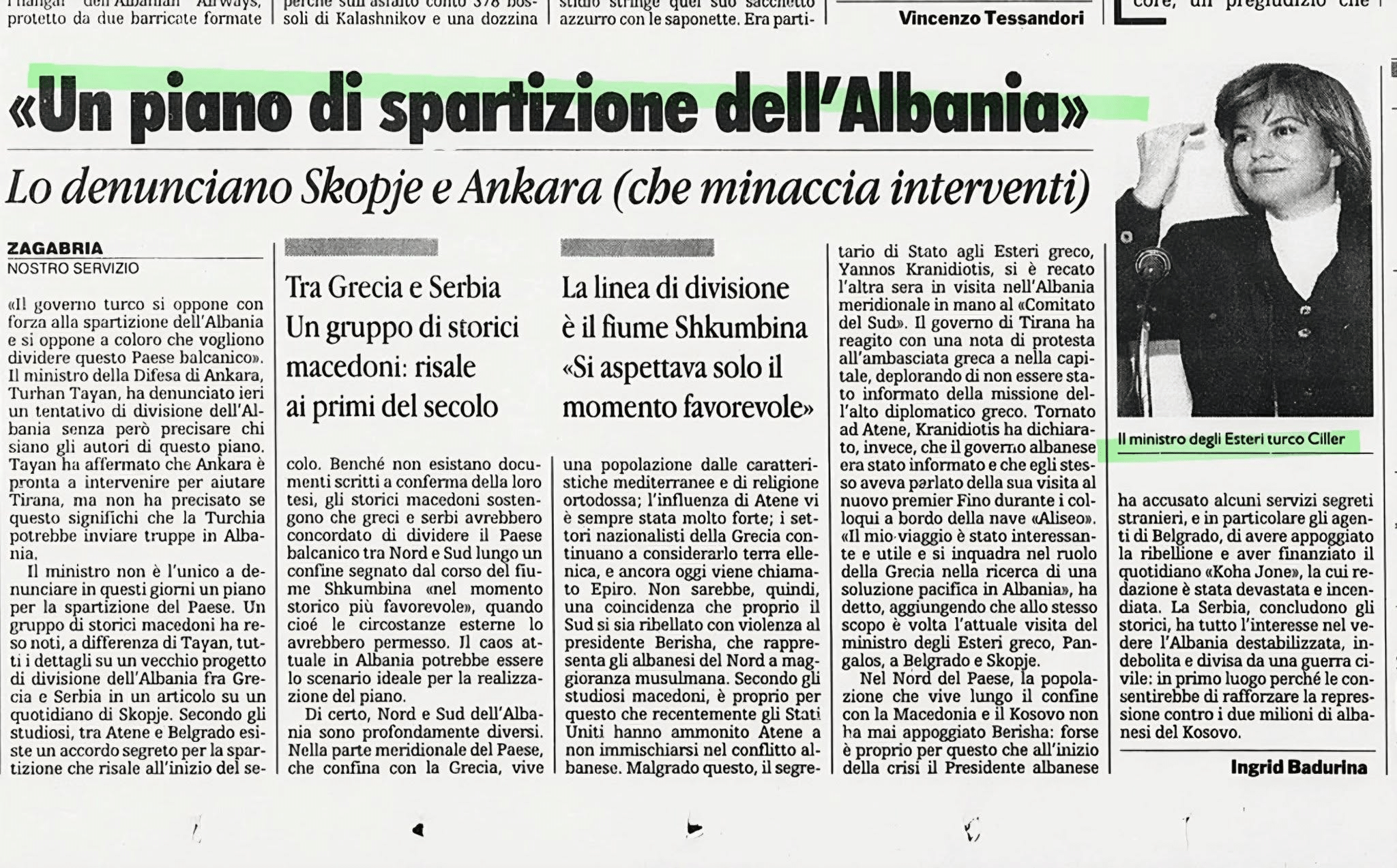

The Italian newspaper La Stampa, on 20 March 1997, reported:
The Turkish government strongly opposes the partition of Albania and stands against those who want to divide this Balkan country. Turkish Defence Minister Turhan Tayan denounced an attempt to partition Albania yesterday, without naming the individuals behind the plan.
Tayan declared that Ankara was prepared to intervene to help Tirana, although he did not specify whether this meant sending Turkish troops to Albania.
The minister was not the only person to denounce a plan to partition the country in recent days. A group of Macedonian historians, unlike Tayan, published all the details of an old plan to divide Albania between Greece and Serbia in a newspaper in Skopje.
According to these researchers, a secret agreement between Athens and Belgrade concerning this partition dates back to the beginning of the century. Although no written documents exist to confirm their theory, the Macedonian historians claim that the Greeks and Serbs agreed to divide the Balkan country into a northern and a southern part, along a boundary defined by the course of the Shkumbin River. This partition, they allege, was to be implemented at the “most favourable historical moment”—that is, when external circumstances made it possible.
The current chaos in Albania could create the ideal scenario for implementing this plan.
Certainly, northern and southern Albania are profoundly different. In the southern part of the country, which borders Greece, lives a population characterised by Mediterranean features and the Orthodox faith. Athens has always exercised considerable influence there. Nationalist sectors in Greece continue to regard this territory as Hellenic, and even today it is referred to as Epirus.
It would therefore be no coincidence, the report suggests, that the South rose up violently against President Sali Berisha, who represented the predominantly Muslim population of northern Albania.
According to the Macedonian researchers, this is precisely why the United States recently warned Athens against intervening in the Albanian conflict.
Despite this, Greece’s Deputy Foreign Minister, Yannos Kranidiotis, visited southern Albania the previous evening, an area then controlled by the “Southern Committee.”
The government in Tirana responded by sending a note of protest to the Greek embassy in the capital, expressing regret that it had not been informed of the senior Greek diplomat’s mission.
However, after returning to Athens, Kranidiotis stated that the Albanian government had indeed been informed and that he himself had discussed the visit with the new prime minister, Fino, during talks aboard the ship Aliseo.
“My trip was interesting and useful; it forms part of Greece’s role in finding a peaceful solution in Albania,” he said, adding that the current visit by Greek Foreign Minister Pangalos to Belgrade and Skopje was intended to serve the same purpose.
In the north of the country, the population living along the borders with Macedonia and Kosovo had never supported Berisha. Perhaps for this very reason, at the beginning of the crisis, the Albanian president accused certain foreign intelligence services—specifically, agents from Belgrade—of supporting the uprising and financing the daily newspaper Koha Jonë, whose offices were subsequently looted and set on fire.
The historians conclude that Serbia has a clear interest in keeping Albania destabilised, weakened and divided by civil war. Among other reasons, this would enable Serbia to intensify its repression of the two million Albanians living in Kosovo.
by E. Ligu

