
by Marios Dimopoulos
Dedicated to illiterate know-it-all internet trolls.
What unscientific nonsense my eyes have had to endure in the comments ever since I started posting about linguistics, history, and ethnology on this profile. And all of it coming from people whose only connection to these academic fields is something a friend told them or something they saw in a three-minute propaganda video on TikTok. These are the Google historians and linguists. Before long, they’ll be performing surgery over their clothes after learning how to do it from little videos, too…
So, guys, before you post any historically ignorant, unscientific bullsh*t on my profile, walk through the doors of a university first, if only to get a taste of what the sciences of linguistics, philology, archaeology, and ethnology are actually about.
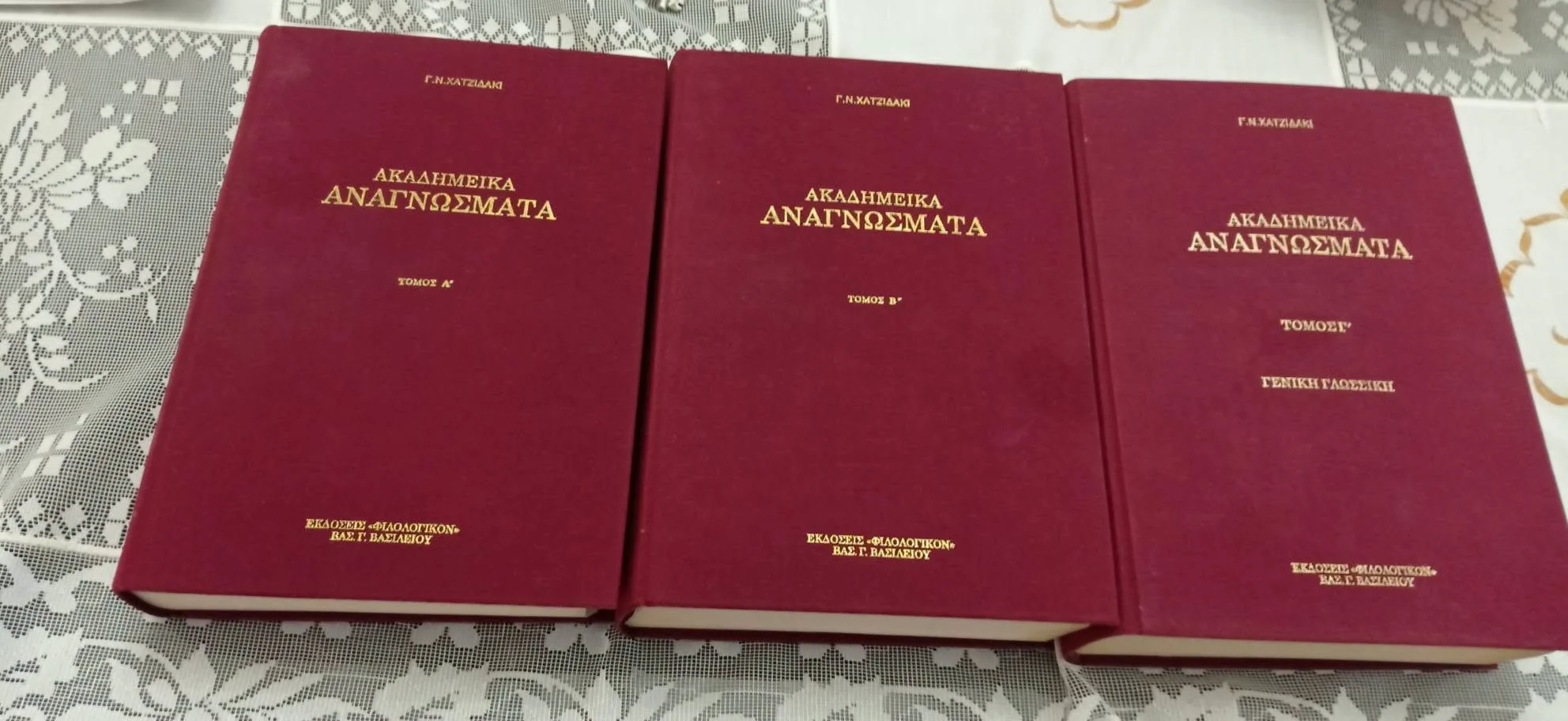
In the photograph is a three-volume, 1,600-page book that those of us who studied in a Faculty of Philosophy read and studied during our first year, simply to get an introductory understanding of historical linguistics. And that’s not to mention that you wouldn’t understand much of it anyway—not only because the subject is difficult and you need to know Ancient Greek and Latin, but also because of the language in which this academic work is written: extremely formal, archaic Katharevousa Greek.
The book is Akadimeika Anagnosmata (Academic Readings) by Georgios Hatzidakis, the father of Greek linguistics.
And then you have illiterates who can’t even write a single sentence correctly coming along to judge me or claim that I’m not Greek. Who, exactly? The Greek-speaking barbarians of Facebook who pretend to be such great Greeks, when I’d bet they’ve never read an Ancient Greek author in their lives or even visited the Acropolis. In other words, fake Greeks.
Below, I’m listing the contents of all three volumes (although I’ve summarized the contents of the second and third volumes), just so you can understand what an introduction to the science of linguistics actually entails—and so you can stop masturbating online with your illiteracy and intellectual stonewalling. You idle, know-it-all, modern-day Greeks of the internet.
VOLUME I
INTRODUCTION
- The purpose of scientific grammar
- The kinship and language of the Indo-European (Iaphetic) peoples
- On each of the related languages
- The geographical distribution of the Greek and Latin languages
- General characteristics of the Greek and Latin languages
- Common characteristics of the two languages and the resulting presumed relationship between them
- On the Greek dialects
- On each individual dialect
- Principal characteristics of the Greek dialects
- On the language of the Homeric epics
- On the Koine (Common Greek)
- The division of the pan-Italian language into dialects
CHAPTER A — THE ALPHABET
- Why knowledge of the symbols used to write ancient languages is necessary
- The origin of the Greek alphabet
- The alphabet’s expansion, the date of its adoption, and its use in different places
- Later additions to the alphabet
- Writing the Greek language using other alphabets
- The alphabets of the Italian languages
- The Indian alphabet and the Indian writing system
CHAPTER B — SOURCES OF ANCIENT GRAMMAR
- Direct and indirect sources of Greek grammar
- Critical examination of these sources
- Sources of the grammar of the Italian languages
CHAPTER C — THE SPEECH ORGANS, THEIR MODES OF OPERATION, AND THEIR PRODUCTS
- Meanings and speech sounds
- What a speech sound is and how it is produced
- A brief description of the speech organs
- The functioning and products of the speech organs
- Nasal vowels
- Long and short quantities and prosody
- The effect of quantity on quality
- On noisy consonants: their places and manners of articulation
- Variations and modifications of these consonants
- Similarities and differences between speech sounds
- On the semivowels
- On the nasals m, n, and ny (including the sounds represented by γκ and γγ)
- On the liquids l, ly, and r
- On the semivowels i, u, or w
- Alternation between semivowels and vowels
- Changes in speech sounds when combined
- The development of additional sounds, whether complete or merely accompanying
CHAPTER D — ON ABLAUT AND VOWEL GRADATION
- Ancient vowel changes: what ablaut is
- The basis for dividing and classifying ablaut phenomena
- Examples of ablaut
- More substantial changes in compound words, especially in the second component
- Loss of initial and other vowels through ablaut
- Analogical disturbances in ablaut patterns
- On vowel augmentation and lengthening
- The distribution of the various classes of ablaut
CHAPTER E — THE PRONUNCIATION OF ANCIENT GREEK
Part A: General
- Difficulties surrounding the question of how the ancient language was pronounced
- The two traditions of pronunciation: oral and written
- The written tradition: its components and foundations
- The pronunciation of the Attic dialect during the fifth and fourth centuries BC. The dialects and later developments do not represent the original Greek pronunciation under investigation
- The value and critical assessment of evidence from ancient grammarians, commentators, and others concerning pronunciation
- The value of evidence obtained by transcribing Greek words into other alphabets by speakers of other languages, and vice versa, representing foreign sounds using the Greek alphabet
- The evidentiary value of puns, alliteration, and similar phenomena
- The value of etymological evidence for reconstructing pronunciation
Part B: Specific
– The pronunciation of each individual speech sound
CHAPTER F — THE ACCENTUATION OF GREEK AND LATIN
CHAPTER G — PHONETICS
Part A: Vowels and Diphthongs, Independent Changes, and Their Scientific Examination
- The sounds of the Indo-European language
- Correspondences between vowels and diphthongs in Greek, Latin, and Indian languages
- Changes affecting these sounds in different languages
- Changes affecting short a in Greek and Latin
And so on, and so forth…
CHAPTER H — COMBINATIONS OR DEPENDENT CHANGES OF VOWELS AND DIPHTHONGS
- The origins of hiatus: acceptable and unacceptable hiatus
- Irregularities in the use of elements subject to elision
- Hiatus and elision in Latin
- On crasis (the contraction of adjacent vowels)
- On aphaeresis (the loss of initial sounds)
- Results of crasis
- On synizesis (the merging of adjacent vowels into a single syllable)
- On synaeresis (the contraction of vowels)
- Synaeresis in Homer
- Synaeresis in other dialects
- Metathesis
- Compensatory lengthening
- Ancient epenthesis and other forms of epenthesis
- Changes in prosody, including shortening and lengthening for phonetic, analogical, and metrical reasons
- Shortening of a long vowel or diphthong within a word
- On metrical lengthening
- Analogical changes in prosody, including shortening and lengthening
- Loss of vowels and the causes of this phenomenon
- Apocope in prepositions
And so on, and so forth…
CHAPTER I — CONSONANTS
- Methods of examining consonants and their division into classes
- General observations on the consonants of the Indo-European language
- An analysis of each consonant in Greek and Latin
CHAPTER J — CHANGES IN CONSONANTS FOR PSYCHOLOGICAL REASONS
CHAPTER K — OTHER CHANGES AND CHARACTERISTICS OF CONSONANTS
CHAPTER L — THE ROUGH BREATHING
VOLUME II
CHAPTER XIII — DECLENSION
CHAPTER XIV — COMPARATIVES AND SUPERLATIVES
CHAPTER XV — NUMERALS
CHAPTER XVI — PRONOUNS
CHAPTER XVII — THE VERB: INTRODUCTION
CHAPTER XVIII — PERSONAL ENDINGS
CHAPTER XIX — AUGMENT
CHAPTER XX — THE CLASSIFICATION OF VERBS INTO CONJUGATIONS ACCORDING TO THEIR PRESENT STEM, AND AN EXAMINATION OF EACH VERBAL TENSE
CHAPTER XXI — THE AORIST
CHAPTER XXII — THE FUTURE TENSE
CHAPTER XXIII — THE PERFECT TENSE
CHAPTER XXIV — THE MOODS: THEIR MEANINGS AND NAMES
CHAPTER XXV — THE INFINITIVE
CHAPTER XXVI — THE PARTICIPLE
CHAPTER XXVII — COMPOSITION AND DERIVATION
CHAPTER XXVIII — THE DERIVATION OF VERBS
CHAPTER XXIX — INDECLINABLE PARTS OF SPEECH
VOLUME III
CHAPTER I — GENERAL METHODOLOGY
- The subject matter of linguistics
- What language is
- Varieties of human language
- The relationship between linguistics and philology
- Linguistic systems and the linguistic changes that occur within them

