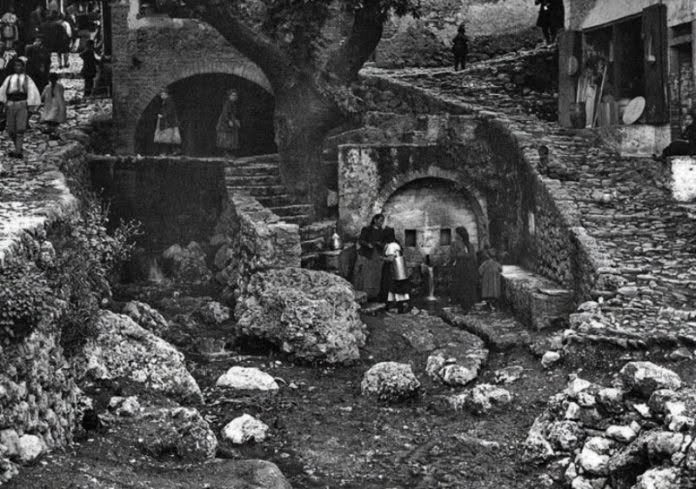

In the south, beyond the border with Albania, lies a region known in antiquity as Thesprotia, and from the Middle Ages until recent times, as Chameria. To the west, it is washed by the Ionian Sea. It is bordered to the north by the mountains of Konispol, protected to the east by the mountains of Souli, and bounded to the south by the Gulf of Arta. This region is my birthplace.
By Fahri Dahri
Before we went to sleep, our mothers and grandmothers would tell us fairy tales, ancient stories, and legends. Regardless of their content, the way they were told imbued them with a certain sweetness, making us children feel safe and secure. We took great delight in them, and with our childlike imaginations, we would conjure up all sorts of vivid mental images until, eventually, sleep overcame us.
Unfortunately, a harsh social fate had been decreed for the inhabitants of our region. Yet, even though they were far from their homeland, our mothers never ceased sharing these fairy tales, stories, and legends as we grew up. Later, our own generation—having learned these tales ourselves—began to pass them on to our own children, grandchildren, and great-grandchildren. And this time, I am sharing one of them: the legend of “Mandu Zog.”
Once, in that region, a great tragedy occurred—a story that has come down to us as a legend. It was April; the warm, fragrant spring had arrived, and the bitter winter had departed, sullen and defeated. The gentle warmth of the sun allowed the lush, green trees to drape themselves in white veils of blossoms. The breezes carried the iodine-rich scent of the Ionian Sea, mingled with the fragrance of various fruit blossoms and the blended aromas of violets, wild thyme, savory, and mountain tea. Together, these scents created an intoxicating atmosphere—one that imbued people with vitality, optimism, and a sense of immortality.
During these “gala” springs—much like the grand, high-society, and festive occasions one might imagine—children and young people of various ages would venture out to play, stroll, dance, and sing. Radiating health and overflowing with joy and happiness, they gathered in the meadows along the riverbanks, near the forests, and at the foot of the hills and mountains. On one of those spring days, Mandu—who had just turned sixteen—set off with her little brother, Gjon, toward the meadow near the village.
She was tall, with pitch-black hair styled in braids and sky-blue eyes. Upon arriving, she joined other young women; full of energy, they played and sang, free from any shyness, fear, or worry. Her little brother, Gjon—who was still two months shy of his sixth birthday—was incredibly energetic and restless. He darted about, playing with children his own age a short distance away from where his sister sat with her friends. Absorbed in conversation and embroidery, Mandu did not notice her brother’s absence until other children arrived and told her that two men on horseback had snatched Gjon and ridden off deep into the forest.
Terrified, the girls and the other children ran back toward the village and their homes. The news spread like wildfire. The men and older boys of the village grabbed wooden stakes, clubs, axes, and pitchforks—and gathered stones to carry—before heading toward the forest, fanning out in different directions. Gjon’s mother, his grandmother, and Mandua screamed, shrieked, and cried out, their voices reaching the very heavens.
The tragedy had already struck; days and months passed, yet little Gjon could not be found.
Mandua wept—she wept in despair, hour after hour, day after day. Every evening at dusk, she would go out, waiting for the return of her sweet, beloved, beautiful, and lively little brother—but her waiting brought no news. Gjon did not return; he had vanished, heaven knows where. His sister was consumed by worry, anxiety, and deep, aching sorrow; she was overwhelmed by such intense longing that her lamentations never ceased—until one evening at dusk, Mandua did not return home as usual. A second sorrow befell the family. Mandua had been lost to the darkness of the night; she never came back. Her prayers and wishes had been granted.
The family searched everywhere for Mandua, as did her friends, but she was never seen again. Three nights later, at dusk, the villagers heard a most peculiar sound echoing from the eaves of the houses—a wailing, the likes of which had never been heard before. Surprised and troubled, the residents approached their windows and doorways, listening into the darkness of the night to the sound of a funeral lament. Though the sound was incredibly powerful, its source remained a mystery; it seemed to come from everywhere, its echo resounding all around.
The cries, shrieks, and the potent, wailing voice uttered deeply sorrowful sounds: “Gjooon,” “Gjooooon,” “Gjoooon.” From time to time, the beating of wings could be heard, yet the “Bird” itself remained unseen—its voice would draw near, then drift away. The villagers were deeply unsettled, unable to make sense of this unprecedented phenomenon. As time passed, every evening at dusk, the cry—“Gjooon, Gjooon, Gjooooon”—would ring out across the village, followed each time by the rustling of the bird’s wings. Months went by, and the bird, with its mournful calls, began to be heard in other villages as well.
Eventually, the inhabitants understood. The wailing voice was the cry of the lost sister, Mandu. Everyone became convinced: it was indeed the sister, Mandu, searching for her lost brother, Gjon. The calls of the bird articulated the name clearly: “Gjooon,” “Gjooon,” “Gjooon.” Mandu had been transformed into a bird, and in her sorrow, she sought to find her little brother, Gjon.
“Mandu the Bird” became immortal; she continues her ceaseless search for her brother, Gjon—from dusk until the approach of dawn. She then finds shelter—no one knows where—only to return again at twilight, hoping that someone in the region might bring news of Gjon, the brother she loved so dearly—so dearly, in fact, that she gave her very life for him, becoming a bird. Throughout the centuries, she has continued her search across the territory of martyred Chameria. Never losing hope, she believes that one day—or perhaps in some future year—she will finally find her brother and quench her unceasing longing.
She will transform her cry into a song, and turn her anguish, sorrow, and deep-seated grief into joy, happiness, and delight. Their life, their love, and their fraternal compassion will resume where it was interrupted—where it was cut short by butchers and murderers—though now with greater caution, heightened vigilance, and a stronger sense of security.
Throughout this long search, Sister Mandu—appearing in the visions and dreams of the local inhabitants, her voice raised in lament—has issued a standing instruction: should we hear the rustling sound of her wings above us, we must remain still and silent. We must not look at her, nor should we cause her any harm; rather, we must show her respect. We must not speak ill of her, but instead honor and revere her profound sorrow.
She conveys her eternal messages through her voice—her lament—and thus, no one should attempt to look upon her, lest they be struck blind for the rest of their days. Furthermore, no one should dare—or even contemplate—harming or killing her; for anyone who does so will be left paralyzed for eternity, and their eventual death will be a truly horrific ordeal.
“Mandua-Zog”—sister to Gjon—continues her search to this day, her lament echoing through the twilight across the martyred lands of Chameria. I do not know if Sister Mandu truly transformed into a bird, but I, too, heard her mournful cry until I was six years old—after which I left my birthplace—yet even today, that wailing cry remains in my memory.
Thus, we reach the conclusion of the Cham legend: “Mandu-the-Bird.”
From this legend, we learn to cultivate respect, love, and brotherly compassion; to bow with reverence before the boundless, tender affection sisters hold for their brothers; and to keep the memory of the birthplace of “Sister Mandu” and her brother “Gjon” alive—thereby upholding the legacy entrusted to us by our ancestors and parents.
Bergamo, January 25, 2017

