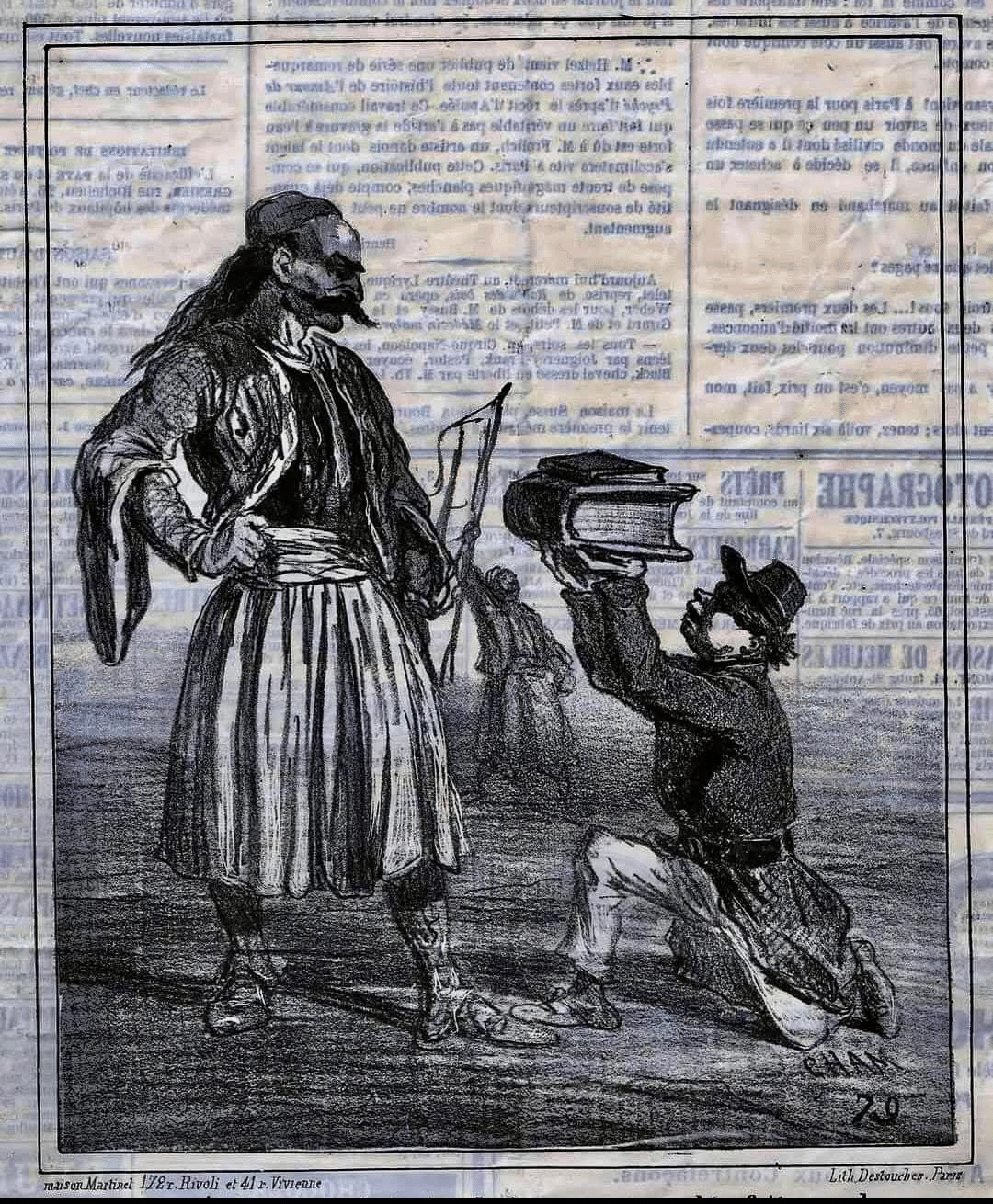

The nineteenth-century caricature depicting a Frenchman demanding that an Albanian abandon his language offers a striking visual commentary on the relationship between language, national identity, and European cultural hierarchies. Accompanied by a caption urging the Albanian to burn his dictionaries and grammars, the image presents Albanian as a source of intellectual anxiety for those who would prefer its disappearance. Read in the context of nineteenth-century European nationalism, the caricature raises questions about the unequal recognition of languages and the competing ways in which Albanian and Greek heritage were represented.
The caption’s central message is explicit: the Albanian would be welcomed by the emerging generation if he relinquished his language. The demand to destroy dictionaries and grammars is particularly significant. These are not merely practical tools; they represent the preservation, study, and transmission of a language across generations. Their destruction symbolizes the erasure of a cultural tradition and the denial of its legitimacy as a vehicle of education and intellectual life.
The image can therefore be interpreted as a critique of linguistic assimilation. Rather than portraying the Albanian language as an ordinary element of cultural diversity, the caption frames it as a problem to be eliminated. Its irony lies in the contrast between the apparent promise of progress and the demand for cultural abandonment. The supposed blessing offered to future students comes at the cost of their linguistic inheritance.
Albanian language and European cultural hierarchies
During the nineteenth century, language became central to the formation of national identities throughout Europe. Philologists, historians, and intellectuals increasingly treated languages as evidence of a people’s antiquity, cultural development, and historical continuity. Yet this interest did not produce equal recognition for every language. Some languages gained institutional support and prestige, while others faced marginalization or pressure to conform to dominant cultural standards.
Albanian occupied a complex position within this environment. Its distinct linguistic character and the limited institutional opportunities available for Albanian-language education in various territories made the preservation and standardization of the language important cultural and political questions. The development of Albanian-language publishing and education became closely associated with efforts to establish a recognized national identity.
Against this background, the caricature’s reference to dictionaries and grammars acquires a broader significance. A language equipped with grammars, dictionaries, literature, and educational institutions can claim a place in intellectual life on its own terms. To demand the destruction of these resources is to challenge not only the language itself but also the cultural autonomy of its speakers.
The image can thus be read as an expression of what may be termed Albanophobia in a linguistic and cultural sense: the rejection or denigration of Albanian language and identity. However, the caricature alone cannot establish how widespread such attitudes were among French intellectuals or within French society as a whole. Its precise publication context, author, date, and intended audience would be necessary to determine whether it documents a particular controversy, satirizes an existing attitude, or deliberately exaggerates linguistic hostility.
Greek Philhellenism and the question of recognition
The image also invites comparison with nineteenth-century European philhellenism, the movement of intellectual and political support for Greece and its struggle for independence. Ancient Greek literature, philosophy, and art occupied a privileged position in European education, while the Greek War of Independence (1821–1830) attracted substantial support from European writers, artists, and political activists.
This admiration had important consequences. It contributed to the international visibility of the Greek independence movement and helped establish modern Greece within a powerful European narrative connecting classical antiquity with national revival.
At the same time, European representations of Greece frequently privileged its classical past, sometimes at the expense of the complex linguistic, cultural, and demographic realities of the contemporary Balkans.
The contrast with Albanian cultural recognition is relevant. Greek antiquity possessed an established position within European institutions, whereas Albanian language and historical traditions had to struggle for comparable recognition in many intellectual and political settings. This difference does not mean that all philhellenes were hostile to Albanians, nor that philhellenism necessarily entailed anti-Albanian prejudice. Rather, it highlights how admiration for one national tradition could coexist with limited knowledge of, or unequal attention to, neighbouring peoples.
Albanian-speaking populations also formed part of the history of Greece, most notably through the Arvanites, whose communities contributed to the social and historical development of the modern Greek state. Their experience illustrates why the relationship between Greek national identity and Albanian linguistic heritage cannot be reduced to a simple opposition between two separate populations. The histories of the region are intertwined, even where later national narratives have emphasized their differences.
Language as a question of cultural autonomy
The caricature’s most enduring theme is the relationship between language and power. A demand that a people abandon its language assumes that cultural integration requires the surrender of an essential marker of collective identity. The destruction of dictionaries and grammars represents the removal of the means through which that identity can be studied, taught, and reproduced.
Read critically, the image challenges the assumption that cultural progress requires linguistic uniformity. It suggests instead that education and intellectual development need not depend on the disappearance of minority or less institutionally powerful languages. Albanian, like Greek and other languages of southeastern Europe, must be understood within its own historical development rather than judged solely against the prestige of classical traditions.
The comparison with philhellenism also raises a broader question about European cultural memory: which peoples were celebrated as heirs to antiquity, and which were treated as peripheral to that inheritance? The answer varied across authors, institutions, and political contexts. Nevertheless, the unequal prestige attached to different languages shaped the ways in which Balkan peoples were represented and understood.
Conclusion
The nineteenth-century caricature offers a pointed representation of linguistic pressure and the struggle for cultural recognition. Its demand that an Albanian burn his dictionaries and abandon his language symbolizes the denial of linguistic autonomy and the assumption that acceptance requires assimilation.
Placed alongside the history of European philhellenism, the image encourages a critical examination of the unequal recognition of Greek and Albanian cultural traditions. European admiration for classical Greece helped shape modern national narratives, while Albanian language and identity often received less institutional attention. The historical relationship between these traditions, however, is marked by interaction, shared regional experiences, and overlapping cultural histories.
The caricature should therefore be treated as a historical source for investigating attitudes toward Albanian language, not as conclusive proof of a uniform French policy or a general European consensus. Its significance lies in the question it raises: whether cultural recognition can be extended to one people without requiring another to abandon its language and historical identity.
Source
Mason Martinel. 172. Rivoli. et 41. Vivienne. Lith. Desoutches. Paris. (Le Charivari)

