
Summary
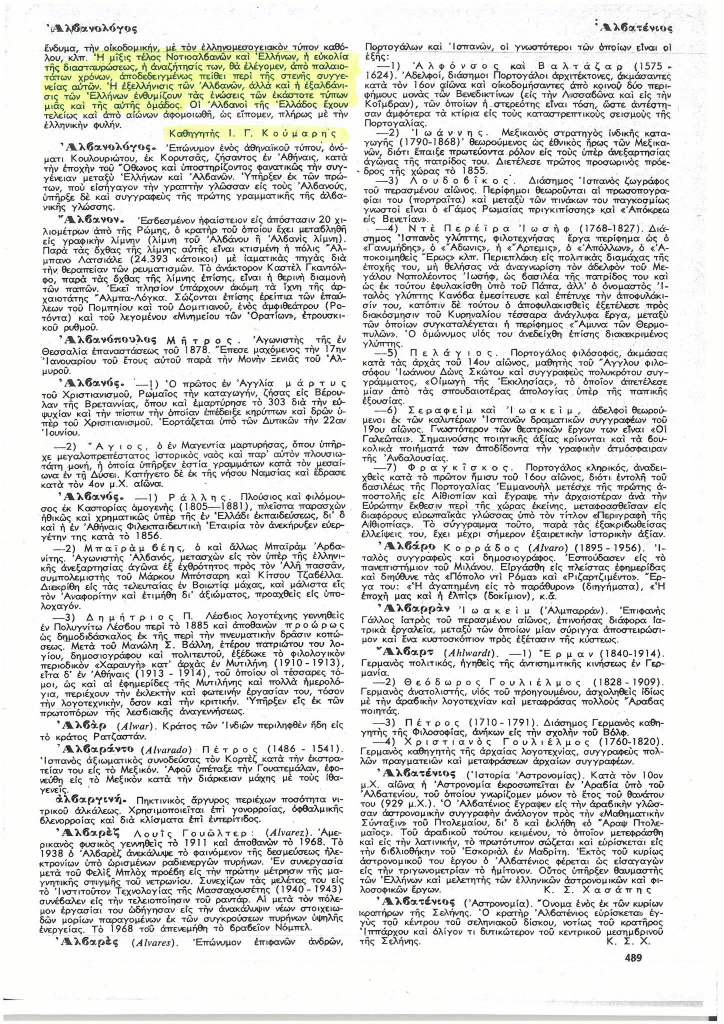
Ioannis Koumaris’s account in the Ilios encyclopedia presents Greeks and Albanians as populations with deep historical and cultural connections, tracing their origins to the ancient peoples associated with Epirus, the Illyrians, and the Pelasgians. He highlights the Arvanites, Albanian migration into Greece, and similarities in folklore, customs, and traditional culture.
The question of the historical relationship between Greeks and Albanians has long been discussed in Greek anthropology, ethnography, and historiography. In the Ilios encyclopedia, Ioannis Koumaris, a Greek physician and anthropologist who founded the Hellenic Anthropological Society, presents a theory connecting both peoples to an ancient Pelasgian population, with Epirus and the Pindus region serving as a geographical centre of their historical development.
In his entry on Albanians, Koumaris argues that Greeks and Albanians share deep historical and cultural connections. He identifies the Arvanites as Albanian-speaking populations who settled in various parts of Greece during the Middle Ages and subsequently became integrated into Greek society. He also discusses Albanian communities in southern Italy, particularly in Calabria and Sicily, illustrating the wider historical movement of Albanian-speaking populations across the Mediterranean.
Koumaris places particular emphasis on the relationship between southern Albanians and the Greek populations of Epirus. He draws attention to similarities in customs, folklore, poetry, traditional clothing, architecture, and other aspects of everyday life. He interprets these parallels, alongside patterns of intermarriage and linguistic contact, as evidence of a long-standing relationship between the two populations.
His account also reflects the historical importance of population exchange and cultural assimilation. The Hellenization of Albanian-speaking communities in Greece and the adoption of Albanian language and customs by neighbouring populations demonstrate how identities developed through centuries of coexistence. The history of the Arvanites provides a significant example of this process, as Albanian-speaking communities became an integral part of Greek society while retaining elements of their linguistic heritage.
Koumaris further associates the historical relationship between Greeks and Albanians with the ancient populations of Epirus and the western Balkans, including the Illyrians and the Pelasgians. His interpretation reflects an early twentieth-century anthropological framework in which physical anthropology, mythology, and cultural similarities were used to reconstruct relationships between ancient and modern populations.
The broader historical record nevertheless demonstrates extensive and enduring connections between Greeks and Albanians. Geographical proximity, migration, intermarriage, religious interaction, and centuries of cultural exchange have shaped both societies. Epirus, in particular, has been a meeting point of Albanian- and Greek-speaking populations, making it central to the study of their shared regional history.

Discovered by Marios Dimopoulos

