
Summary
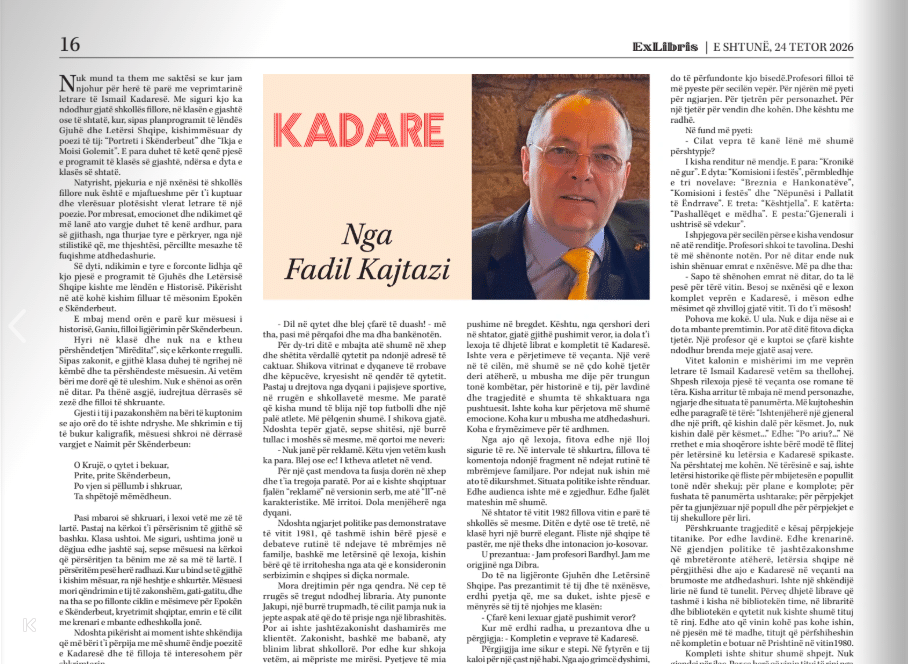
Fadil Kajtazi recounts how his early encounters with Ismail Kadare’s poetry and novels shaped his literary interests, Albanian patriotism, and understanding of national history. Inspired by school lessons about Skanderbeg, he began searching for Kadare’s books, despite their scarcity in Kosovo. A secondary-school teacher recognized his extensive reading and encouraged his enthusiasm. Kajtazi describes how Kadare’s literature preserved Albanian cultural identity, explored historical struggles, and offered insight into oppression, freedom, and political power. He presents Kadare as more than a novelist: a formative intellectual influence whose writing strengthened his connection to Albanian history, literature, and collective memory.
Part 1 — My first encounters with Kadare
I cannot say exactly when I first became acquainted with the literary work of Ismail Kadare. It most likely happened during primary school, in the sixth or seventh grade, when, according to the Albanian Language and Literature curriculum, we studied two of his poems: “Skanderbeg’s Portrait” and “The Escape of Moisi Golemi.” The first must have been part of the sixth-grade curriculum, while the second belonged to the seventh grade.
Naturally, a primary-school pupil does not yet have sufficient maturity to fully understand and appreciate the literary merits of a poem. But the impressions, emotions, and influences those verses left on me must have come above all from their perfect composition and the way their simplicity conveyed powerful messages of patriotism.
Secondly, their impact was strengthened by the connection between this part of the Albanian Language and Literature curriculum and the subject of History. It was precisely at that time that we had begun studying the Age of Skanderbeg.
I remember the first lesson when our history teacher, Ganiu, began teaching us about Skanderbeg.
He entered the classroom and did not return our greeting of “Good afternoon,” as custom required. According to the rules, the whole class was supposed to stand up and greet the teacher. He merely gestured for us to sit down. He did not even record the lesson in the register. Without saying a word, he turned toward the blackboard and began writing.
His unusual gesture made us realize that this lesson would be different. In his beautiful calligraphic handwriting, the teacher wrote Naim’s verses about Skanderbeg on the board:
O Krujë, blessed city,
Welcome, welcome Skanderbeg,
He comes like a decorated dove,
To save our homeland.
When he had finished writing, he read the verses aloud himself. Then he asked us all to repeat them together. The classroom rang with our voices. Our chanting could surely be heard outside, too, because the teacher instructed us to repeat the verses as loudly as possible. We repeated them five times in succession.
When he was convinced that we had all memorized them, a brief silence fell. The teacher resumed his usual upright, almost military stance and told us that he was beginning a series of lessons on the Age of Skanderbeg, the Albanian national hero whose name our school proudly bore.
Perhaps that very moment was the spark that made me devour Kadare’s poetry with greater enthusiasm and begin taking an interest in the writer himself.
The verses of the poem about Skanderbeg:
“Whatever Gjergj left unfinished during the day, Skanderbeg completed at night…”
And those of the poem about Moisiu:
“…except for your conscience, no one follows you from behind…”
The following lines evoke the sound of hoofbeats on cobblestones and address Moisi Golemi, referring to him as “General Moj-Zi.”
These verses about the great figure of Skanderbeg, whom we studied at school and whose name we proudly bore, became student demonstrations in 1981.
Those verses began to gather within me a source that I had not yet recognized clearly: rebellion and an emerging awareness.
And alongside them, there was another feeling, even more powerful: the feeling of national tradition.
I went to the small bookshop on the seventh floor, where a copy of the novel The Castle was displayed. It was a small but significant victory for me. During the first race to the finish line, I was the first to reach the goal. As soon as I took it from the shelf, the joy of owning the book was so great that I began reading it immediately. I read it with passion and speed, as though I had conceived a desire for revenge. I was captivated by the book and could not put it down. I finished it quickly, only to return to it again.
Later, I began searching for Kadare’s books in the city bookshops. It was a difficult undertaking. At that time, Gjilani had three bookshops. In none of them could I find another work by Kadare. However, I found some translations and collections of literary works from Albania.
Among the works I read and discussed were The Waves of Life by Vedat Kokona, The Kennel by Fatmir Gjata, The Awakening by Sterjo Spasse, Repeating the Past by Dhimitër Xhuvani, The Disappearance of the Professor by Skënder Drini, The Man at the Top by Komisar Memo, The Decline of the Nobility by Zija Çela, The Wave of the Murderer by Foqion Postoli, and The Great Deception by Thoma Kacori, as well as other works.
But Kadare, apart from The Castle, remained an elusive author for me. I could not find his other books anywhere.
In the autumn of 1982, I finished the eighth grade with excellent results. I returned home with a diploma that had been carefully wrapped in paper.
My family celebrated the achievement.
During the celebrations, my father took a large banknote from his wallet. It was worth a considerable amount. Nothing like that had happened before, and I had never seen so much money.
He told me:
“Go into town and buy whatever you want!”
For two or three days, I had been walking around the shops and looking at the various items displayed in their windows, trying to decide what to buy. I had calculated the prices of the clothes and shoes in the shop windows, the bookshop, and the sports-equipment stores. Then I went from one sporting-goods shop to another, looking for my favorite sneakers.
I had money saved from the school holidays. With the money I had, I could buy a pair of top-quality football boots and a tennis racket. I was tempted by many things. I looked at them eagerly.
However, the temptation lasted only a short time, because the shopkeeper, a bald, middle-aged man, rebuked me with disgust:
“They’re not for advertising. Only people with money come here.”
I put the sneakers back. For a moment, I considered reaching into my pocket and showing him the money. But he had pronounced the word “advertising” in its Serbian form, with its characteristic “l.” That irritated me. I immediately left the shop.
Perhaps the political events following the demonstrations of 1981, which had by then become a regular topic of discussion at family gatherings in the evenings, together with the literature I was reading, had made me resent those who regarded the Serbianization of the Albanian language as something normal.
I headed toward the town center. At the corner of the market street stood the bookshop. Jakupi worked there, a large-built man whose appearance did not suggest what one might expect of a bookseller. But he was exceptionally kind to his customers. My father and I usually bought my schoolbooks there. Even when I went alone, he welcomed me warmly. He answered my questions about literary books without hesitation:
- “Yes, we have that book.”
- “That one has sold out.”
- “We’ve ordered it. It will arrive next week.”
From what I read, I also gained a new sense of confidence. At short intervals, I would comment on a passage during our family’s evening gatherings. But those gatherings were no longer what they had once been. The political situation had become more tense, and the audience was more selective. Words were weighed more carefully.
Part 2 — Discovering Kadare’s works
In September 1982, I began secondary school. On the second or third day, an elegant-looking man entered the classroom. He spoke clear Albanian, with an accent and intonation that were not typically Kosovar.
He introduced himself:
“I am Professor Bardhyl. I come from Dibra.”
He would teach us Albanian Language and Literature. After introducing himself and the students, he asked a question that apparently formed part of his way of getting to know the class:
“What have you read during the summer holidays?”
When my turn came, I introduced myself and answered:
“The complete collection of Kadare’s works.”
My answer seemed to take him aback. A momentary expression of surprise crossed his face. From that brief reaction, I thought I had given him the impression that I was unserious, perhaps even troublesome, and that I spoke without thinking.
I remembered a legend that circulated among students in the humanities faculty…
The professor began questioning me about each work. For one, he asked about the plot; for another, about the characters; for a third, about the setting and period, and so on.
Finally, he asked me:
“Which works have impressed you the most?”
I had already ranked them in my mind. First: Chronicle in Stone. Second: The Festival Commission, a collection of three novellas: The Lineage of the Hankonates, The Festival Commission, and The Palace of Dreams Official. Third: The Castle. Fourth: The Great Pashas. Fifth: The General of the Dead Army.
I explained why I had placed each work in that order. The professor went to his desk and wanted to enter my grade. But the students’ names had not yet been recorded in the register. He looked at me and said:
“As soon as the names are entered in the register, I will give you a five for the entire year. I believe that a student who reads all of Kadare’s works also learns the lessons I teach throughout the year. You will learn them, too!”
I nodded. I sat down. I did not know whether he would keep his promise. But that day I gained something else: a teacher who understood what had happened inside me during that summer.
As the years passed, my identification with Ismail Kadare’s literary work only deepened. I often reread particular passages or entire novels. I had managed to remember countless characters, events, and situations. I could recall entire paragraphs, too.
Among my social circles, talking about literature had become fashionable, and Kadare’s work stood out. It suited the times. Taken as a whole, it was historical literature that spoke of our people’s survival throughout the centuries: of plans and conspiracies, countless military campaigns, attempts to bring a people to their knees, and its centuries-long struggle for freedom.
It described the tragedies of this titanic struggle, but also its glory and pride.
In the extraordinary political circumstances that prevailed at the time, Albanian literature in general, and Kadare’s work in particular, instilled patriotism in us. It was a spark of freedom at the end of the tunnel.
Apart from the ten books I already had in my library, there were few new titles in the bookshops and the town library. Even the books that arrived from time to time were mostly titles included in the collection published in Pristina in 1980.
The collection sold out very quickly. It was practically impossible to find. But whenever new titles arrived from Tirana, I bought them. That was how I began building my own collection of Kadare’s works, published by various publishers.
Meanwhile, the political circumstances after 1981 meant that information about events in Albania was scarce, particularly information about cultural activities. Radio Tirana and television broadcasts from Tirana were closely monitored, and listening to them could be dangerous. People listened to them secretly, often at considerable risk.
Even so, information about the new books published in Tirana reached us. The titles of Kadare’s works, published by different publishers, circulated among readers. The collection published in Pristina in 1980 was particularly important, as it brought together many of his works.
The complete collection was highly sought after. It was difficult to find. Whenever a new title arrived from Tirana, I would buy it. This was how I continued building my collection of Kadare’s works.
Part 3 — Kadare’s literary legacy
When the opportunity finally came, I presented my work and its conclusions regarding Kadare’s literary achievement.
My answer was as follows: Kadare’s work had become an essential part of my intellectual life. Through his novels, I had come to understand the historical experiences of the Albanian people, their struggles, their suffering, and their aspirations for freedom.
For me, Kadare was not simply a writer. He was a figure whose literary work had helped shape my understanding of history and national identity.
His books had given me a way to reflect on the past, to understand the present, and to imagine the future. They had taught me that literature could be more than a form of artistic expression: it could also be a means of preserving collective memory and resisting oppression.
I had come to recognize that Kadare’s works possessed a distinctive power. Their characters, historical settings, and political themes revealed the tensions between the individual and the state, between freedom and authority, and between truth and imposed ideology.
His writing had made a lasting impression on me because it combined historical reflection with literary imagination. The novels were not merely stories about the past; they also offered ways of understanding the political realities of the time in which they were written.
As I grew older, my appreciation of his work deepened. I became increasingly aware of the ways in which his novels explored the relationship between power, fear, tradition, and human dignity.
Kadare’s writing also encouraged me to think about the role of intellectuals and writers in society. A writer’s responsibility, I came to believe, was not simply to produce beautiful prose, but also to confront difficult questions and preserve the freedom of thought.
His work remained important to me because it could be read on several levels: as literature, as historical reflection, and as a commentary on the society in which it was produced.
I continued to return to his books, finding new meanings in passages I had read many times before. The older I became, the more I understood the significance of his literary achievement.
For me, Kadare’s legacy was inseparable from the history of the Albanian people and their cultural experience. His writing had become part of the intellectual world through which I understood my own society.

